Exponents as Repeated Multiplication Worksheets
About This Worksheet Collection
Exponents give students a compact way to represent repeated multiplication. Instead of writing the same factor several times, learners can use a base and an exponent to show which number repeats and how many times it appears as a factor. Understanding this connection is essential before students begin evaluating powers or applying more advanced exponent rules.
This collection gives students many ways to explore the relationship among exponent notation, repeated multiplication, factors, and numerical values. Activities include matching equivalent forms, expanding powers, identifying bases and exponents, completing charts, solving missing-exponent problems, evaluating true-or-false statements, studying patterns, using visual models, sorting representations, and applying exponents to real-world situations. The worksheets can be used for classroom instruction, math centers, independent practice, homework, tutoring, intervention, enrichment, or homeschool lessons.
As students work through the collection, they strengthen multiplication fluency, exponent vocabulary, representation skills, pattern recognition, and mathematical reasoning. They also practice moving between power notation and expanded multiplication, explaining what an exponent means, evaluating powers, recognizing equivalent expressions, and connecting abstract notation with visual and practical situations. These activities help learners develop a strong conceptual foundation before moving into more advanced exponent operations and algebraic expressions.
Detailed Descriptions Of These Worksheets
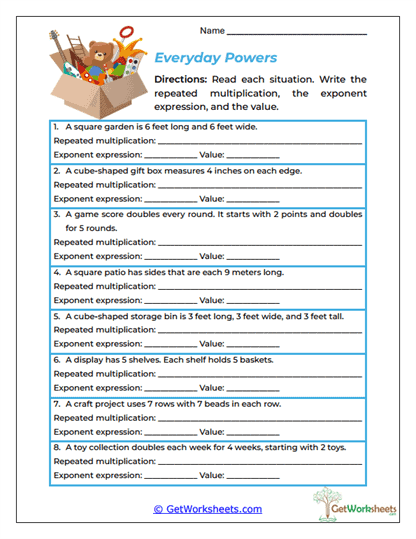
Everyday Powers
Real-world situations help students see where repeated multiplication and exponent notation can be useful. Learners work with square shapes, cubes, equal dimensions, rows and columns, and simple growth patterns before writing the repeated multiplication, power expression, and numerical value. Connecting mathematical symbols to situations students can picture makes the concept more meaningful. The activity also strengthens word-problem interpretation and provides natural links to geometry and number patterns.
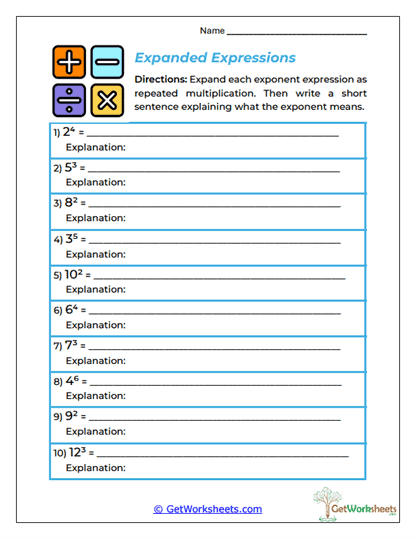
Expanded Expressions
Students take compact power notation and rewrite it as complete repeated multiplication. After identifying the base and exponent, learners explain in words what the expression represents. Combining symbolic work with written reasoning helps reveal whether students truly understand the meaning of the notation. This activity builds mathematical vocabulary while reinforcing the relationship between exponents and repeated factors.
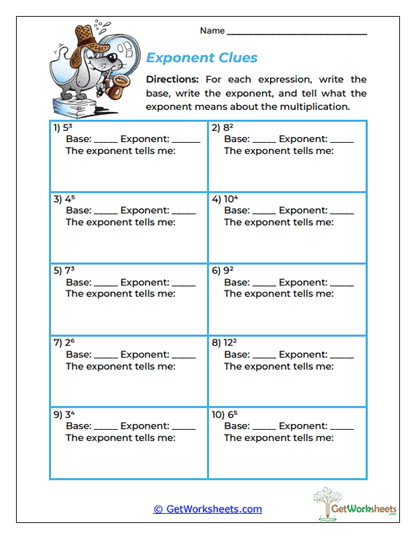
Exponent Clues
Each problem focuses on the two essential parts of exponent notation: the base and the exponent. Students identify both parts and explain what the raised number tells them about the number of repeated factors. Describing the notation in words helps prevent common confusion between the roles of the two numbers. The worksheet provides a strong vocabulary and comprehension check before learners begin more complicated work with powers.
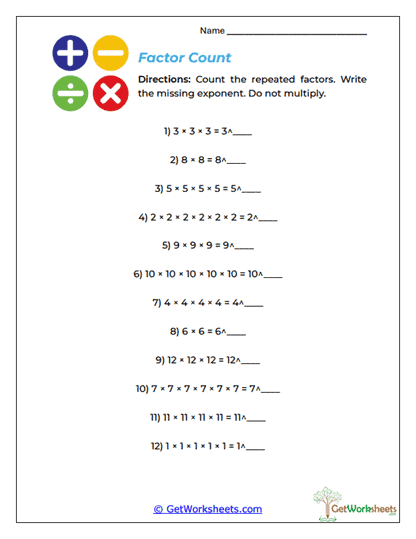
Factor Count
Repeated multiplication expressions are used to help students determine the missing exponent. Learners identify the base, count how many times it appears as a factor, and write the correct raised number. Because they do not need to calculate the final product, students can focus completely on the structure of power notation. This targeted practice reinforces the idea that the exponent tells how many repeated factors are present.
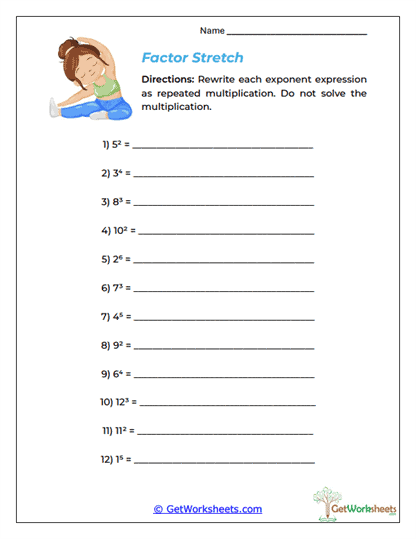
Factor Stretch
Students expand powers into the multiplication expressions they represent. They identify the base, read the exponent, and write the correct number of repeated factors without evaluating the product. This focused approach is especially helpful for learners who mistakenly think an exponent should be multiplied by the base. Repeated practice makes the meaning of compact power notation much clearer.
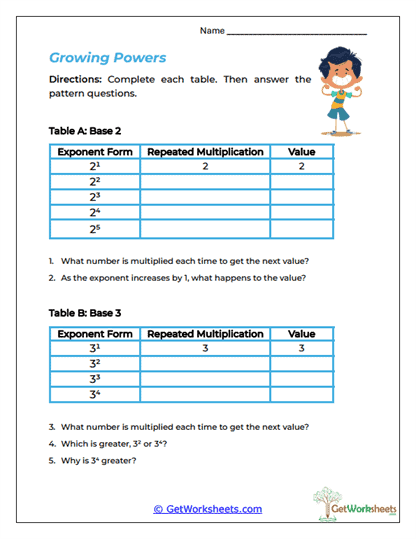
Growing Powers
Tables help students investigate how powers change as the exponent increases. Learners write repeated multiplication, determine numerical values, and compare consecutive powers that share the same base. Seeing several examples together makes the growth pattern easier to recognize. The activity encourages students to explain why adding one to the exponent introduces one additional factor of the base. It also strengthens number sense and pattern reasoning.
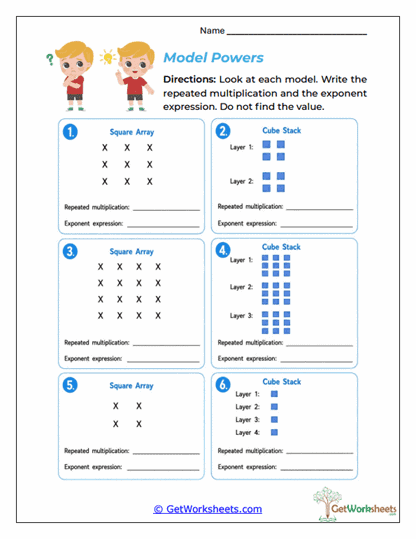
Model Powers
Square arrays and cube models give learners a visual introduction to repeated factors. Students study each arrangement, write the multiplication it represents, and connect that expression with the appropriate power notation. The pictures help make abstract symbols more concrete and show how powers relate to equal dimensions. This activity provides useful preparation for later work with squares, cubes, area, and volume.
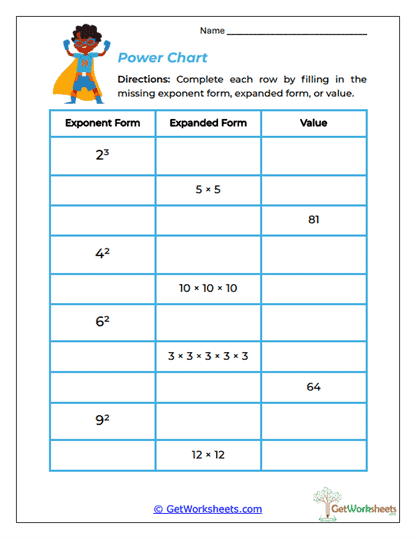
Power Chart
A structured chart asks students to move among power notation, repeated multiplication, and numerical value. Different rows provide different starting information, so learners may need to work forward or backward to complete the missing forms. This variety prevents students from relying on only one familiar routine. The chart also makes it easy to compare equivalent representations side by side. It works well as practice, review, or an informal assessment of conceptual understanding.
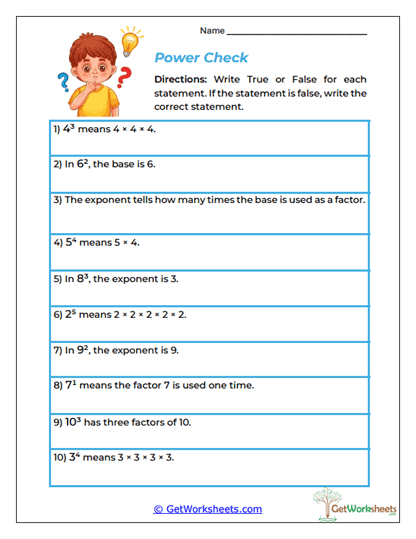
Power Check
True-or-false statements challenge students to decide whether descriptions of exponent notation are accurate. Learners examine bases, exponents, factor counts, and repeated multiplication, then correct statements that contain mistakes. Evaluating someone else's reasoning encourages closer attention to mathematical meaning. This format is particularly useful for identifying common misconceptions before students move into more advanced exponent skills.
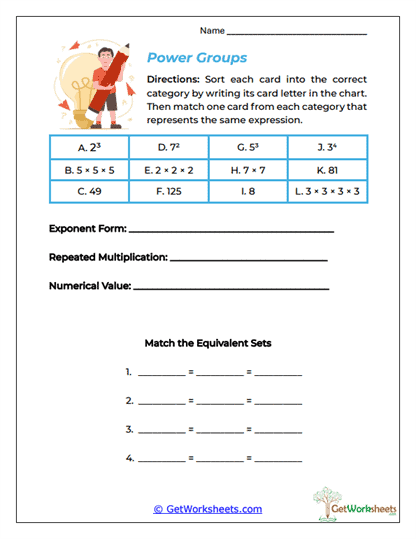
Power Groups
Students sort and match representations of powers into complete equivalent sets. Each set connects power notation, repeated multiplication, and a numerical value. The sorting format requires learners to compare the structure of each expression rather than simply complete a calculation. Explaining why the pieces belong together strengthens reasoning and gives students flexible practice moving among different forms.
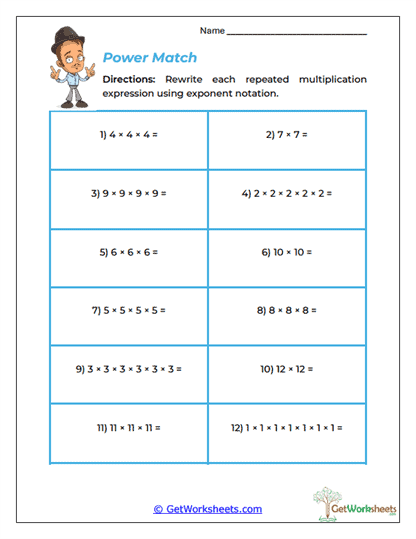
Power Match
Long multiplication strings are rewritten using compact power notation. Students identify the repeated factor, count how many times it appears, and use that information to write the correct base and exponent. This straightforward activity gives beginners a clear introduction to why exponent notation is useful. It also reinforces careful factor counting and helps students see that the shorter notation does not change the mathematical value.
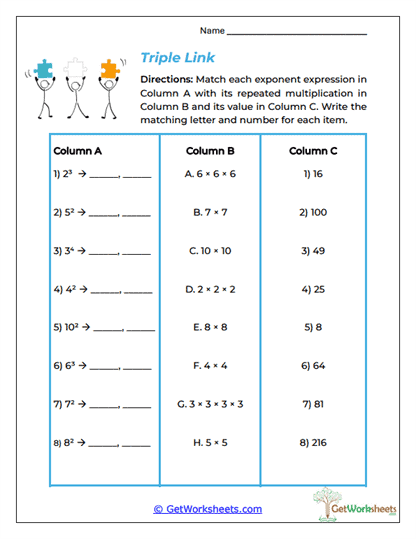
Triple Link
Three representations of the same quantity are connected in this matching activity. Learners pair a power expression with its repeated multiplication form and then with the correct numerical value. Matching all three requires students to understand both the structure and the result of the expression. The activity strengthens flexible representation skills and encourages learners to check whether each part of a set truly agrees with the others.
Bookmark Us Now!
New, high-quality worksheets are added every week! Do not miss out!