Scientific Notation Worksheets
About This Worksheet Collection
Scientific notation gives students an efficient way to represent numbers that are extremely large or extremely small. A value is written using a coefficient between 1 and 10 multiplied by a power of ten, which allows long strings of zeros to be replaced with compact exponent notation. Understanding this system requires students to connect decimal place value, powers of ten, positive and negative exponents, and the overall magnitude of a number.
This collection gives learners several ways to practice scientific notation and use it in meaningful situations. Activities include converting between standard and scientific form, checking coefficients, tracking decimal movement, matching equivalent representations, comparing values, correcting errors, multiplying and dividing scientific notation, and working with real-world measurements. The worksheets can be used for classroom instruction, independent practice, homework, tutoring, intervention, enrichment, test review, or homeschool lessons.
As students work through the collection, they strengthen place-value reasoning, exponent fluency, number comparison, mathematical accuracy, and scientific number sense. They also practice determining whether an exponent should be positive or negative, maintaining proper coefficient form, checking conversions for reasonableness, and applying exponent rules during multiplication and division. These skills prepare learners to use scientific notation confidently in algebra, chemistry, physics, astronomy, technology, and other subjects involving very large or very small quantities.
Detailed Descriptions Of These Worksheets
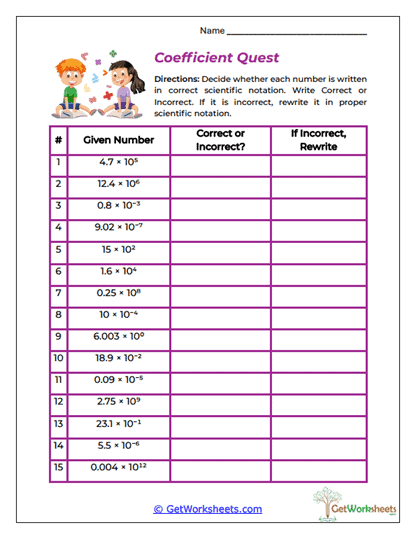
Coefficient Quest
Students examine scientific notation expressions and decide whether each one follows the required coefficient rule. Any coefficient smaller than 1 or at least 10 must be rewritten while the power of ten is adjusted to preserve the original value. This focused practice helps learners understand that an expression can be mathematically equivalent yet still not be written in proper scientific notation. The activity strengthens accuracy and gives students a reliable final check to use on future work.
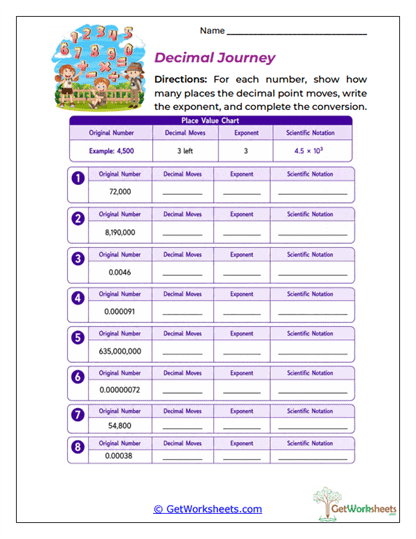
Decimal Journey
A structured chart breaks scientific notation conversion into manageable steps. Learners begin with a standard number, count how far the decimal must move to create a proper coefficient, determine the corresponding exponent, and write the finished expression. Both very large and very small values are included so students practice choosing positive and negative exponents. The organized format is especially helpful for learners who need additional support connecting decimal movement with powers of ten.
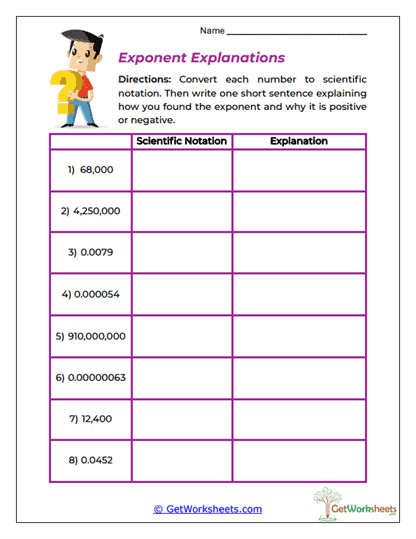
Exponent Explanations
Students convert numbers into scientific notation and then explain why the exponent is positive or negative. Writing about the process requires learners to think about the size of the original number as well as the direction and distance of the decimal shift. This helps reveal whether a correct answer comes from genuine understanding or from a memorized routine. The worksheet strengthens both mathematical reasoning and written communication.
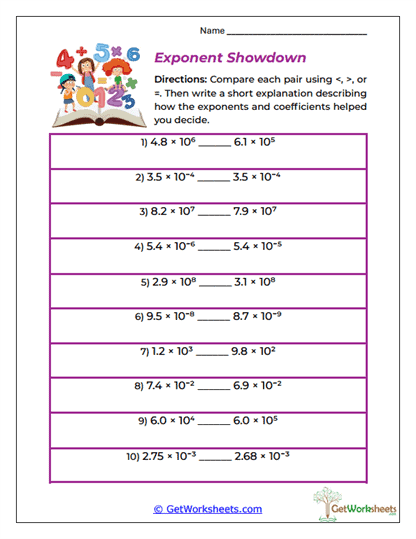
Exponent Showdown
Pairs of numbers written in scientific notation are compared without requiring students to expand every value first. Learners examine the powers of ten to judge overall scale and then compare coefficients when the exponents match. They use comparison symbols and explain how the structure of the notation helped them decide. This efficient strategy builds magnitude understanding and strengthens number sense with both large and small quantities.
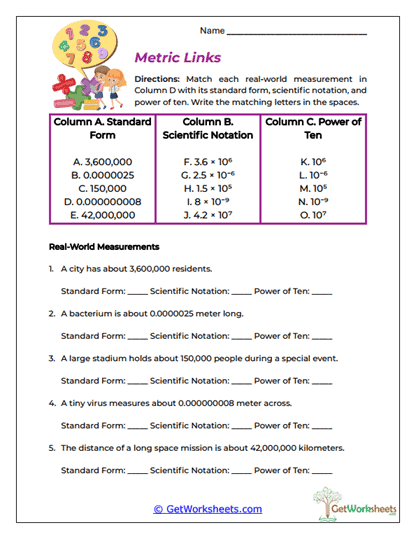
Metric Links
Real-world measurements and quantities are connected with their equivalent standard and scientific notation forms. Students work with examples involving populations, microscopic measurements, distances, and other values that demonstrate why compact notation is useful. Matching the representations encourages learners to consider scale as well as numerical equivalence. The activity also creates natural connections between mathematics, science, geography, and measurement.
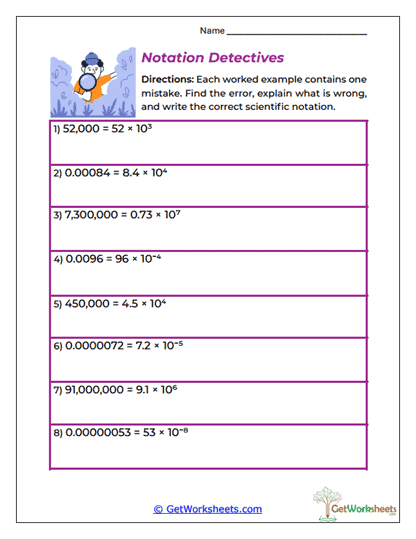
Notation Detectives
Incorrect conversions give students the opportunity to investigate common scientific notation mistakes. Learners identify whether the problem involves the coefficient, exponent, decimal placement, or sign of the exponent before writing the corrected form. Examining believable errors develops stronger self-checking habits and helps students understand why a conversion fails. This worksheet is useful for review, intervention, or discussion of common misconceptions.
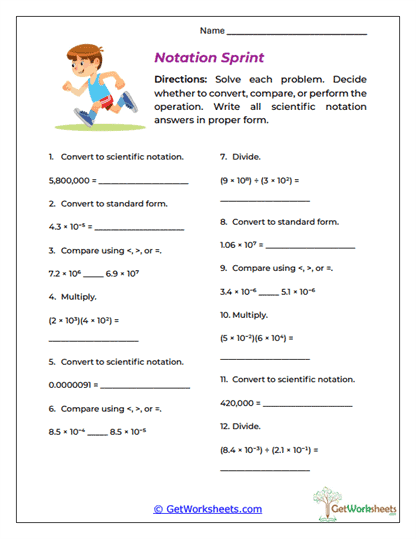
Notation Sprint
Several major scientific notation skills appear together in this mixed review. Students convert between forms, compare values, multiply and divide expressions, and make sure final results follow proper scientific notation conventions. Switching among task types requires learners to identify the appropriate strategy independently. The page works well as cumulative practice or preparation for an assessment. It can also help teachers quickly identify whether difficulties involve conversion, comparison, operations, or notation rules.
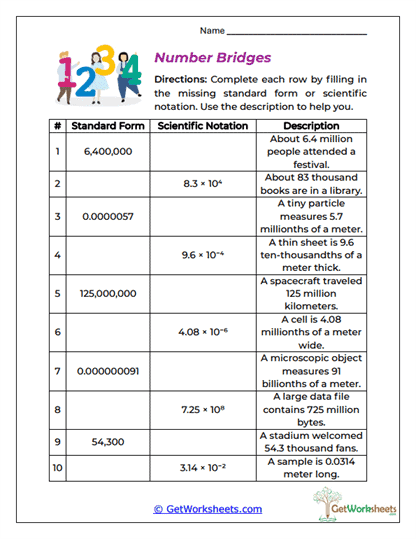
Number Bridges
A table connects standard form, scientific notation, and descriptions of real-world quantities. Different rows provide different starting information, requiring students to work in both directions as they complete the missing representations. Because the values may describe populations, distances, measurements, or data, learners must also think about whether the quantity is very large or very small. This flexible format strengthens number sense as well as conversion fluency.
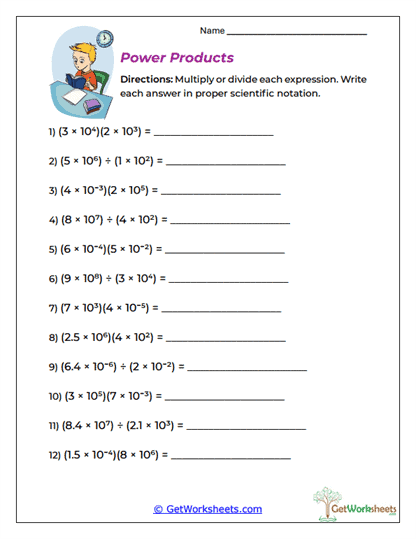
Power Products
Students multiply and divide numbers written in scientific notation by working separately with the coefficients and powers of ten. Product and quotient rules are used to combine the powers before the answer is rewritten in proper scientific form. Some problems require an additional adjustment when the resulting coefficient falls outside the accepted range. This multi-step practice builds a strong connection between exponent laws and numerical operations. It is particularly appropriate for learners ready to move beyond basic conversion.
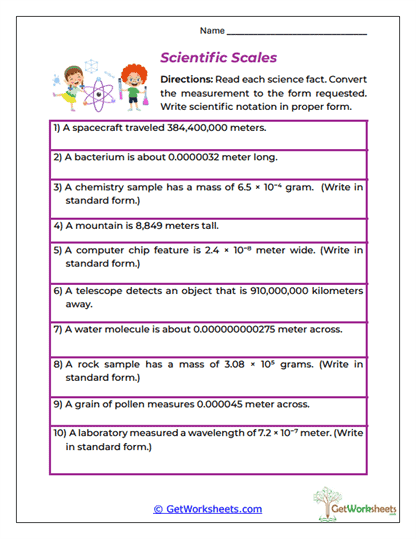
Scientific Scales
Real measurements from science, technology, and the natural world give scientific notation a practical purpose. Learners convert values involving distances, tiny organisms, mass, wavelengths, and other quantities between standard and scientific form. The examples highlight why scientists use powers of ten when ordinary notation becomes cumbersome. This activity strengthens conversion skills while helping students develop a stronger understanding of scale.
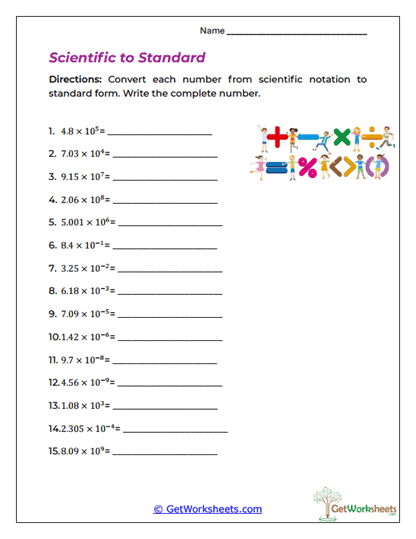
Scientific to Standard
Students expand scientific notation expressions back into ordinary numerical form. They interpret the coefficient and exponent, determine whether the value should become larger or smaller, and place zeros carefully as needed. Positive and negative exponents provide practice with both large whole numbers and small decimals. Working in this direction balances standard-to-scientific conversion and helps students understand the meaning of the exponent rather than relying on a one-way rule.
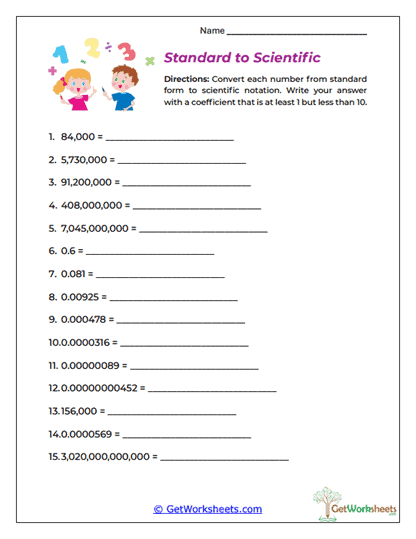
Standard to Scientific
Large whole numbers and tiny decimal values are rewritten in compact scientific notation. Learners create a coefficient between 1 and 10, count the decimal-place movement, and select the corresponding positive or negative power of ten. Practicing both ends of the number scale helps students see how the same notation system can represent extremely different quantities. This foundational page prepares learners for comparison, operations, and scientific applications.
Bookmark Us Now!
New, high-quality worksheets are added every week! Do not miss out!