Powers of Ten Worksheets
About This Worksheet Collection
Powers of ten help students understand how our base-ten number system grows and shrinks in predictable patterns. A power such as 103 represents repeated multiplication by 10, while multiplying or dividing a number by powers of ten changes the place value of its digits. Understanding these relationships gives students a strong foundation for decimal operations, metric conversions, scientific notation, and large-number reasoning.
This collection gives students several ways to explore powers of ten and their connection to place value. Activities include rewriting repeated multiplication in power form, completing equivalent-form tables, multiplying and dividing whole numbers and decimals, modeling digit shifts with place-value charts, matching representations, solving missing-value equations, checking true-or-false statements, explaining place-value changes, and applying powers of ten to real-world conversions. The worksheets can be used for classroom lessons, math centers, independent work, homework, tutoring, intervention, enrichment, or homeschool instruction.
As students work through the collection, they strengthen place-value fluency, exponent notation, scaling, decimal reasoning, pattern recognition, and mathematical communication. They also practice predicting whether values should become larger or smaller, moving between expanded, power, standard, and word forms, checking answers for reasonableness, and applying powers of ten in measurement contexts. These varied activities help learners understand the structure behind the pattern instead of relying only on shortcuts about moving decimal points.
Detailed Descriptions Of These Worksheets
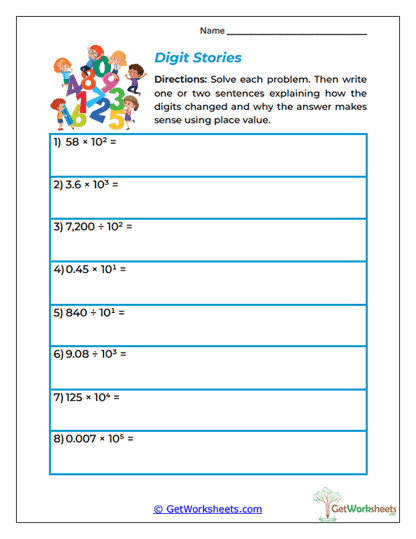
Digit Stories
Students solve multiplication and division problems involving powers of ten and then explain what happened to the digits. The written portion asks learners to describe the place-value shift and why the result became larger or smaller. Explaining the process helps reveal whether students truly understand the pattern behind the computation. This activity strengthens both mathematical reasoning and communication.
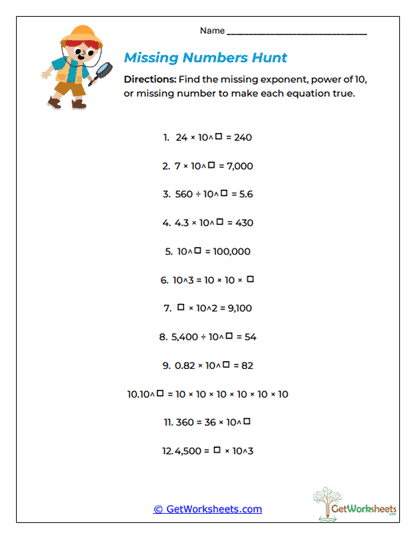
Missing Numbers Hunt
Missing-value equations challenge students to determine the power, exponent, or number that makes each relationship true. Learners work backward with multiplication, division, standard form, and repeated factors of ten. Because the problems begin from different points, students must rely on place-value relationships rather than one memorized procedure. The activity also provides useful preparation for algebraic thinking.
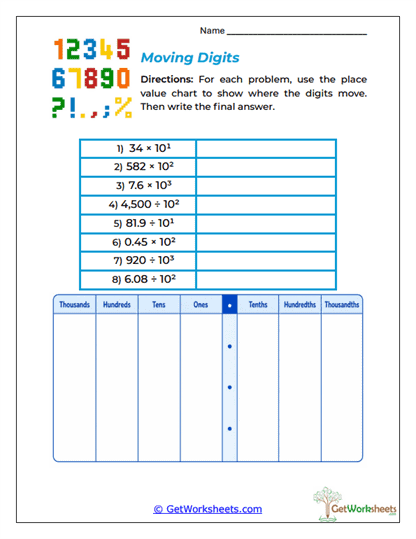
Moving Digits
A place-value chart gives students a visual way to model what happens when numbers are multiplied or divided by powers of ten. Learners track each digit from its original position to its new place before writing the final answer. This helps replace the misleading idea that the decimal point itself is moving. The activity is especially helpful for visual learners and students who need extra support with decimal placement.
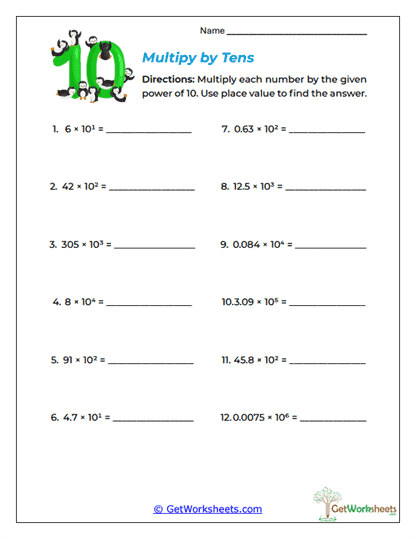
Multiply by Tens
Students multiply whole numbers and decimals by powers of ten while using place-value reasoning to determine the result. The problems help learners see that each factor of ten shifts digits into positions with greater value. Working with both whole and decimal numbers reinforces that the same base-ten pattern applies across different forms. This practice prepares students for scientific notation, measurement, and decimal computation.
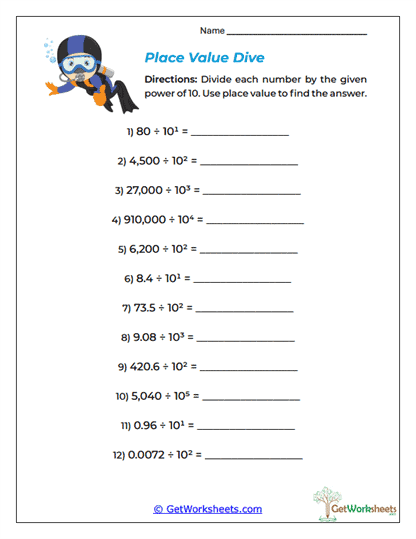
Place Value Dive
Division by powers of ten is explored through whole-number and decimal examples. Students track how digits shift into positions with smaller values and determine where the decimal belongs in the result. The worksheet emphasizes understanding the place-value change rather than memorizing a directional trick. Repeated practice strengthens scaling, decimal fluency, and number sense.
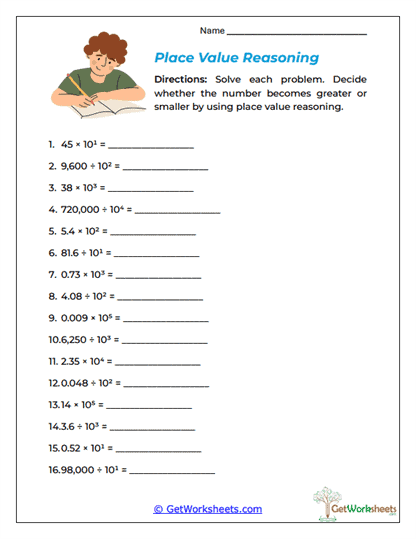
Place Value Reasoning
Mixed multiplication and division problems ask students to predict whether the answer should become larger or smaller before calculating. Learners then solve using powers of ten and compare the result with their prediction. This habit provides a useful way to catch misplaced decimal points and other major errors. The activity combines computation, estimation, and self-checking in one review.
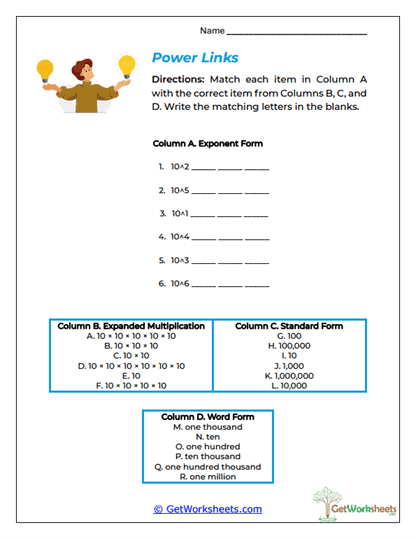
Power Links
Students match four equivalent representations of each power of ten: power notation, repeated multiplication, standard form, and word form. Building complete sets helps learners recognize that different representations can describe the same quantity. The matching format adds variety while reinforcing large-number reading and place-value relationships. It works well for review, centers, partner work, or informal assessment.
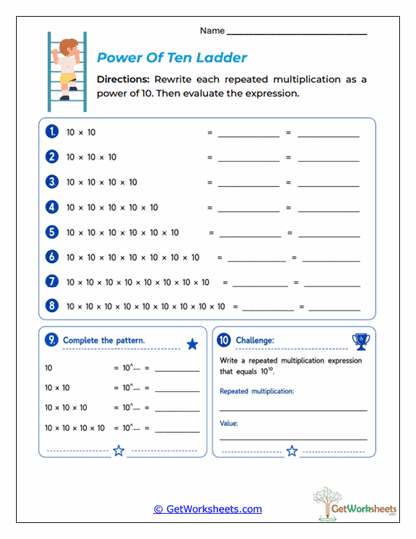
Power of Ten Ladder
Repeated factors of ten are converted into compact power notation and then evaluated in standard form. Students count the factors, identify the base, and observe how the value grows with each additional ten. The sequence makes the pattern especially easy to see. This activity provides a clear introduction to powers of ten and their relationship with place value.
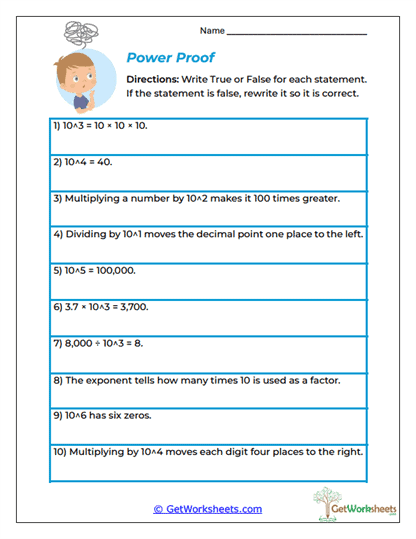
Power Proof
True-or-false statements ask students to evaluate whether powers of ten, expanded forms, and place-value relationships have been represented correctly. Learners correct any false statements and explain the accurate relationship. This format targets common misconceptions involving exponents, zeros, and digit shifts. It also encourages students to question whether an answer makes sense before accepting it.
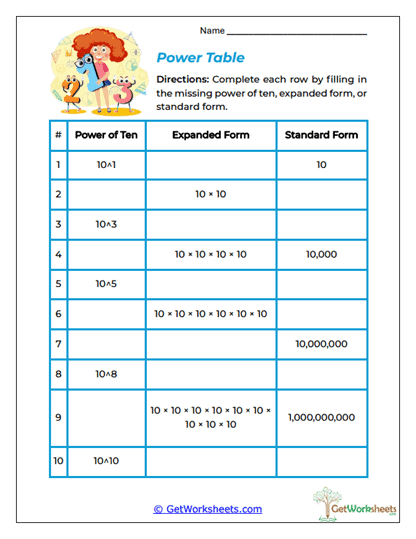
Power Table
A structured chart connects power notation, repeated multiplication, and standard form. Students use the information already provided in each row to complete the missing equivalent representations. Because different rows begin with different forms, learners practice moving both forward and backward. The visual organization makes relationships easy to compare and helps teachers spot misunderstandings quickly.
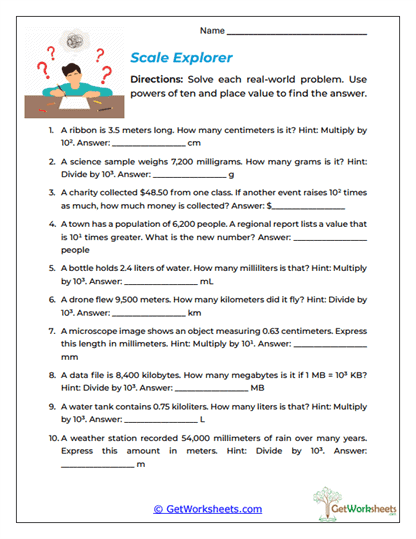
Scale Explorer
Real-world conversion problems show students how powers of ten appear in measurement, metric units, data, and scientific quantities. Learners decide whether to multiply or divide, calculate the result, and record the answer in the requested unit. Choosing the operation adds an important reasoning step before computation begins. This activity helps students see powers of ten as a practical tool rather than an isolated math skill.
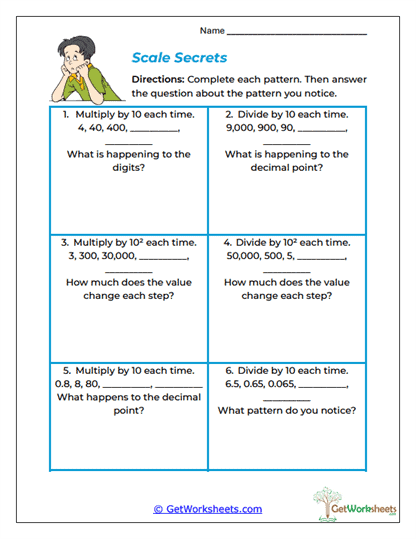
Scale Secrets
Number patterns help students investigate what happens when values are repeatedly multiplied or divided by ten or one hundred. Learners complete the sequences and explain how the digits and place values change from one step to the next. Comparing whole numbers and decimals reinforces that the same rule works throughout the base-ten system. The activity strengthens pattern recognition, place-value understanding, and mathematical explanation.
Bookmark Us Now!
New, high-quality worksheets are added every week! Do not miss out!