Laws of Exponents Worksheets
About This Worksheet Collection
The laws of exponents help students simplify expressions that contain powers by showing how exponents behave during multiplication, division, grouping, and repeated powers. Rather than memorizing isolated shortcuts, learners benefit from seeing how matching bases, repeated multiplication, products, quotients, zero powers, negative powers, and grouped expressions are connected. Understanding these relationships gives students a much stronger foundation for algebra and more advanced work with variables and expressions.
This collection gives students several ways to study and apply exponent laws. Activities include identifying rules from expanded form, choosing the correct law, simplifying through repeated multiplication, matching expressions with laws and results, solving missing-value puzzles, correcting errors, evaluating true-or-false statements, sorting expressions by rule, explaining mathematical reasoning, completing mixed practice, working through multi-step expressions, and applying exponent laws in real-world situations. The worksheets can be used for classroom instruction, independent work, homework, tutoring, intervention, enrichment, or homeschool lessons.
As students complete the collection, they strengthen pattern recognition, exponent vocabulary, algebraic reasoning, expression simplification, and mathematical communication. They also practice analyzing problem structure, deciding which law applies, working backward from equivalent expressions, correcting misconceptions, and combining multiple rules in an organized sequence. These varied activities help learners move from memorizing exponent laws to understanding when, why, and how each law should be used.
Detailed Descriptions Of These Worksheets
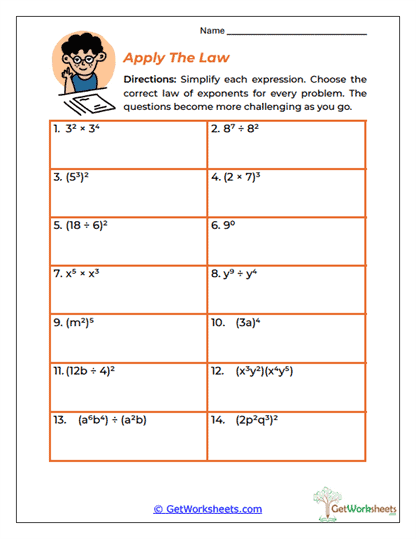
Apply the Law
Mixed exponent expressions require students to decide which law applies before simplifying. Learners work with products, quotients, grouped expressions, powers of powers, and special cases, so each problem demands a fresh look at its structure. Naming the rule first encourages students to make a thoughtful decision instead of relying on one repeated shortcut. This page works especially well as cumulative review before a quiz or unit assessment.
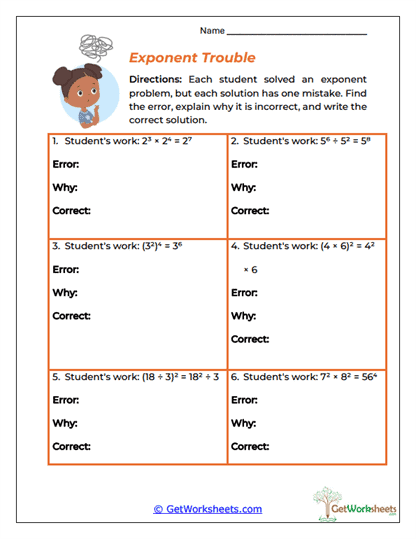
Exponent Trouble
Incorrect exponent solutions become opportunities for students to analyze mathematical reasoning. Learners identify where a law was misused, explain why the step is incorrect, and replace it with a valid simplification. The activity highlights common mistakes involving matching bases, grouped powers, products, and quotients. Studying errors in this way strengthens self-checking habits and helps students recognize misconceptions before repeating them in their own work.
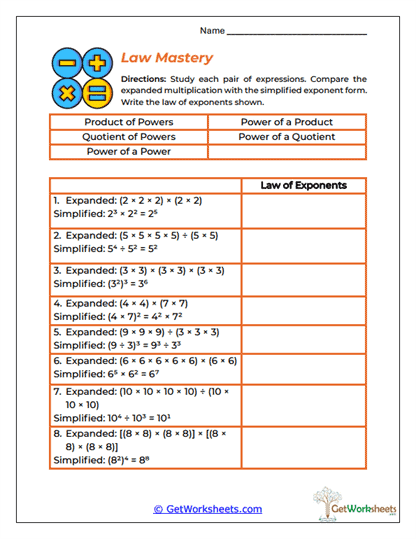
Law Mastery
Expanded multiplication gives students a concrete way to see where exponent laws come from. Learners compare repeated factors with simplified power expressions and determine which law explains the relationship. This approach helps make rules such as product of powers, quotient of powers, and power of a power more meaningful. The worksheet is especially useful for students who need to understand the pattern before they are ready to rely on a shortcut.
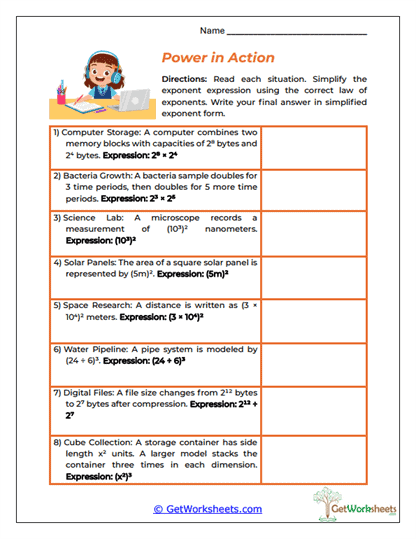
Power in Action
Real-world situations connect exponent laws with science, technology, geometry, measurement, storage, and growth. Students interpret each scenario, identify the power expression involved, and simplify it using the appropriate law. The context helps learners see that exponent rules can describe useful mathematical relationships outside of routine exercises. This activity also strengthens reading comprehension and the ability to move between words and symbolic expressions.
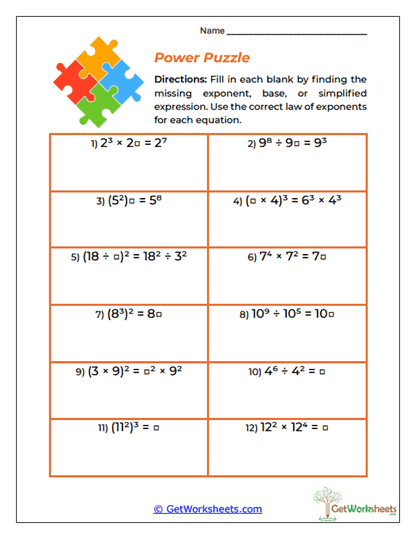
Power Puzzle
Missing-value equations challenge students to use exponent laws in reverse. Learners compare both sides of each equation and determine the unknown base, exponent, or simplified expression that makes the relationship true. Because the problems do not all follow the same pattern, students must reason carefully about which law is operating. This puzzle-style activity strengthens algebra readiness and flexible mathematical thinking.
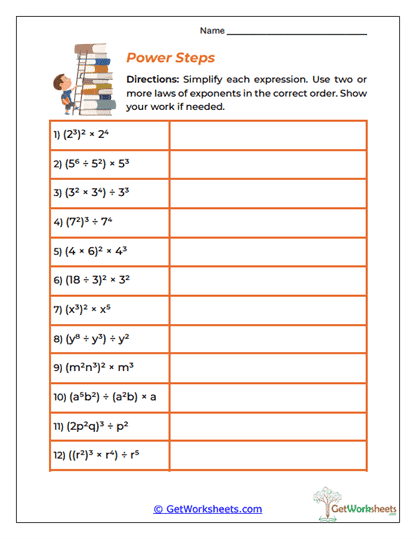
Power Steps
Multi-step expressions require students to combine two or more exponent laws in an organized sequence. Learners simplify grouped powers, products, quotients, and variable expressions one step at a time while tracking how each exponent changes. Showing intermediate work helps prevent students from losing important information as the expression becomes shorter. The worksheet prepares learners for more advanced algebra where several rules often appear together.
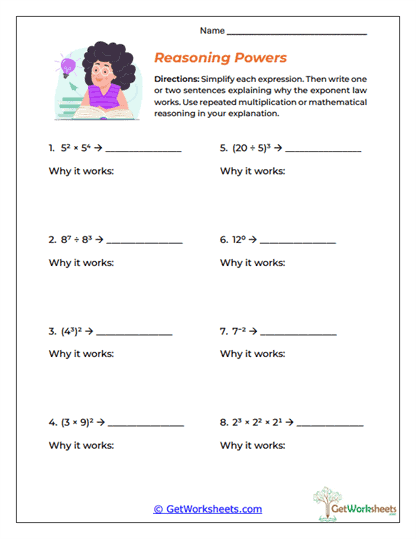
Reasoning Powers
Students simplify exponent expressions and then explain why the chosen law works. Their written reasoning may use repeated multiplication, matching bases, products, quotients, or special exponent cases to justify each result. Requiring an explanation reveals whether students understand the mathematics beneath the shortcut. This activity strengthens both exponent fluency and mathematical communication. It is also useful for identifying gaps that may not be visible from a correct final answer alone.
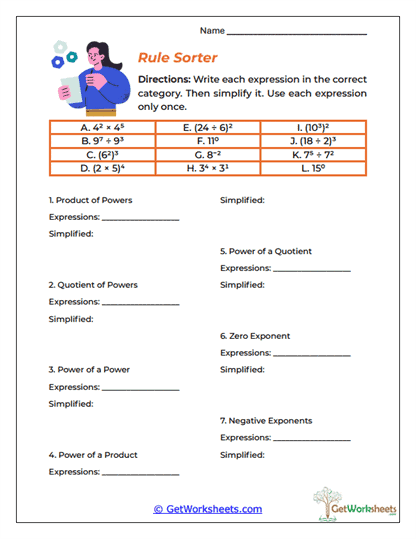
Rule Sorter
Expressions are organized into categories such as product of powers, quotient of powers, power of a power, power of a product, power of a quotient, zero power, and negative powers. Students classify each problem before simplifying it. Sorting first encourages learners to look for structural clues instead of immediately applying a familiar rule. The activity is especially helpful when several exponent laws have been introduced close together and students need practice distinguishing among them.
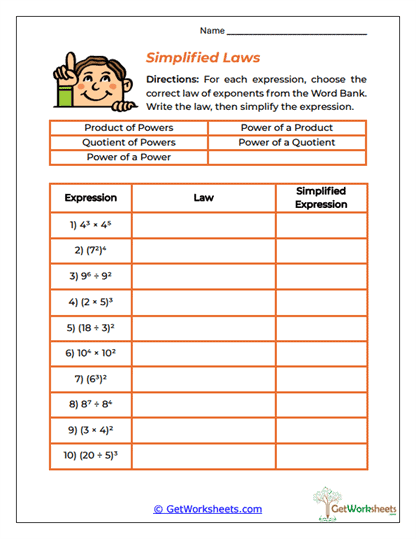
Simplified Laws
Students examine each exponent expression, choose the law that fits its structure, and then simplify it. Problems mix products, quotients, grouped powers, and other related forms so learners cannot rely on a single routine. The worksheet strengthens rule recognition as well as calculation accuracy. It gives teachers and parents a clear way to see whether a student understands which law applies, how to use it, or both.
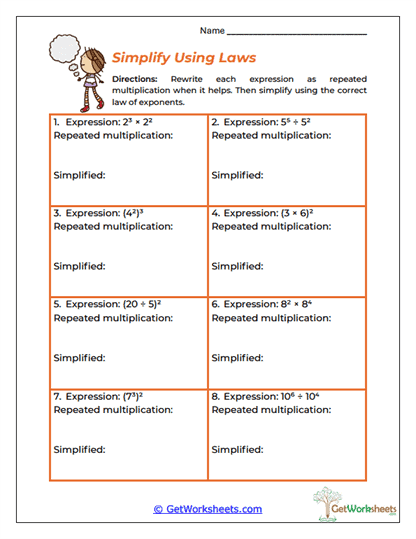
Simplify Using Laws
Repeated multiplication serves as a bridge between symbolic exponent notation and simplified expressions. Students expand the powers into factors, examine how those factors combine, and then use the resulting pattern to simplify the original expression. This slower method helps learners see why exponent laws work rather than treating them as unexplained rules. It is particularly useful for reteaching or for students who need more conceptual support before moving to mental shortcuts.
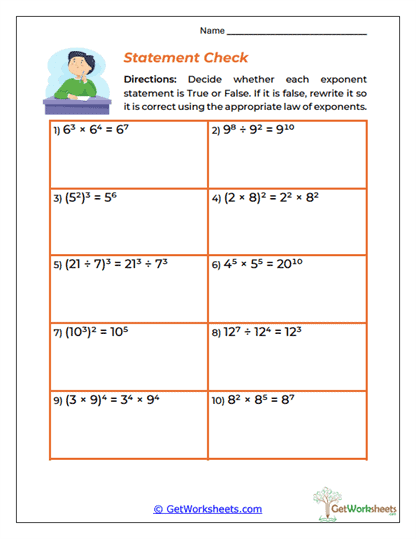
Statement Check
True-or-false equations ask students to judge whether exponent laws have been applied correctly. Learners inspect each statement, decide whether it is valid, and rewrite any incorrect relationship. The format encourages careful attention to matching bases, multiplication, division, grouping, and special exponent cases. Correcting false statements also helps students develop stronger mathematical language and more reliable self-checking habits.
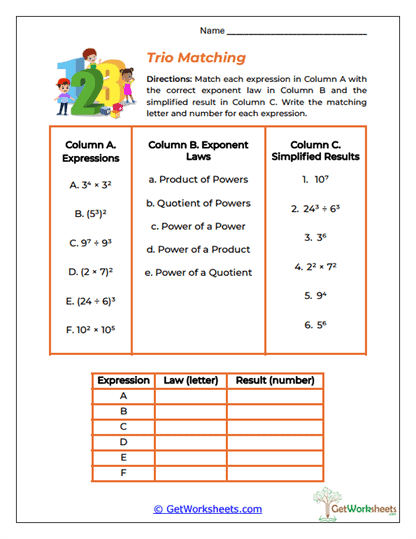
Trio Matching
Students connect each original expression with both the correct exponent law and its simplified result. All three pieces must agree, so learners are encouraged to check their reasoning from more than one direction. The matching format reinforces the relationship between problem structure, rule selection, and final answer. It works well for partner practice, math centers, review, or formative assessment.
Bookmark Us Now!
New, high-quality worksheets are added every week! Do not miss out!