Subtracting Decimals Worksheets
About This Worksheet Collection
Subtracting decimals requires students to understand place value and carefully align decimal points before finding a difference. Learners must keep ones, tenths, hundredths, and thousandths in the correct columns while regrouping when necessary. Building this understanding helps students see decimal subtraction as an extension of whole-number subtraction rather than a completely different process.
This collection develops decimal subtraction through vertical computation, visual models, expanded form, estimation, regrouping practice, error analysis, missing-number equations, money problems, measurement situations, data tables, matching activities, and mixed review. Some worksheets focus on one important skill, such as borrowing or decimal alignment, while others ask students to apply subtraction in practical situations or explain why an answer is correct. The pages can be used during direct instruction, guided math, centers, intervention, tutoring, homework, assessment, review, or homeschool lessons.
As students complete the collection, they strengthen decimal place value, regrouping, subtraction fluency, estimation, inverse operations, and mathematical reasoning. They also practice finding differences in money and measurement contexts, interpreting data, checking errors, solving for unknown values, and deciding whether answers are reasonable. These skills prepare learners for multi-step decimal problems, financial math, measurement, data analysis, and more advanced decimal operations.
Detailed Descriptions Of These Worksheets
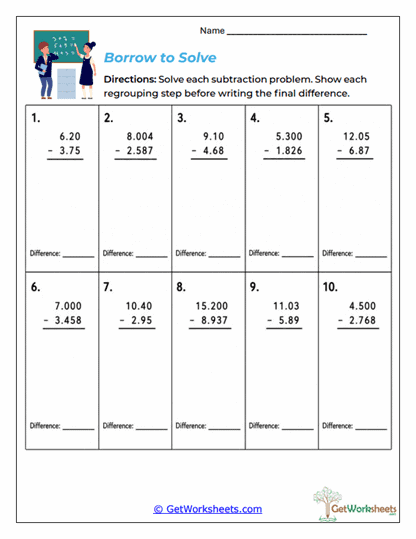
Borrow to Solve
Students focus specifically on decimal subtraction problems that require regrouping. Because the problems are already written vertically, learners can concentrate on borrowing across ones, tenths, hundredths, thousandths, and even strings of zeros. The activity reinforces the idea that regrouping is an exchange between neighboring place values. Repeated practice helps students become more accurate and confident with difficult subtraction setups.
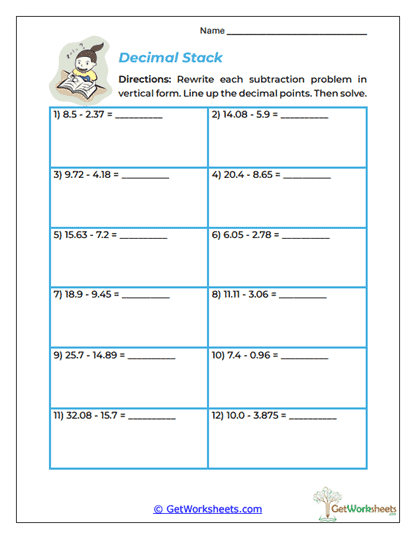
Decimal Stack
Horizontal decimal subtraction problems are rewritten vertically before students solve them. Learners line up the decimal points so matching place values fall into the correct columns and then regroup when needed. This routine directly addresses one of the most common causes of decimal subtraction mistakes. The page provides steady practice with setup, computation, and accurate decimal placement.
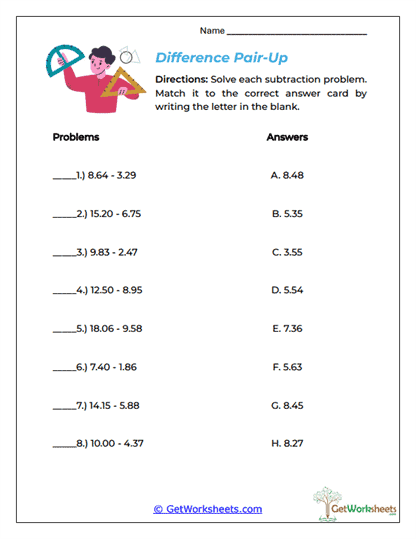
Difference Pair-Up
Students solve decimal subtraction problems and match each difference with an answer choice. The matching format gives learners a simple way to check whether their calculation appears reasonable. If a result is missing from the answer bank, they are encouraged to review alignment, regrouping, and subtraction facts. This activity builds fluency while promoting independent self-checking.
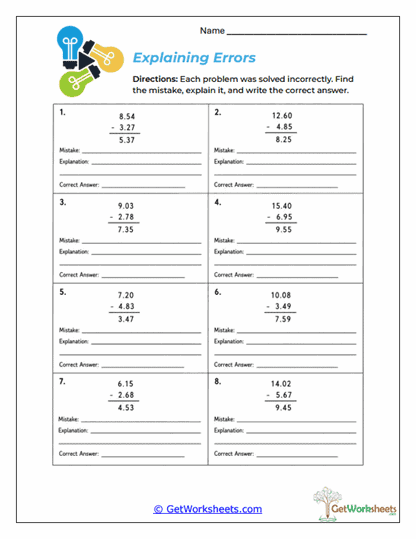
Explaining Errors
Incorrectly solved decimal subtraction problems must be examined and repaired. Students identify whether the mistake involves regrouping, place-value alignment, or basic subtraction and then explain what went wrong. They finish by calculating the correct difference. This error-analysis format strengthens deeper understanding and helps learners become more careful when reviewing their own work.
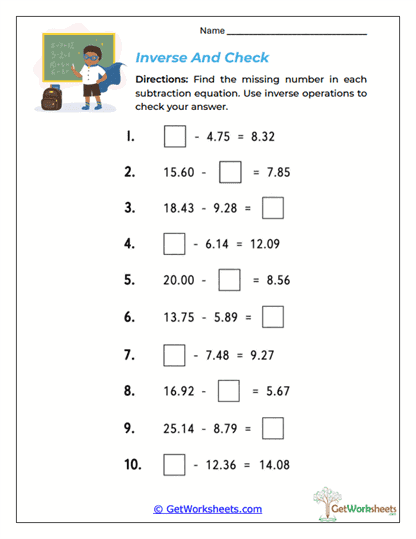
Inverse and Check
Missing values appear in different positions within decimal subtraction equations. Students determine whether the unknown is the starting amount, the amount removed, or the difference and then use addition or subtraction to work backward. Each completed equation is checked to make sure the solution fits. The activity strengthens inverse-operation reasoning and provides useful preparation for algebraic thinking.
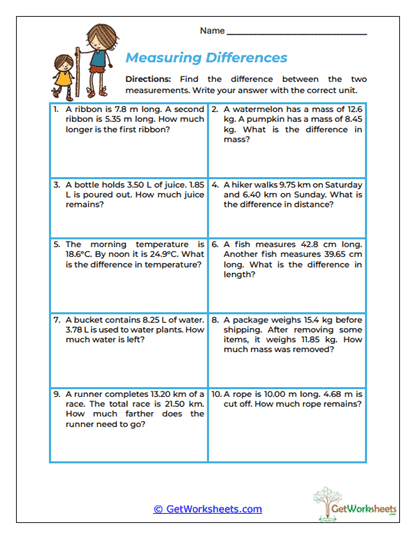
Measuring Differences
Real-world measurement problems ask students to find how much longer, heavier, farther, warmer, or greater one quantity is than another. Learners subtract the decimal measurements and include the appropriate unit in each answer. The varied examples connect subtraction with science, travel, and everyday measurement. This page also reinforces that subtraction can be used to compare quantities, not only to find what remains.
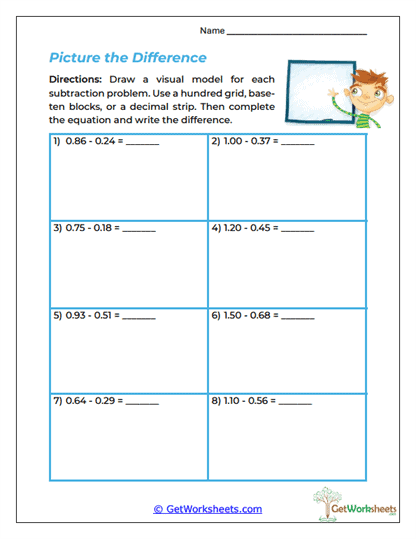
Picture the Difference
Hundred grids, decimal strips, and base-ten models give students a visual way to represent subtraction. Learners show the starting amount, remove the second decimal, and identify what remains before writing the equation. The models help make tenths and hundredths more concrete and can also illustrate why regrouping is sometimes needed. This activity provides a strong conceptual foundation before students rely only on written algorithms.
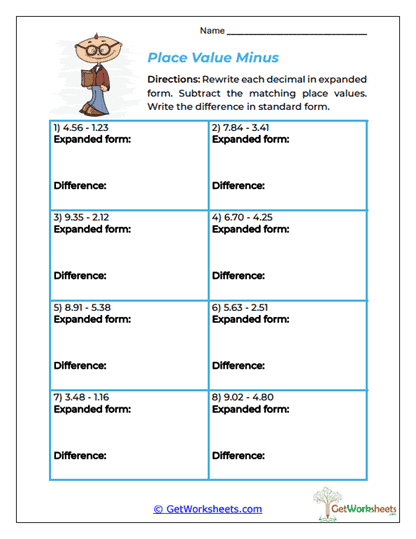
Place Value Minus
Students break decimals into ones, tenths, and hundredths before subtracting. Working in expanded form helps them see exactly how each place contributes to the number and how regrouping changes those values. After subtracting the individual parts, learners recombine them into standard decimal notation. This approach makes the reasoning behind the standard algorithm easier to understand.
Shop and Subtract
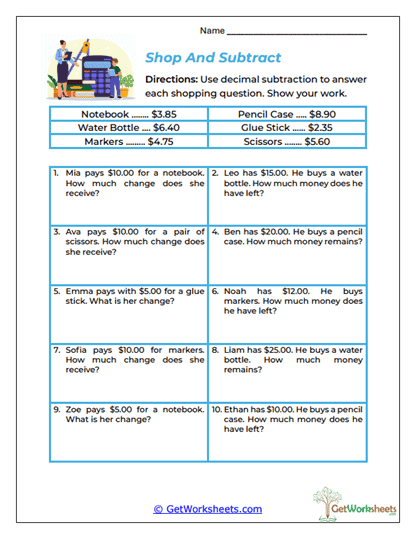
A store price chart provides practical practice with finding change and money remaining after purchases. Students subtract item costs from starting amounts and record answers using correct dollar-and-cent notation. The familiar shopping context gives decimal subtraction an immediate real-world purpose. It also strengthens financial reasoning, budgeting awareness, and careful place-value alignment.
Smart Difference
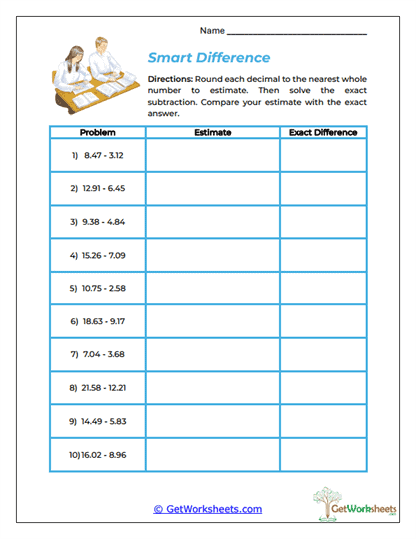
Students estimate each decimal difference before solving exactly. They round the original numbers, calculate an approximate answer, and then compare it with the precise result. A large mismatch can signal a place-value, regrouping, or decimal-placement error. This routine encourages learners to judge whether an answer makes sense instead of accepting every calculation automatically.
Subtracting Data
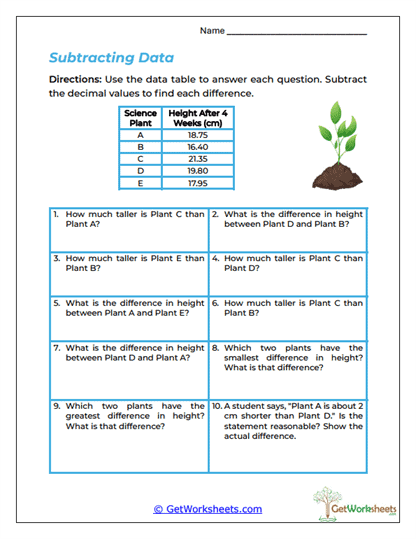
A science-style table of plant measurements gives students decimal values to compare. Learners subtract heights, identify the smallest and largest differences, and decide which measurements are closest or farthest apart. The activity combines decimal computation with table reading and interpretation. This makes subtraction more meaningful by showing how differences help people analyze real data.
Subtraction Mastery
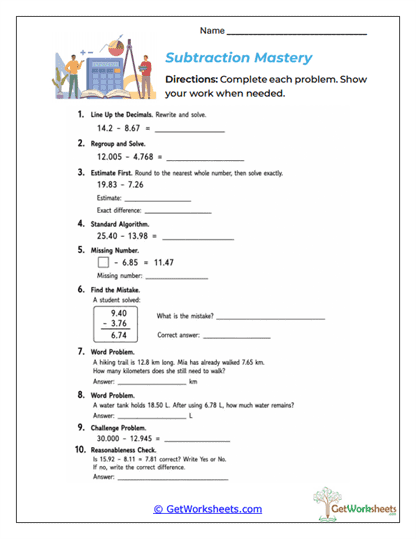
This cumulative review brings decimal alignment, regrouping, estimation, missing-number equations, error analysis, measurement, and word problems together on one page. Students must choose among several strategies rather than repeating the same type of calculation. The variety helps reveal whether learners understand both the procedure and the reasoning behind decimal subtraction. It works well as a final review, assessment, or checkpoint before more advanced decimal work.
Bookmark Us Now!
New, high-quality worksheets are added every week! Do not miss out!