Decimal Word Problems Worksheets
About This Worksheet Collection
Decimal word problems help students connect calculation skills with real situations involving money, measurement, travel, recipes, data, and everyday decisions. To solve them successfully, learners must understand what the numbers represent, decide which operation fits the situation, and then calculate accurately. This process strengthens both decimal fluency and the deeper reasoning needed to use mathematics meaningfully.
This collection develops decimal problem-solving through operation selection, estimation, bar models, budgeting, measurement, recipe math, travel situations, data tables, error analysis, equation-based story writing, and multi-step challenges. Some worksheets focus on choosing and explaining the correct operation, while others ask students to model situations, check whether answers are reasonable, or apply several decimal skills at once. The pages can be used during direct instruction, guided math, centers, intervention, tutoring, homework, assessment, review, enrichment, or homeschool lessons.
As students complete the collection, they strengthen decimal addition, subtraction, multiplication, division, estimation, place value, operation sense, and mathematical reasoning. They also practice interpreting units, reading data, working with money, explaining strategies, checking errors, and solving increasingly complex multi-step situations. These skills prepare learners for more advanced work with ratios, percentages, measurement, algebra, financial math, and real-world problem solving.
Detailed Descriptions Of These Worksheets
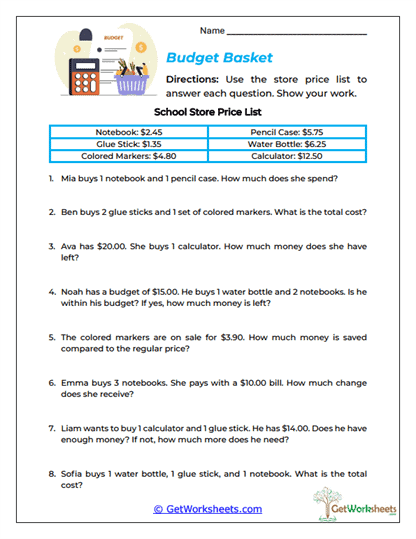
Budget Basket
A school-store price list gives students practical experience solving money problems with decimals. Learners add purchases, subtract spending from a budget, calculate change, compare prices, and decide whether available money is enough. Several questions require more than one step, so students must keep their work organized. The activity strengthens decimal computation while introducing useful budgeting and financial reasoning.
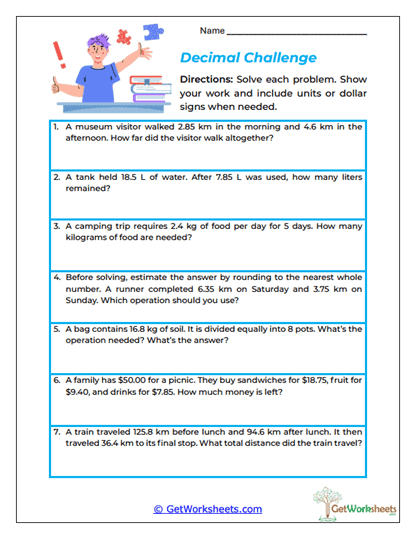
Decimal Challenge
This mixed review combines decimal operations, estimation, money, measurement, and multi-step reasoning. Students must decide which operation or sequence of operations fits each situation before solving. Some problems require an estimate or an intermediate result before the final answer can be found. The page works well as a cumulative review, enrichment task, or assessment of independent problem-solving skills.
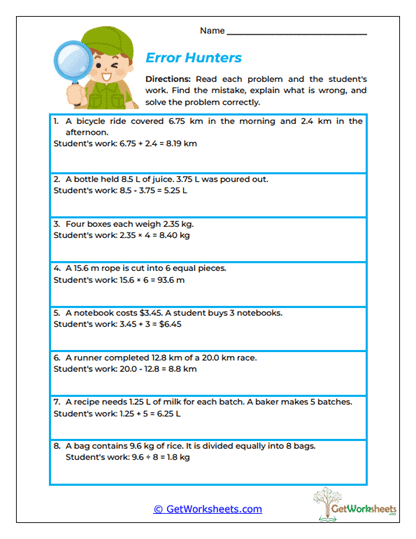
Error Hunters
Completed decimal word problems contain mistakes that students must locate and correct. Learners check whether the chosen operation matches the story and whether the decimal computation itself is accurate. They then explain the problem with the original work and solve the situation correctly. This activity builds self-checking habits and helps students see that a reasonable solution depends on both comprehension and calculation.
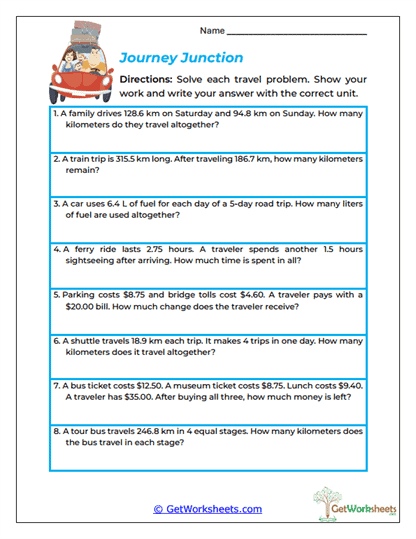
Journey Junction
Travel-related situations ask students to work with distances, time, transportation costs, and repeated trips. Learners add totals, find remaining amounts, multiply repeated distances, and divide journeys into equal parts. Because the operation changes from problem to problem, students must understand the context before calculating. The activity connects decimal computation with measurement and everyday decision-making.
Kitchen Counts
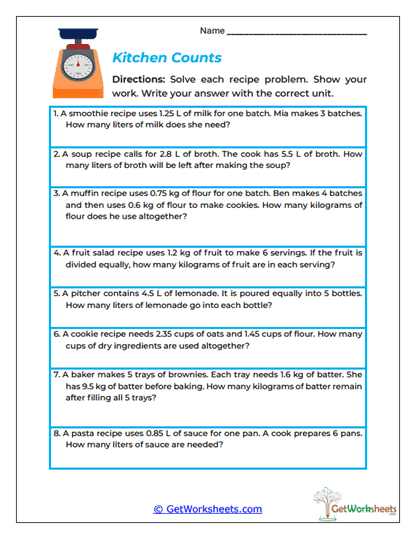
Recipe and cooking situations provide practice with all four decimal operations. Students may scale ingredients for several batches, combine quantities, find what remains, or divide amounts into equal portions. Units such as cups, liters, and kilograms help learners connect the arithmetic with meaningful quantities. The familiar setting makes operation choice easier to visualize while strengthening measurement skills.
Market Math
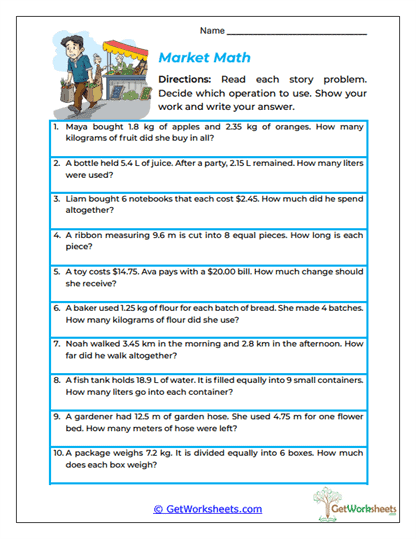
A variety of everyday stories require students to determine whether addition, subtraction, multiplication, or division is appropriate. Situations involving shopping, travel, measurement, and other familiar contexts prevent learners from assuming that every problem uses the same operation. Students show their work and include the correct unit or money notation. This page provides broad practice with operation selection and decimal computation.
Measure Master
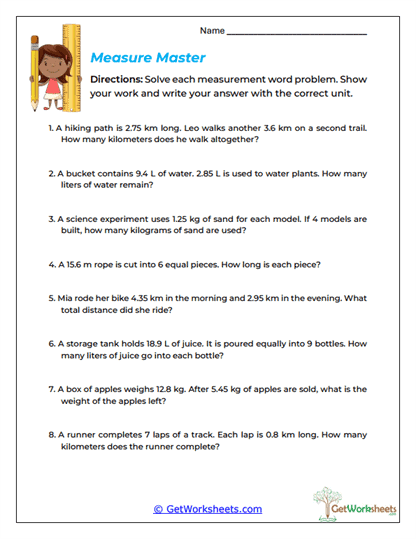
Decimal word problems involving length, volume, mass, distance, and repeated measurements ask learners to interpret both the quantity and the unit. Students decide whether to combine, subtract, repeat, or divide the measurements before solving. Accurate units are required in every final answer. The activity provides a useful connection between decimal math, science, and real-world measurement.
Model Moves
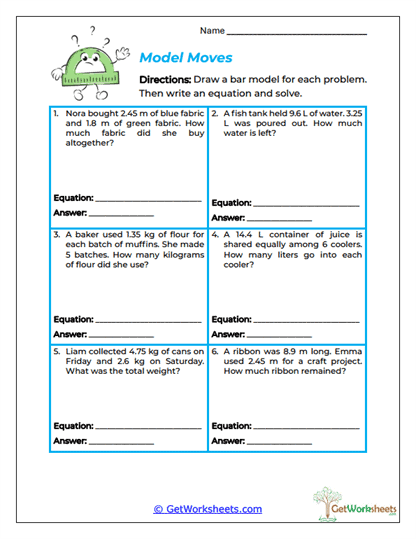
Students draw bar models to represent decimal word problems before writing equations and calculating answers. The visual structure helps them see whether quantities are being joined, compared, repeated, or separated into equal groups. This added planning step can make operation choice much clearer. The worksheet is especially helpful for learners who understand computation but struggle to translate written situations into equations.
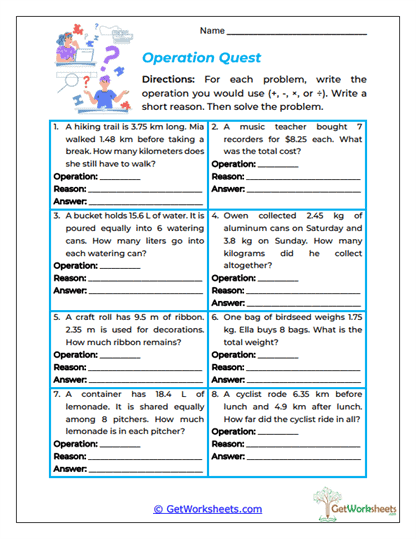
Operation Quest
Each problem asks students to name the decimal operation, explain why it fits the situation, and then solve. Words and relationships such as altogether, remains, shared equally, and repeated amounts provide clues, but learners must justify their decisions. The written explanation makes it easier to see whether students truly understand the story. This activity strengthens mathematical vocabulary and thoughtful operation sense.
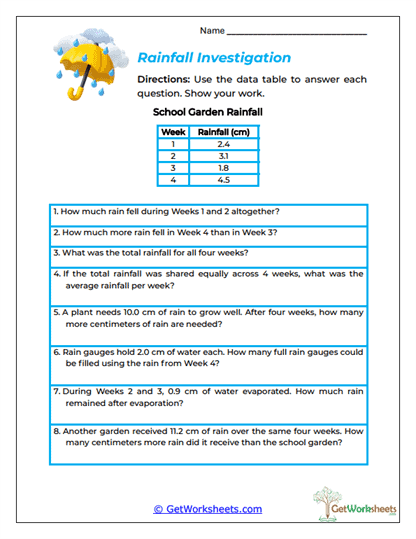
Rainfall Investigation
A weekly rainfall table provides decimal data for totals, differences, averages, missing amounts, and equal-sharing questions. Students must first identify the correct values from the table and then choose the needed operation or sequence of operations. Several questions require more than one calculation. This worksheet combines decimal skills with measurement, data literacy, and science-style reasoning.
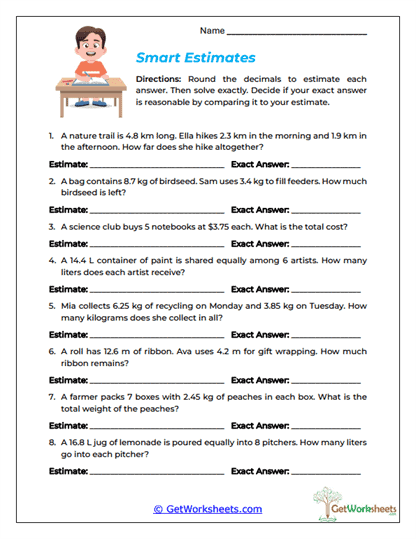
Smart Estimates
Students estimate answers to decimal word problems before finding the exact result. They round the given quantities, calculate an approximate answer, solve the original problem, and compare the two. A large mismatch can signal an operation, place-value, or calculation error. This routine builds number sense and encourages learners to check whether their answers are reasonable.
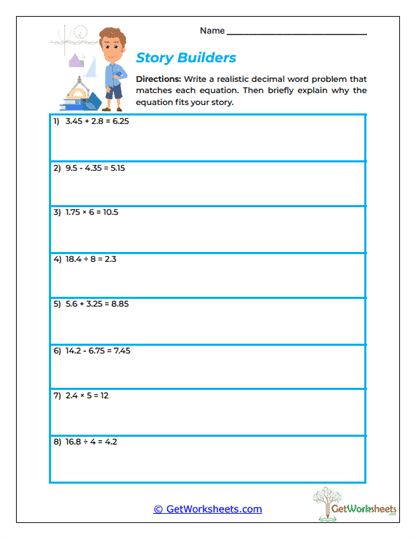
Story Builders
Provided decimal equations become the basis for original word problems written by the student. Learners choose realistic quantities and units, create a situation that matches the operation, and explain why the equation represents the story correctly. Writing the problem requires a deeper understanding of addition, subtraction, multiplication, and division than solving alone. The open-ended format combines mathematical modeling, reasoning, creativity, and written communication.
Bookmark Us Now!
New, high-quality worksheets are added every week! Do not miss out!