Adding Decimals Worksheets
About This Worksheet Collection
Adding decimals requires students to understand place value and keep matching digits aligned before combining amounts. The decimal point acts as an important place-value marker, helping learners place ones beneath ones, tenths beneath tenths, and hundredths beneath hundredths. Building this understanding helps students add accurately while also making sense of decimal quantities used in money, measurement, data, and everyday situations.
This collection develops decimal addition through vertical computation, visual models, expanded form, estimation, missing-addend problems, number lines, error analysis, matching activities, money problems, measurement situations, data tables, and mixed review. Some worksheets focus closely on setup and place value, while others ask students to apply addition in practical contexts or explain why an answer is reasonable. The pages can be used during direct instruction, guided math, centers, intervention, tutoring, homework, assessment, review, or homeschool lessons.
As students complete the collection, they strengthen decimal place value, addition fluency, regrouping, estimation, inverse operations, number sense, and mathematical reasoning. They also practice interpreting money and measurements, checking calculations, reading data tables, modeling decimal amounts, and solving problems in several different formats. These skills prepare learners for decimal subtraction, multiplication, division, multi-step problems, and more advanced work with measurement and financial mathematics.
Detailed Descriptions Of These Worksheets
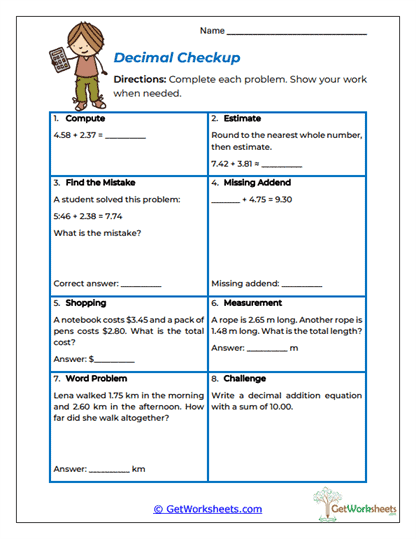
Decimal Checkup
This mixed review brings several decimal-addition skills together on one page. Students complete computation, estimation, error analysis, missing-addend work, money and measurement problems, and an open-ended equation challenge. Because the question types change throughout the activity, learners must decide which strategy fits each task rather than repeating one routine. It works well as a final review, assessment, or checkpoint before moving into decimal subtraction.
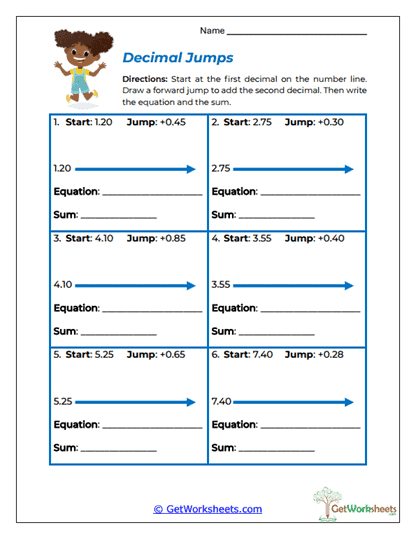
Decimal Jumps
Number lines help students see decimal addition as forward movement from one value to another. Learners locate the starting decimal, make a jump representing the second addend, and record the landing point as the sum. The visual format strengthens decimal magnitude and shows how tenths and hundredths represent real distances between numbers. This activity is especially helpful for students who need an alternative to stacked computation.
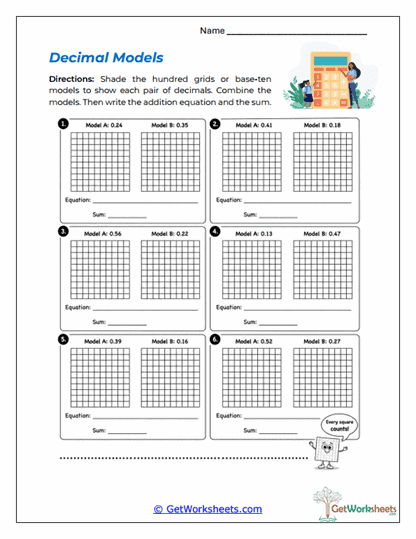
Decimal Models
Hundred grids and base-ten style models make decimal quantities visible. Students shade each amount, connect the picture with decimal notation, and combine the models to find the total. Seeing values such as thirty-five hundredths represented on a grid strengthens understanding of what digits after the decimal point actually mean. The worksheet provides a strong bridge from concrete models to standard addition algorithms.
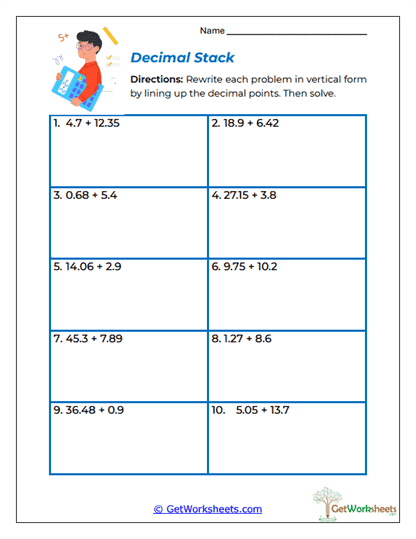
Decimal Stack
Students rewrite horizontal decimal problems vertically before solving them. Careful alignment keeps ones, tenths, and hundredths in the correct columns and gives learners practice regrouping when necessary. The structured format directly targets one of the most common sources of decimal addition errors. It reinforces the idea that decimal points should be lined up before any computation begins.
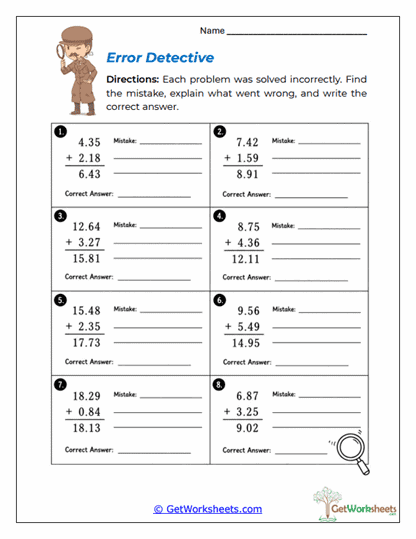
Error Detective
Incorrectly solved decimal addition problems become opportunities for investigation. Students inspect each setup, identify whether the mistake involves decimal alignment, place value, regrouping, or addition, and then calculate the correct result. Explaining the error requires learners to understand the process rather than simply perform it. This makes the page especially useful for intervention and self-checking practice.
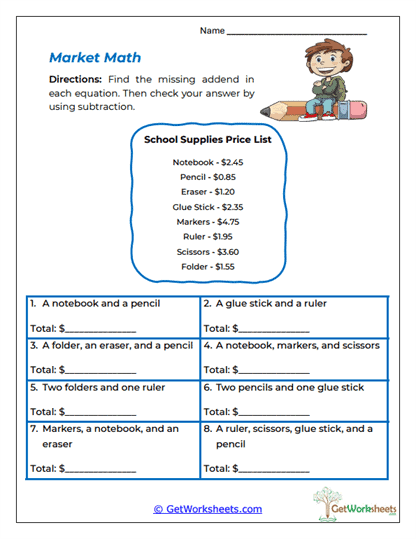
Market Math
A school-supplies price list gives students practical experience adding decimal money amounts. Learners combine the costs of several items while keeping dollar-and-cent notation accurate. Some problems involve multiple addends, which encourages careful organization and place-value alignment. The familiar shopping context also shows how decimal addition supports budgeting and everyday financial decisions.
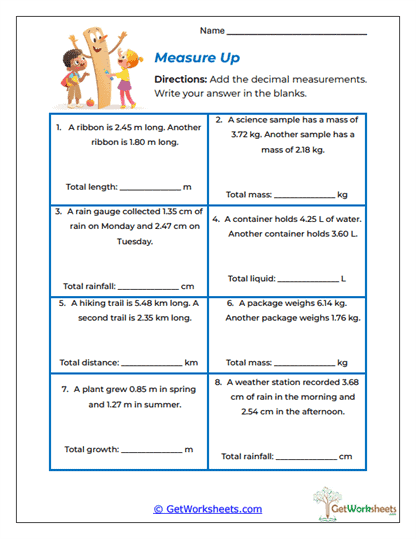
Measure Up
Short measurement problems ask students to add decimal quantities involving length, mass, rainfall, volume, distance, and growth. Learners must calculate accurately and include the correct unit with each final answer. The varied contexts connect decimal computation with science and real-world measurement. This page also strengthens reading comprehension because students must identify both the quantities and what they represent.
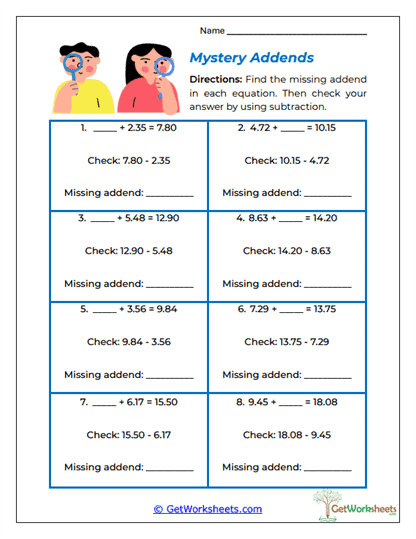
Mystery Addends
Students work backward to determine an unknown decimal in each addition equation. They use subtraction to find the missing addend and then check the solution by adding it back to the known amount. This structure reinforces the inverse relationship between addition and subtraction. It also develops flexible equation thinking and provides early preparation for algebraic reasoning.
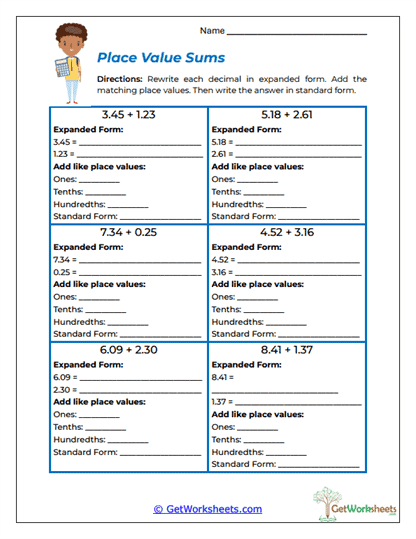
Place Value Sums
Decimals are broken apart into ones, tenths, and hundredths before being added. Students combine matching place-value amounts and then write the final result in standard form. This process makes regrouping easier to understand because learners can see where each value comes from. The activity helps students understand the reasoning behind the standard algorithm instead of relying only on memorized steps.
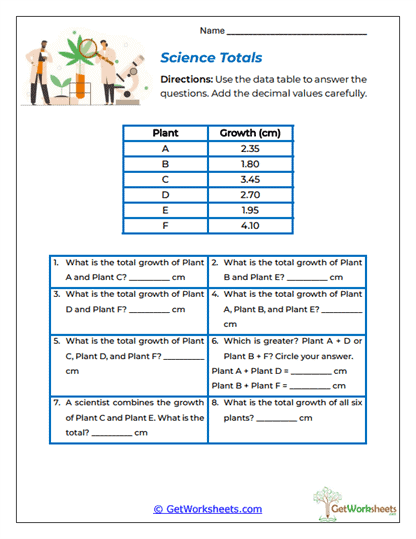
Science Totals
A plant-growth data table gives learners practice locating and combining decimal measurements. Students add selected values, compare totals, and answer questions involving two or more data points. The activity blends decimal computation with table reading, measurement, and comparison. It provides a meaningful connection between mathematics and the type of numerical data students may encounter in science.
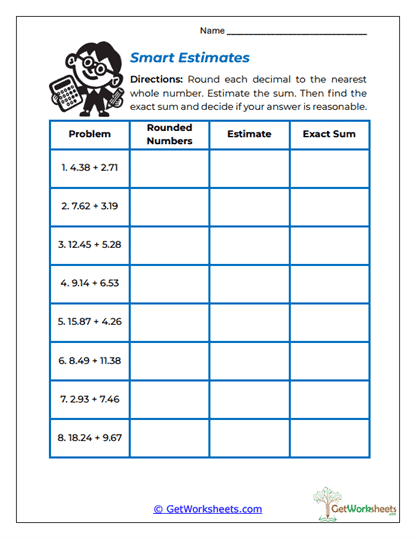
Smart Estimates
Students round decimal addends to the nearest whole number before finding the exact sum. Comparing the estimate with the calculated answer encourages them to decide whether the result is reasonable. A large difference between the two can signal a decimal-placement or regrouping mistake. This worksheet builds the useful habit of predicting and checking rather than trusting every calculation automatically.
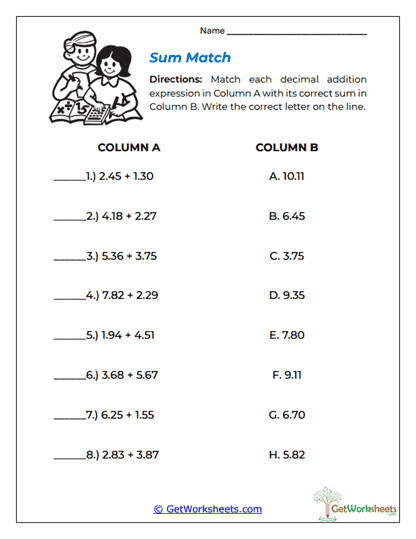
Sum Match
Students calculate decimal sums and connect each result with the matching answer in a second column. The answer bank provides a simple self-checking feature because a missing match may indicate that the calculation needs to be reviewed. Learners must pay close attention to decimal placement when comparing similar-looking values. The matching format offers repeated computation practice in a more interactive structure.
Bookmark Us Now!
New, high-quality worksheets are added every week! Do not miss out!