Rounding Decimals Worksheets
About This Worksheet Collection
Rounding decimals helps students replace an exact value with a nearby number that is easier to use, estimate, or compare. To round accurately, learners need to understand place value, identify the digit in the target place, and examine the digit immediately to its right before deciding whether the target digit stays the same or increases. Building this understanding helps students see rounding as a place-value decision rather than just a memorized rule.
This collection gives students several ways to practice and understand decimal rounding. Activities include identifying deciding digits, using benchmark values, rounding to different places, working with place-value charts, estimating operations, correcting mistakes, matching rounded values, reasoning backward from a rounded number, sorting decimals into rounding groups, and applying rounding to everyday situations. The worksheets can be used for classroom lessons, math centers, independent practice, homework, tutoring, intervention, or homeschool instruction.
As students work through the collection, they strengthen place-value fluency, decimal magnitude, benchmark reasoning, estimation, comparison, and mathematical explanation. They also practice checking whether answers are reasonable, recognizing rounding intervals, interpreting real-world measurements, and explaining why a number rounds up or down. These varied activities help learners move from simply following a rule to understanding how and why decimal rounding works.
Detailed Descriptions Of These Worksheets
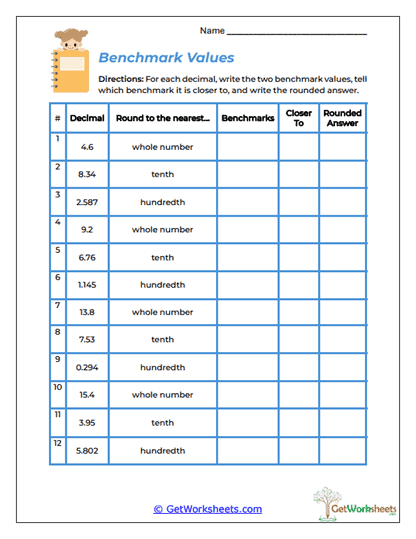
Benchmark Values
Students identify the two nearby benchmark values surrounding each decimal before deciding which one is closer. This approach helps learners see rounding as a question of distance rather than only a digit rule. They work with whole numbers, tenths, and hundredths while thinking carefully about the number's position between two choices. The activity builds strong number sense and gives students a clear explanation for why a decimal rounds in one direction instead of the other.
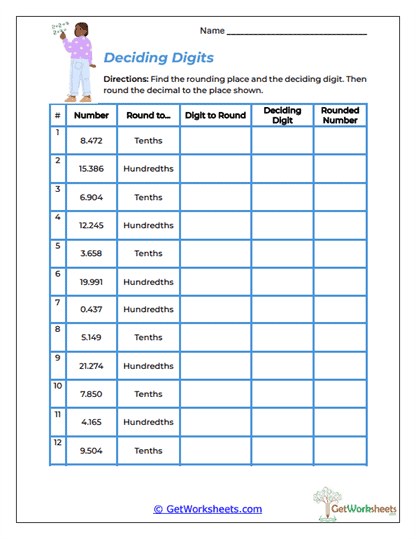
Deciding Digits
This worksheet breaks the rounding process into clear steps so students can see which digits have different jobs. Learners identify the target place, locate the digit being rounded, and then examine the digit immediately to its right. That deciding digit determines whether the target digit remains the same or increases. The structured format is especially helpful for students who know the basic rounding rule but sometimes look at the wrong place.
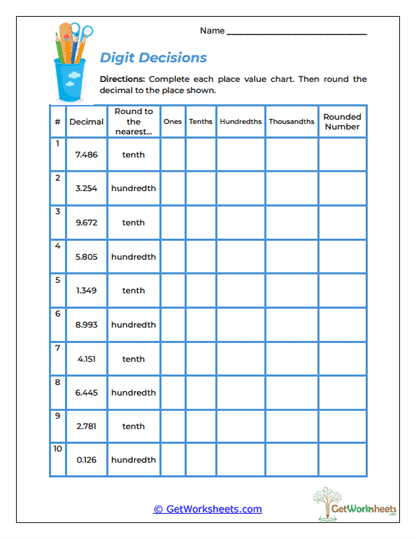
Digit Decisions
A place-value chart helps students organize decimals before making a rounding decision. Learners place digits into ones, tenths, hundredths, and thousandths columns, identify the requested place, and then inspect the digit to its right. Seeing the number separated by place reduces confusion about which digit controls the decision. This visual approach supports accurate rounding to tenths and hundredths.
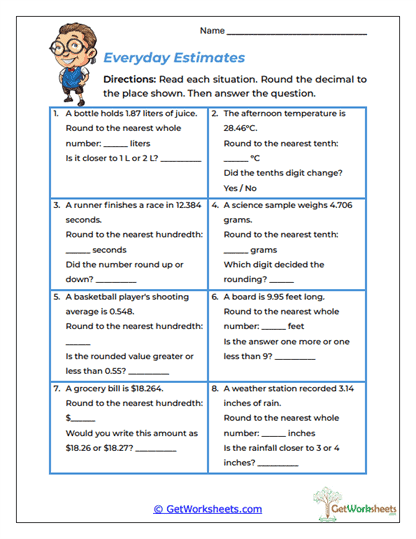
Everyday Estimates
Real-world situations show students why rounding can be useful when an exact value is more precise than necessary. Learners round quantities involving money, temperature, measurements, race times, rainfall, and other familiar contexts. They also think about which level of precision makes sense for each situation. The activity strengthens rounding skills while helping students understand that different real-world problems may require different degrees of accuracy. It makes estimation feel practical rather than abstract.
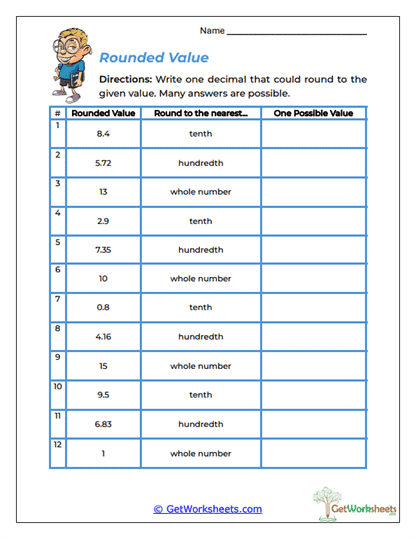
Rounded Value
Instead of starting with an exact decimal, students work backward from a rounded result. Learners determine one possible original number that could have produced the given rounded value. This requires them to think about the full interval of decimals that round to the same benchmark. The activity encourages flexible reasoning and helps students understand that many different values may share one rounded answer.
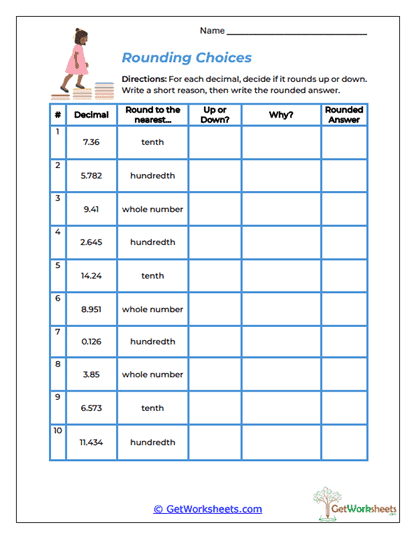
Rounding Choices
Students do more than produce a rounded number on this page. They identify whether the value rounds up or stays the same, explain which digit caused the decision, and then write the final result. Putting the reasoning into words helps reveal whether learners truly understand the process. This activity strengthens mathematical communication along with place-value accuracy and rounding fluency.
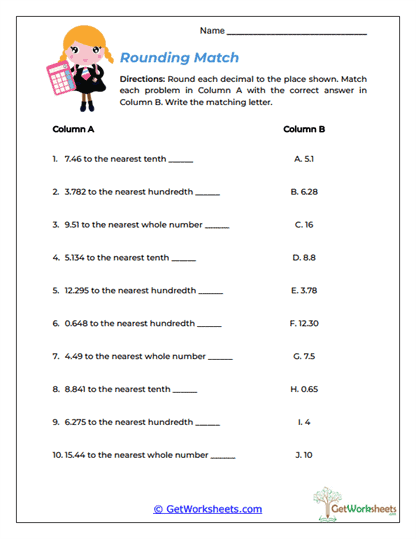
Rounding Match
A matching format gives students repeated practice rounding decimals to whole numbers, tenths, and hundredths. Learners calculate each rounded value and connect it with the appropriate answer choice. If their result is not available, they have a clear reason to return to the problem and check their work. The built-in feedback makes this page useful for independent practice, math centers, or review.
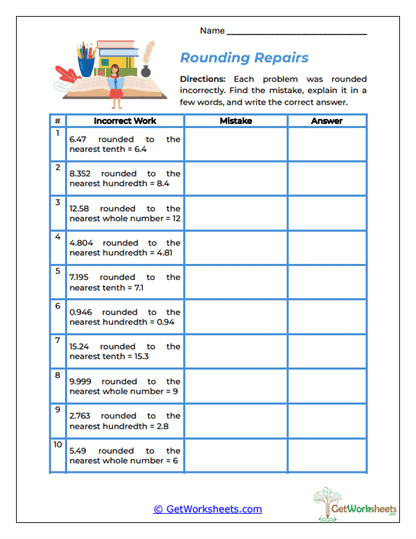
Rounding Repairs
Incorrect examples ask students to find and fix common decimal rounding mistakes. Learners determine the intended rounding place, inspect the deciding digit, explain what went wrong, and then write the correct result. Studying errors helps students notice problems such as looking at the wrong digit or rounding to the wrong place. The activity encourages stronger self-checking habits and deeper understanding of the rounding process.
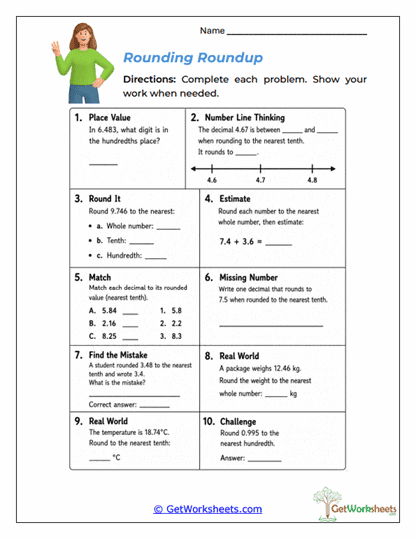
Rounding Roundup
This mixed review combines several decimal rounding skills in one final practice page. Students work with place value, number lines, benchmark values, direct rounding, estimation, matching, reverse reasoning, error correction, and real-world measurements. The variety requires learners to apply rounding ideas in different ways instead of repeating one routine. It works well as a unit review or checkpoint. Teachers and parents can also use the results to identify concepts that may need additional practice.
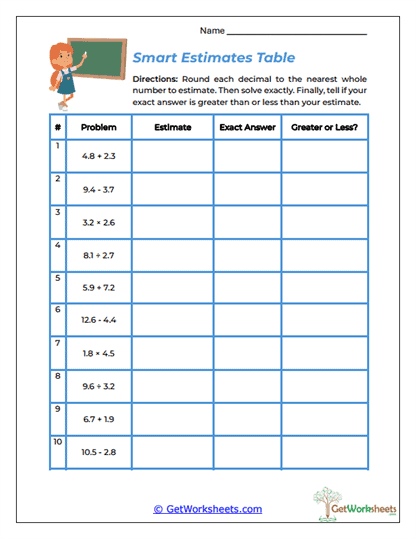
Smart Estimates Table
Students use rounding as a tool for estimating decimal calculations before finding exact answers. Learners round values to nearby whole numbers, calculate an estimate, solve the original problem, and compare the two results. This gives them a practical way to judge whether an exact answer is reasonable. The activity connects rounding with decimal operations and strengthens mental math, number sense, and self-checking.
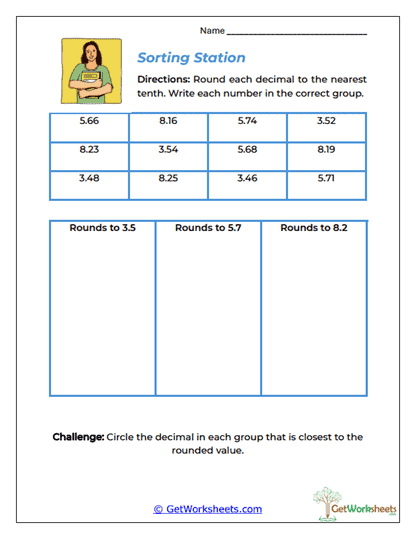
Sorting Station
Learners round several decimals to the nearest tenth and sort them into groups based on their rounded values. Seeing multiple numbers land in the same group helps students understand that one rounded result represents a range of nearby decimals. A follow-up challenge asks them to identify which value is closest to each benchmark. The sorting format strengthens comparison, distance reasoning, and understanding of rounding intervals.
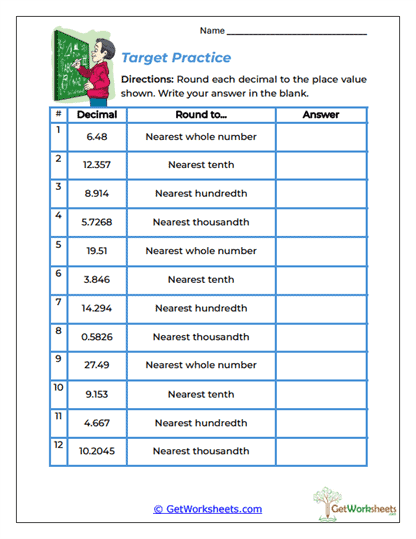
Target Practice
This worksheet gives students direct practice rounding decimals to several different target places. Problems include the nearest whole number, tenth, hundredth, and thousandth, so learners must identify the requested position before making each decision. Changing targets from one problem to the next prevents students from relying on a single routine. Repeated practice strengthens place-value awareness and helps learners apply the same rounding logic at different levels of precision.
Bookmark Us Now!
New, high-quality worksheets are added every week! Do not miss out!