Decimal Operations Worksheets
About This Worksheet Collection
Decimal operations help students work confidently with numbers that include tenths, hundredths, and other place values beyond the decimal point. Learners need to understand not only how to add, subtract, multiply, and divide decimals, but also how place value affects each calculation. Building this understanding helps students solve problems more accurately and prepares them to use decimals in money, measurement, data, and real-world situations.
This collection gives students many different ways to practice decimal operations. Activities include choosing the correct operation, modeling calculations visually, identifying errors, estimating answers, using inverse operations, working with money and measurement, interpreting data, and solving mixed-operation problems. The worksheets can be used for classroom instruction, math centers, independent practice, homework, intervention, tutoring, assessment review, or homeschool lessons.
As students complete the collection, they strengthen decimal computation, place-value awareness, operation sense, estimation, mathematical reasoning, and problem-solving skills. They also practice reading word problems carefully, checking whether answers are reasonable, interpreting units, explaining their thinking, and moving flexibly among all four operations. These skills help learners become more independent and confident when working with increasingly complex decimal problems.
Detailed Descriptions Of These Worksheets
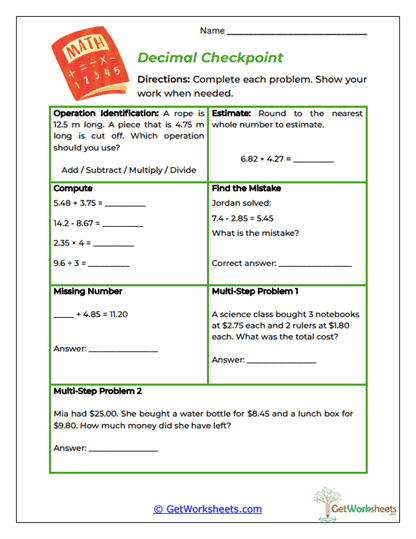
Decimal Checkpoint
This mixed review brings several important decimal skills together on one page. Learners identify operations, estimate results, compute exact answers, correct mistakes, find missing values, and work through multi-step money situations. Because the problems require different strategies, students must decide how to approach each task instead of repeating the same procedure. The worksheet works well as a final review or informal assessment before moving into more advanced decimal applications. It also gives teachers and parents a clear picture of which skills may need additional practice.
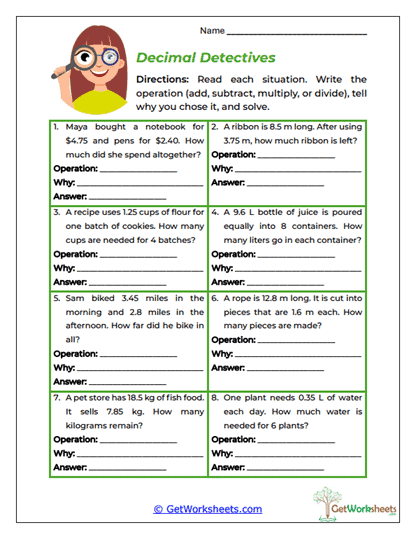
Decimal Detectives
Real-world situations challenge students to decide which decimal operation makes sense before they begin calculating. Learners read each short problem, determine whether addition, subtraction, multiplication, or division is needed, and explain their reasoning. They then complete the calculation and connect the result back to the situation. This approach strengthens both reading comprehension and mathematical decision-making while discouraging students from simply grabbing numbers and computing.
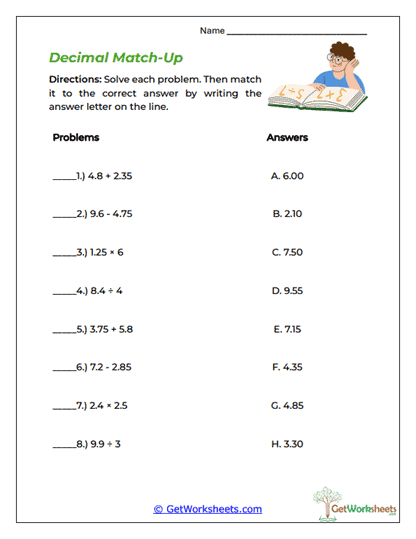
Decimal Match-Up
A matching format gives learners practice switching among decimal addition, subtraction, multiplication, and division. Students solve each equation and connect the result with the correct answer choice. If an answer does not appear, they have a built-in reason to return to the problem and check their work. The activity strengthens fluency while also encouraging careful attention to operation symbols and decimal placement. It is a useful choice for review, math centers, homework, or independent practice.
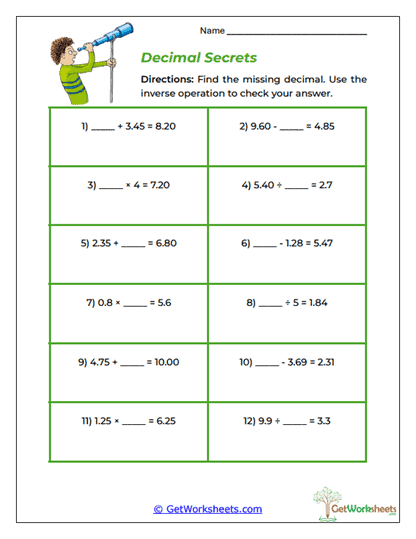
Decimal Secrets
Missing-number equations help students see how decimal operations are connected. Learners use inverse relationships to find unknown addends, factors, divisors, dividends, and other missing values. Instead of simply performing a calculation from left to right, they must think about which opposite operation will undo the equation. This provides valuable preparation for algebra while reinforcing decimal accuracy and equation sense.
Draw and Solve
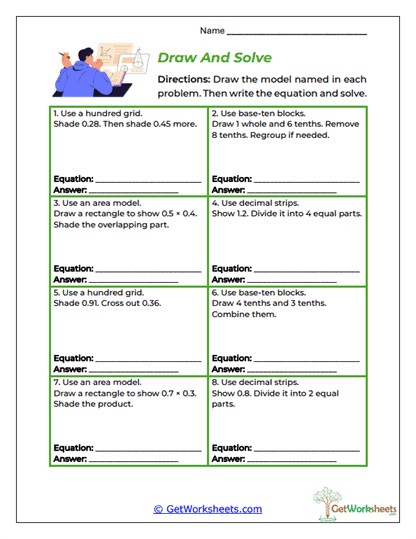
Visual models give students a concrete way to explore all four decimal operations. Learners use tools such as hundred grids, base-ten blocks, area models, and decimal strips to represent what is happening before writing and solving each equation. Different models help show why addition, subtraction, multiplication, and division work the way they do. This activity is especially helpful for students who understand procedures more clearly when they can first see the quantities represented.
Explain and Solve
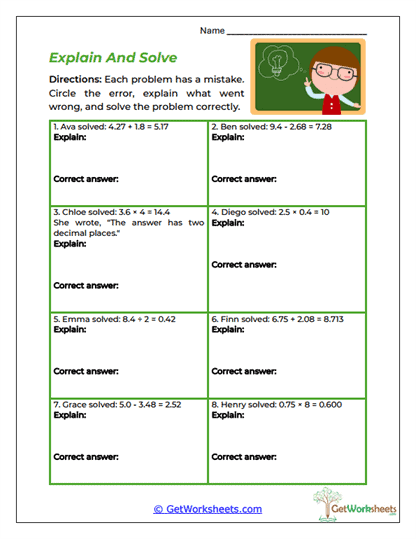
Students examine decimal calculations that contain mistakes and figure out where the reasoning went wrong. Errors may involve regrouping, decimal alignment, place value, multiplication, division, or incorrect decimal placement. After identifying the problem, learners explain it and solve the calculation correctly. Analyzing someone else's work encourages stronger self-checking habits and helps students understand the rules behind each operation. It also gives teachers a useful way to uncover misconceptions that may not appear during routine practice.
Measure and Solve
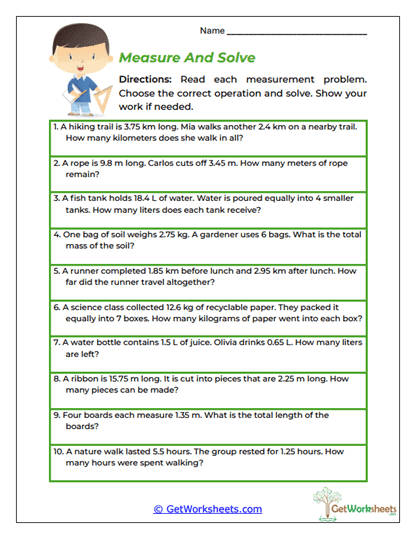
Measurement-based word problems ask learners to choose and use the correct decimal operation in practical situations. Problems may involve distance, length, volume, mass, repeated quantities, or elapsed time. Students decide whether the situation requires combining, reducing, repeating, or sharing amounts before calculating. Writing the correct unit with each answer reinforces the meaning of the result. The activity blends decimal computation with careful reading and measurement reasoning.
Multiply Mastery
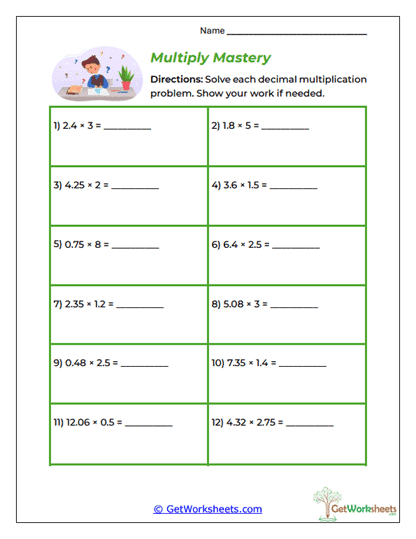
Focused multiplication practice helps learners become more comfortable finding products that involve decimals. Students work with both decimal-by-whole-number and decimal-by-decimal problems while paying close attention to place value. Estimating the likely size of each product can help them decide where the decimal point belongs. Repeated practice strengthens multiplication fluency and gives students a reliable way to check whether an answer is reasonable.
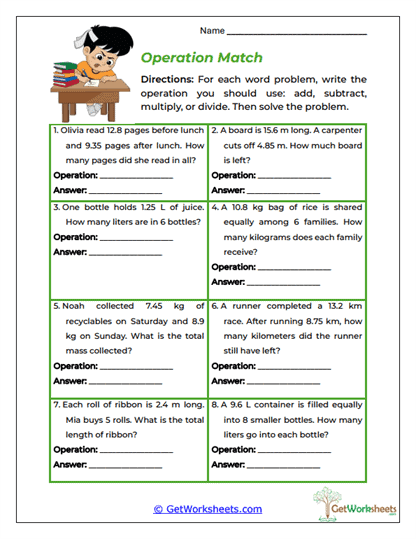
Operation Match
Each word problem asks students to determine whether addition, subtraction, multiplication, or division is the best choice. Learners identify the operation first and then solve the decimal calculation. Because the page mixes all four operations, students have to understand what the situation means instead of relying on a repeated routine. The activity strengthens operation sense, reading comprehension, and flexible problem solving. It is particularly useful for learners who can compute accurately but struggle to decide which operation a story problem requires.
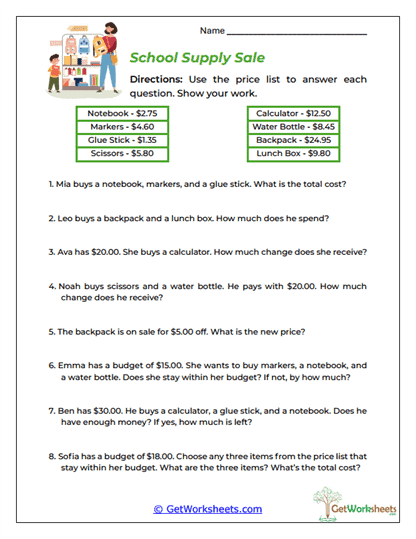
School Supply Sale
Shopping and budgeting situations make decimal practice practical and easy to connect with everyday life. Students use a price list to total purchases, find change, work within a budget, and solve sale-price questions. Some problems require a single calculation, while others ask learners to organize several steps. The activity strengthens money skills along with decimal addition, subtraction, and financial reasoning.
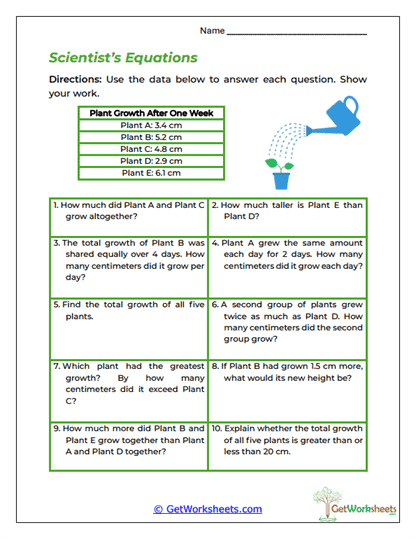
Scientist's Equations
Plant-growth data provides a science-based setting for practicing decimal operations. Learners read measurements from a table and use them to find totals, differences, averages, rates, and comparisons. Selecting the correct values is just as important as performing the calculation correctly. This encourages students to combine data interpretation with operation choice and measurement reasoning. The worksheet helps show how decimal math can be used to analyze real information rather than only complete isolated equations.
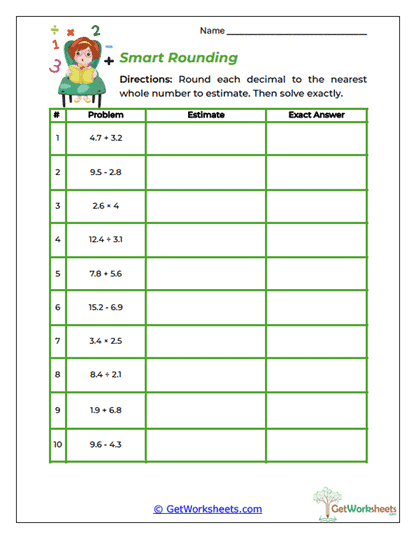
Smart Rounding
Students estimate decimal answers before solving the original problems exactly. They round values to nearby whole numbers, perform the indicated operation, and compare the estimate with the precise result. The page includes addition, subtraction, and multiplication so learners must pay attention to both the numbers and the operation. Estimation gives students a useful way to notice decimal-placement or computation mistakes before accepting an unreasonable answer. This practice strengthens mental math, number sense, and independent checking habits.
Bookmark Us Now!
New, high-quality worksheets are added every week! Do not miss out!