Dividing Decimals Worksheets
About This Worksheet Collection
Dividing decimals helps students understand how decimal quantities can be shared into equal groups or separated into equal-sized parts. Successful division depends on place-value knowledge, division facts, careful decimal placement, and a clear understanding of what the quotient represents. Building these skills helps learners move beyond memorized procedures and develop stronger number sense.
This collection develops decimal division through visual models, standard algorithms, powers-of-ten patterns, estimation, decimal-placement activities, error analysis, missing-number equations, money problems, measurement situations, data tables, matching tasks, and mixed review. Some worksheets focus on conceptual understanding, while others build procedural fluency or ask students to apply division in practical situations. The pages can be used during direct instruction, guided math, centers, intervention, tutoring, homework, assessment, review, or homeschool lessons.
As students complete the collection, they strengthen decimal place value, quotient reasoning, long division, estimation, inverse operations, unit rates, and mathematical accuracy. They also practice interpreting equal groups, checking answers with multiplication, comparing quotients, reading data, solving measurement and money problems, and explaining why decimal placement makes sense. These skills prepare learners for ratios, rates, proportions, percent, algebraic reasoning, and more advanced decimal applications.
Detailed Descriptions Of These Worksheets
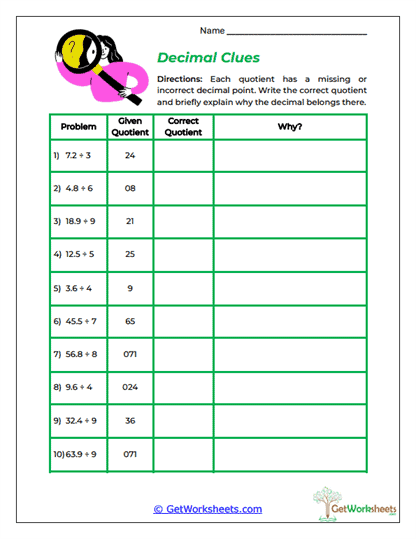
Decimal Clues
Students examine quotients that contain the correct digits but have misplaced decimal points. They use estimation and place-value reasoning to determine where the decimal belongs and then explain their correction. Multiplication can also be used to check whether the revised quotient recreates the original dividend. This activity directly targets a common source of decimal-division errors.
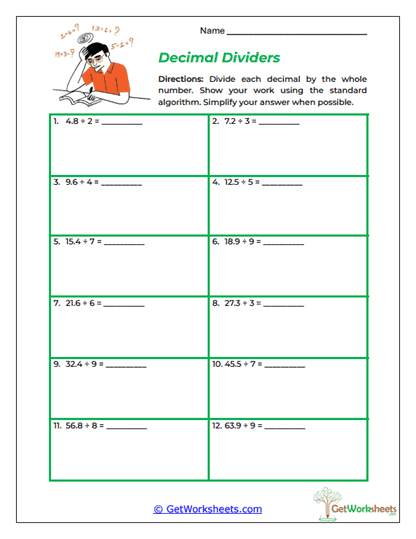
Decimal Dividers
Students divide decimal dividends by whole-number divisors using the standard long-division algorithm. They work carefully through each place value and bring the decimal point into the quotient in the correct position. Repeated practice strengthens division facts, regrouping, and procedural fluency. The open workspace also encourages learners to show each step clearly.
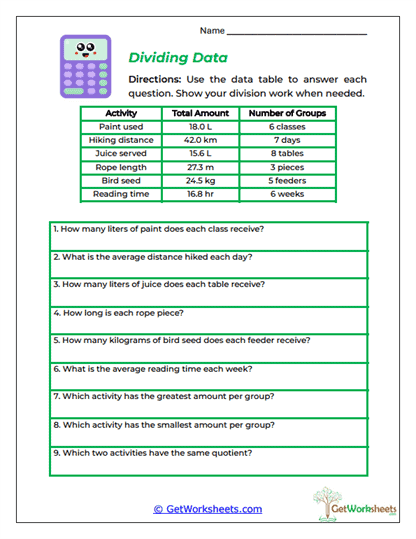
Dividing Data
A data table provides total amounts and numbers of groups for several real-world situations. Students divide to find the amount per group and then compare the resulting quotients. Some questions ask them to identify the greatest, smallest, or equal per-group values. The activity combines decimal division with table reading and early unit-rate reasoning.
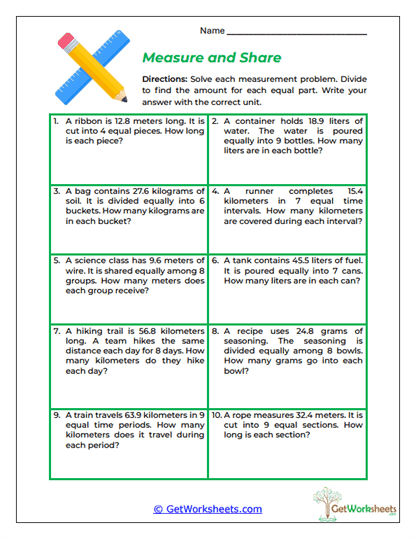
Measure and Share
Measurement situations ask students to divide lengths, masses, volumes, distances, and other quantities into equal parts. Learners calculate each quotient and label the answer with the correct unit. Estimating whether each portion should be smaller than the original amount helps reinforce reasonableness. This page connects decimal division with science, measurement, and everyday applications.
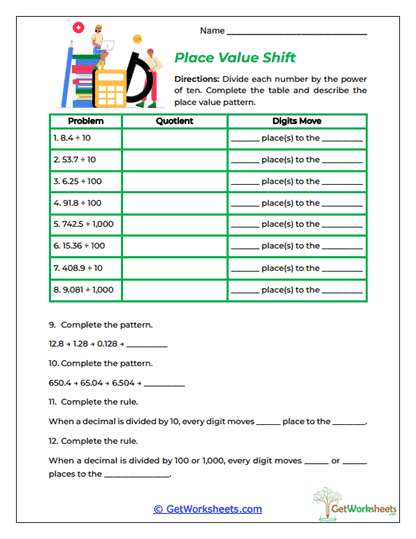
Place Value Shift
Students investigate what happens when decimals are divided by 10, 100, and 1,000. They calculate quotients, complete numerical patterns, and explain how each digit changes place value. The activity emphasizes that digits become worth one tenth, one hundredth, or one thousandth as much rather than relying only on a shortcut about moving the decimal point. This builds a stronger foundation for powers of ten and metric conversions.
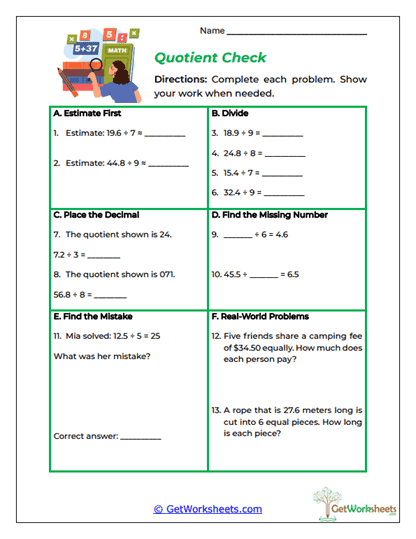
Quotient Check
This mixed review combines estimation, computation, decimal placement, missing-number reasoning, error correction, and real-world division problems. Students must decide which strategy fits each task instead of repeating one procedure throughout the page. The variety makes it useful for identifying both strengths and gaps in decimal-division understanding. It works well as a cumulative review or final checkpoint.
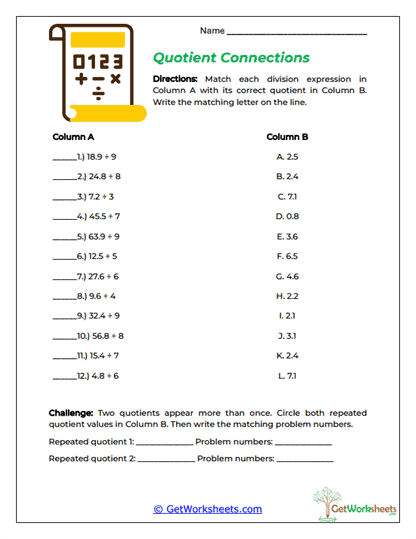
Quotient Connections
Decimal division expressions are solved and matched with their correct quotients. The answer bank provides a built-in way for students to notice when a calculation may need to be checked. Some different expressions may produce the same result, encouraging learners to look carefully at quotient relationships. The matching format gives repeated computation practice without feeling like a traditional drill.
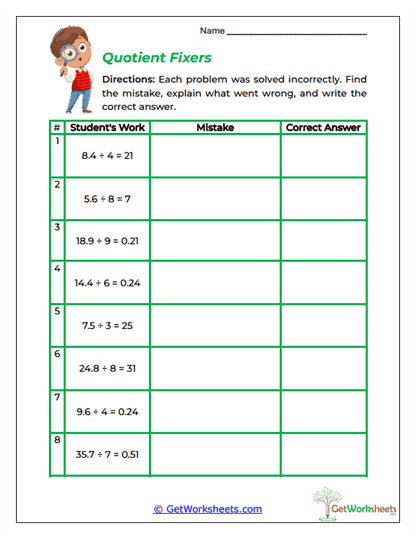
Quotient Fixers
Incorrectly solved decimal division problems become opportunities for error analysis. Students inspect the work, locate mistakes involving division facts, place value, or decimal placement, and then solve the problem correctly. They also explain why the original quotient was unreasonable or inaccurate. This practice strengthens self-checking and mathematical communication.
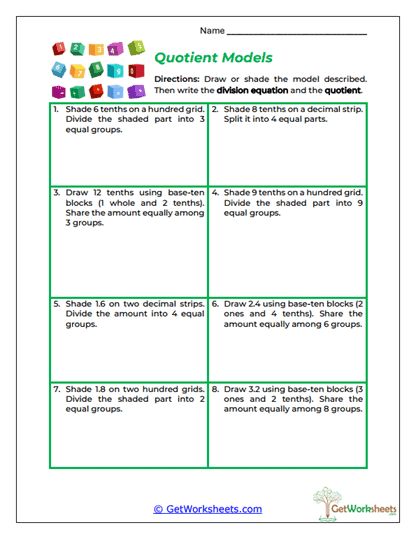
Quotient Models
Hundred grids, decimal strips, and base-ten models help students see decimal division as equal sharing. Learners represent a decimal quantity, divide it into a stated number of groups, and write the matching equation and quotient. The visual approach makes tenths and hundredths easier to understand before students rely only on an algorithm. It provides a strong conceptual foundation for later computation.
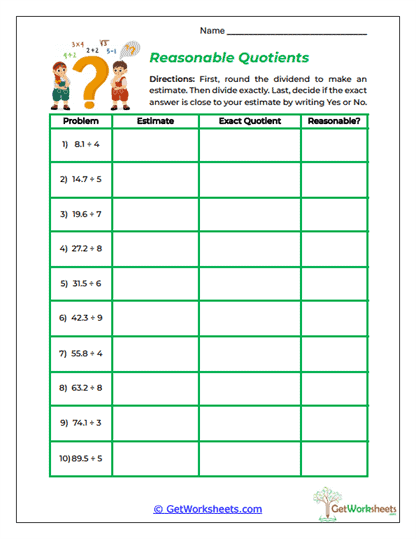
Reasonable Quotients
Students estimate each quotient before completing the exact division. They round the dividend to a friendlier value, make a mental prediction, and then compare it with the calculated answer. A large difference signals that the decimal placement or division may need to be checked. This routine builds number sense and encourages learners to judge whether an answer is believable.
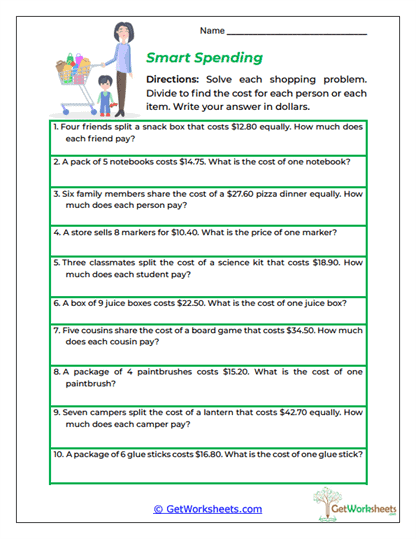
Smart Spending
Shopping and cost-sharing situations give students practical experience with decimal division. Learners divide total prices to determine cost per item or how much each person should pay. Correct dollar-and-cent notation is required in the final answer. The activity connects division with unit pricing, fair shares, budgeting, and everyday financial reasoning.
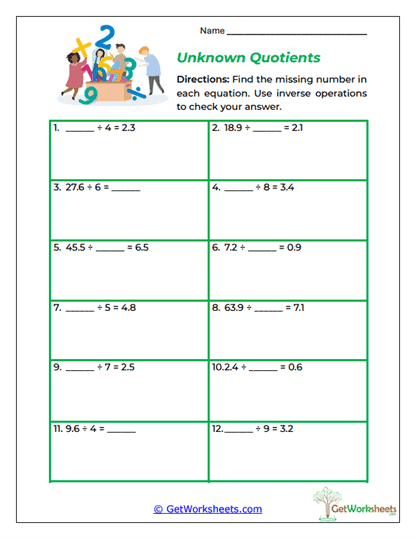
Unknown Quotients
Division equations contain a missing dividend, divisor, or quotient that students must determine. Learners use multiplication and division as inverse operations to work backward and then verify each solution. Because the unknown changes position, students cannot rely on one repeated setup. This activity strengthens equation sense and prepares learners for more advanced algebraic reasoning.
Bookmark Us Now!
New, high-quality worksheets are added every week! Do not miss out!