Mixed Operations with Decimals Worksheets
About This Worksheet Collection
Mixed operations with decimals help students move beyond practicing one computation skill at a time. Learners must recognize whether a problem requires addition, subtraction, multiplication, division, or a combination of operations, then apply the correct procedure while keeping decimal place value accurate. This kind of practice strengthens flexibility and prepares students for more advanced expressions, equations, measurement problems, money situations, and multi-step applications.
This collection gives students many ways to work with mixed decimal operations. Activities include direct computation, operation selection, order of operations, estimation, missing-number equations, error analysis, matching activities, data interpretation, money problems, measurement situations, and organized multi-step word problems. The worksheets can be used for classroom review, independent practice, homework, math centers, tutoring, intervention, enrichment, or homeschool instruction.
As students work through the collection, they strengthen decimal fluency, place-value accuracy, operation recognition, estimation, inverse-operation reasoning, and multi-step problem solving. They also practice reading carefully, organizing calculations, checking whether answers are reasonable, interpreting units, and explaining mathematical thinking. These skills help learners become more independent when a problem does not immediately tell them which strategy to use.
Detailed Descriptions Of These Worksheets
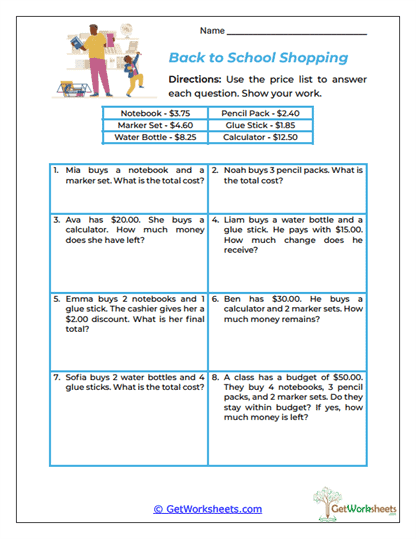
Back to School Shopping
Shopping and budgeting situations give learners a practical reason to use several decimal operations together. Students total prices, multiply repeated costs, calculate change, and decide whether purchases fit within a budget. Some problems require more than one step, so learners must plan the order of their calculations carefully. The activity strengthens money sense while showing why accurate decimal computation matters in everyday decisions.
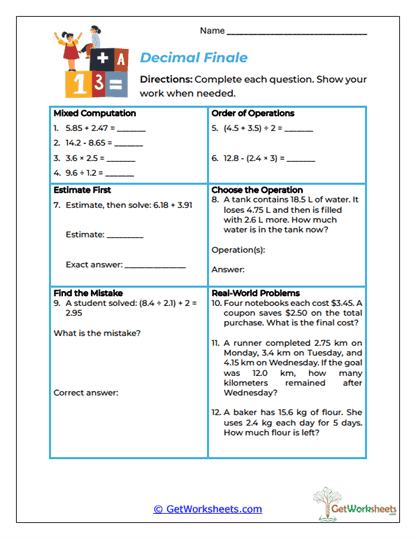
Decimal Finale
This comprehensive review combines many of the major skills involved in mixed decimal work. Learners solve direct calculations, follow order of operations, estimate results, select appropriate operations, analyze errors, and complete practical money and measurement problems. Because the format changes from section to section, students must decide which strategy is appropriate instead of relying on one repeated procedure. The worksheet works well as a unit review, assessment, or final checkpoint. It can also help teachers and parents identify areas that may need additional instruction.
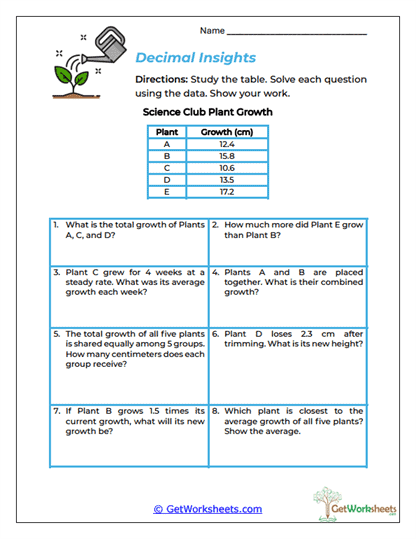
Decimal Insights
A plant-growth data table gives students a meaningful setting for using decimal operations. Learners locate the correct measurements, calculate totals and differences, find averages, multiply values, and compare results. They must understand both the data and the mathematical question before deciding how to calculate. This combination strengthens decimal fluency along with table reading and data interpretation. It also helps students see how computation can be used to draw conclusions from real information.
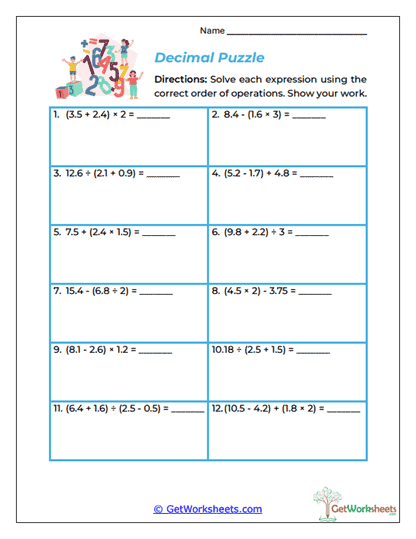
Decimal Puzzle
Multi-step decimal expressions challenge students to follow the correct order of operations. Learners work through parentheses, multiplication or division, and addition or subtraction while recording intermediate steps. Careful organization helps prevent errors that can occur when students simply solve from left to right. The activity builds procedural accuracy and provides useful preparation for more advanced algebraic expressions.
Hidden Decimal
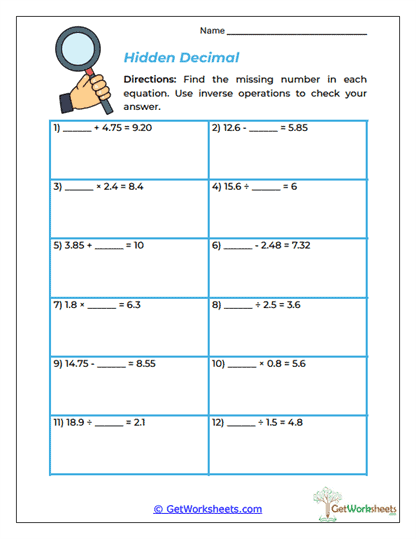
Missing-number equations encourage students to think about how the four decimal operations are related. Learners use inverse operations to find unknown addends, factors, divisors, dividends, and other missing values. Checking each solution in the original equation gives students an additional way to confirm their reasoning. This work strengthens equation sense and provides an early bridge from arithmetic to algebra. It also encourages students to think backward instead of always calculating in the usual direction.
Measurement Problems
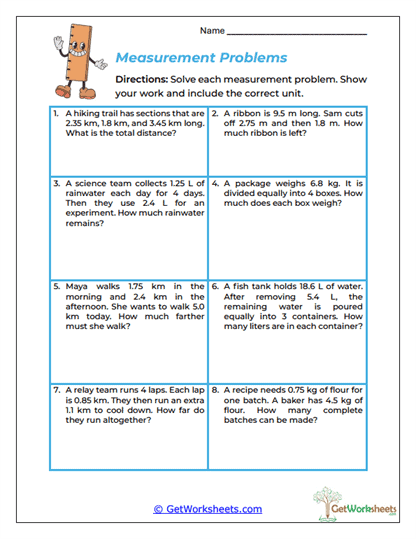
Realistic measurement situations require students to choose among addition, subtraction, multiplication, and division with decimals. Problems may involve distances, lengths, liquid volumes, masses, repeated measurements, or equal groups. Learners must determine what is happening to each quantity before they calculate and then include the appropriate unit in the answer. Some questions involve more than one operation, adding valuable multi-step practice. The activity connects decimal computation with science and everyday measurement.
Mistake Hunter
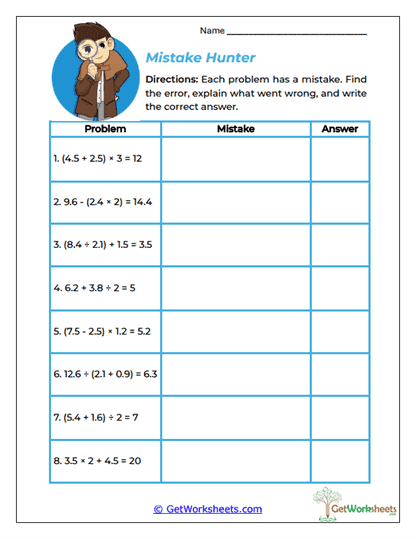
Incorrect multi-step decimal solutions give learners the chance to study where mathematical reasoning went off track. Students identify the first error, explain whether it involves computation, decimal placement, or order of operations, and then solve the expression correctly. Analyzing mistakes requires a deeper understanding than simply completing another problem from scratch. The activity also encourages students to inspect their own work more carefully.
Operation Mix
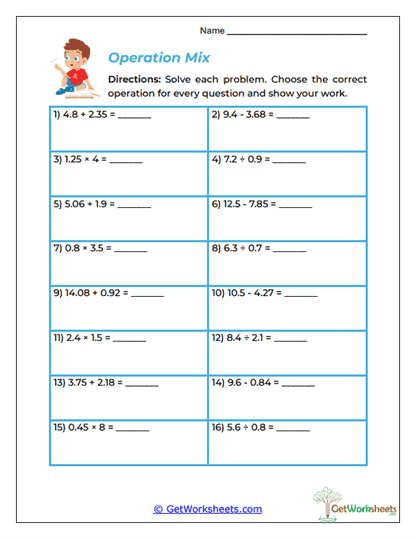
This page gives students straightforward practice switching among the four decimal operations. Each problem requires learners to notice the operation symbol, recall the appropriate procedure, and keep decimal place value organized. Changing operations from one question to the next helps prevent students from falling into an automatic routine. The repeated practice builds flexibility, accuracy, and confidence with mixed computation.
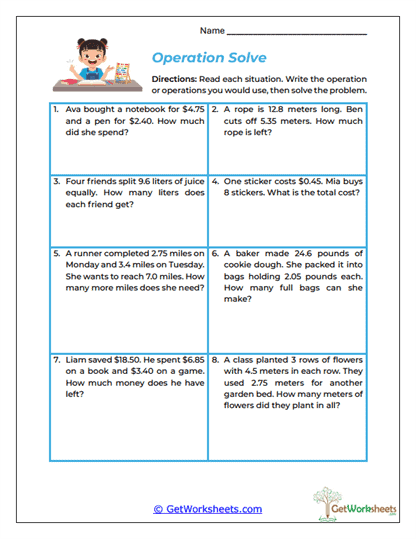
Operation Solve
Real-world word problems ask students to determine which decimal operation makes sense before beginning the calculation. Learners decide whether quantities are being combined, reduced, repeated, or shared equally and then solve using the appropriate method. Familiar situations involving money, measurement, food, and other everyday contexts make the mathematical action easier to picture. The activity strengthens both reading comprehension and operation sense. It is especially useful for students who calculate accurately once they know which operation to use.
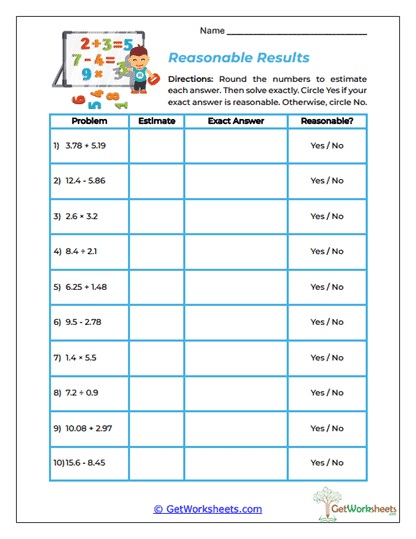
Reasonable Results
Estimation gives students a valuable way to check mixed decimal calculations. Learners round the numbers, predict an approximate result, solve the original problem exactly, and decide whether the answer is sensible. Working with all four operations requires them to think about both the computation and the likely size of the result. This habit can help students catch misplaced decimal points and other large errors before moving on.
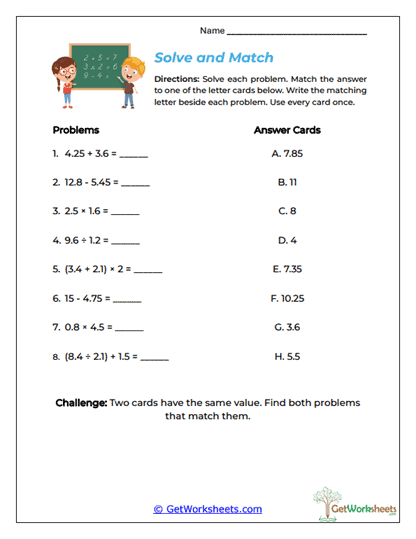
Solve and Match
A matching format turns mixed decimal computation into a self-checking activity. Students solve addition, subtraction, multiplication, division, and multi-step expressions before connecting each result with the correct answer card. If a result is missing from the choices, learners have a clear reason to revisit the calculation. The activity encourages careful operation recognition and reinforces order-of-operations skills. It works well for review, math centers, homework, or independent practice.
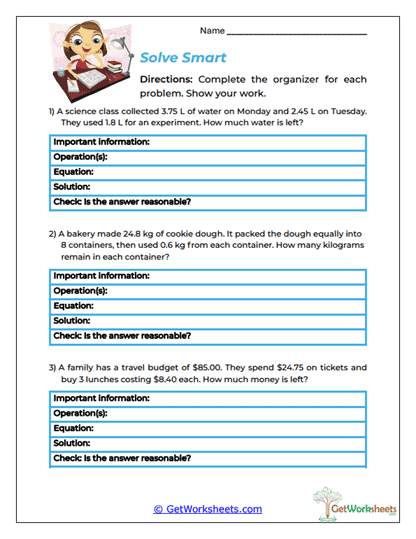
Solve Smart
A consistent organizer helps students slow down and make sense of multi-step decimal word problems before calculating. Learners identify important information, choose the operation or operations, write an equation, solve, and then check whether the result is reasonable. Breaking the process into stages makes it easier to see whether a difficulty comes from reading, strategy choice, or computation. This structure gives students a repeatable problem-solving routine they can use with increasingly challenging tasks. It also strengthens mathematical communication by asking learners to show how the story connects to the equation.
Bookmark Us Now!
New, high-quality worksheets are added every week! Do not miss out!