Comparing and Ordering Decimals Worksheets
About This Worksheet Collection
Comparing and ordering decimals helps students understand the size and value of numbers written with tenths, hundredths, and thousandths. Learners compare digits from left to right, recognize when trailing zeros do not change a value, and use symbols such as <, >, and = to describe relationships accurately. Building this place-value understanding helps students move beyond guessing and develop a reliable method for deciding which decimal is greater, smaller, or equal.
This collection develops decimal comparison and ordering through place-value analysis, symbol practice, equivalent-decimal matching, visual models, number lines, money, measurements, race times, data tables, error correction, and mixed review. Some worksheets focus on comparing two values, while others ask students to order several decimals, explain their reasoning, or apply the skill in practical situations. The pages can be used during direct instruction, guided math, centers, intervention, tutoring, homework, assessment, review, or homeschool lessons.
As students complete the collection, they strengthen place-value fluency, decimal magnitude, equivalent-decimal understanding, comparison-symbol accuracy, ordering, estimation, and mathematical reasoning. They also practice interpreting models, reading tables, comparing measurements and prices, identifying errors, and explaining which place value determines a result. These skills support later work with rounding, decimal operations, measurement, data analysis, fractions, and other rational numbers.
Detailed Descriptions Of These Worksheets
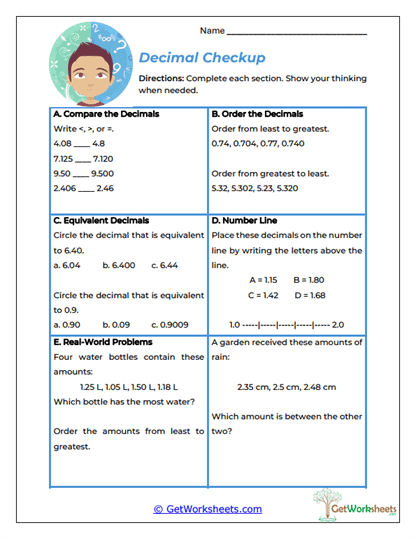
Decimal Checkup
This mixed review brings several comparison and ordering skills together in one activity. Students compare pairs, order groups, recognize equivalent decimals, place numbers on a number line, and solve measurement-based problems. Moving among several formats helps reveal whether learners understand decimal magnitude beyond one repeated procedure. The page works well as a final review, assessment, or checkpoint before more advanced decimal work.
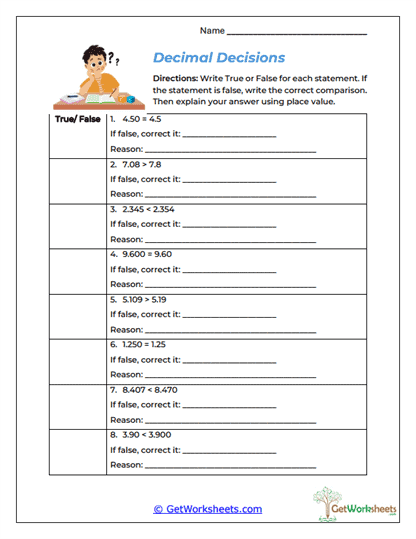
Decimal Decisions
Students decide whether completed decimal comparisons are true or false and explain their reasoning. False statements must be corrected using accurate comparison symbols and place-value evidence. The activity includes close values and decimals with trailing zeros, so learners must examine each digit carefully. Written explanations help show whether students understand why a comparison is correct rather than simply guessing.
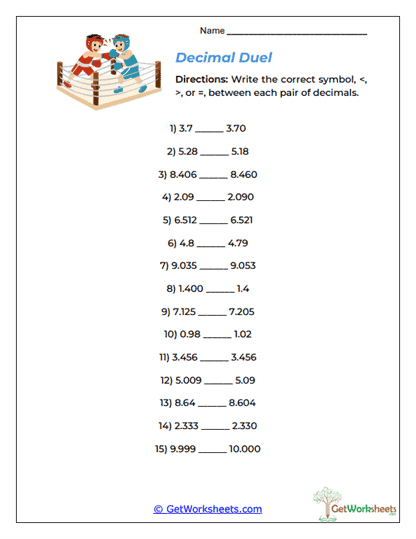
Decimal Duel
Pairs of decimals are compared using less than, greater than, or equal symbols. Students work with values containing different numbers of decimal places and must recognize that extra trailing zeros do not increase a number. Repeated practice helps build speed while reinforcing careful place-value thinking. This page is useful for independent review, warm-ups, homework, or fluency practice.
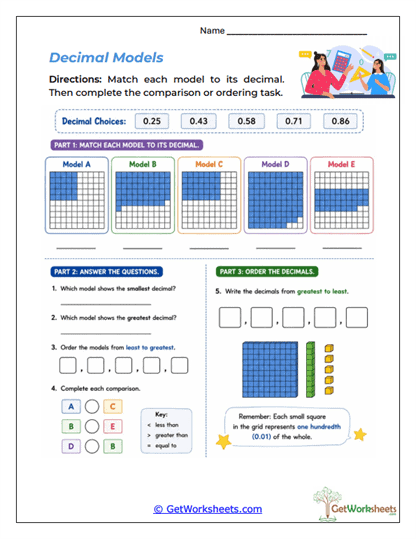
Decimal Models
Shaded hundred grids and base-ten style models give students a visual way to compare decimal values. Learners match each model with its decimal, identify the smallest and greatest amounts, and place the values in order. Seeing the shaded portions makes differences in hundredths easier to understand. The activity provides a strong bridge from concrete representations to abstract decimal notation.
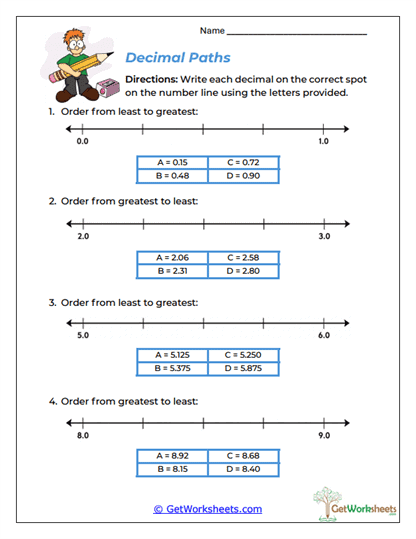
Decimal Paths
Students place decimal values on number lines and use their positions to arrange the numbers in order. The visual spacing helps learners judge which values are closer to neighboring whole numbers and how close decimals compare with one another. This develops a stronger sense of magnitude than digit comparison alone. The page also supports later work with rounding and estimation.
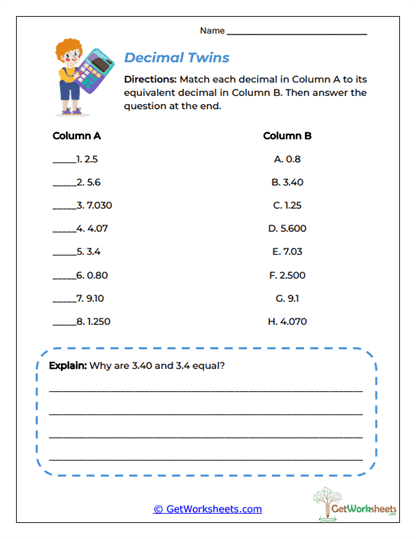
Decimal Twins
Equivalent decimals are matched even when they are written with different numbers of digits. Students connect values such as 2.5, 2.50, and 2.500 and explain why the added zeros do not change the amount. This directly addresses the misconception that more digits automatically mean a larger number. Understanding decimal equivalence makes future comparison and ordering tasks much easier.
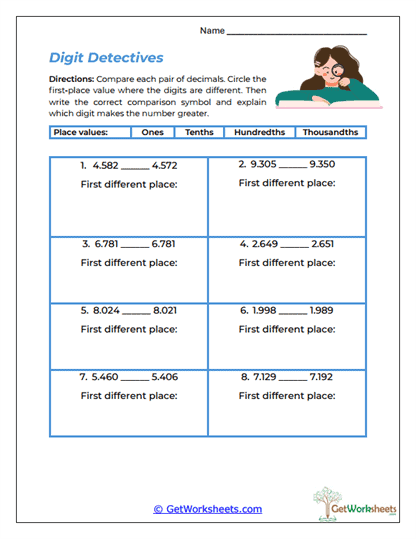
Digit Detectives
Students compare decimals from left to right and circle the first place where the digits differ. They then choose the correct comparison symbol and explain which digit determines the relationship. This method helps learners understand exactly why one decimal is larger instead of relying on appearance. The activity strengthens place-value vocabulary and mathematical explanation.
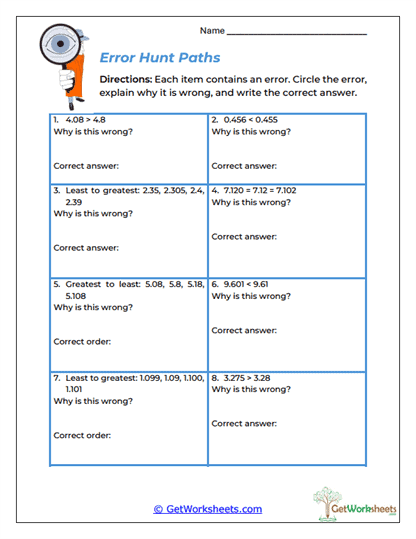
Error Hunt Paths
Incorrect comparisons and ordered lists must be examined and repaired. Students locate the place-value mistake, correct the symbol or sequence, and explain what went wrong. Errors involving trailing zeros and closely spaced values give learners practice with common misconceptions. This format encourages stronger self-checking and careful reasoning.
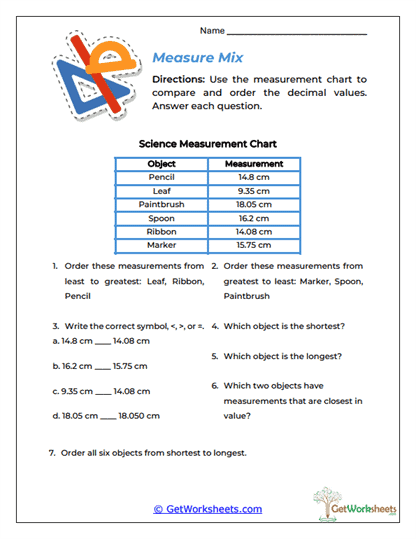
Measure Mix
A science-style measurement chart gives students decimal values to compare and order. Learners identify the shortest and longest objects, compare pairs, locate the closest measurements, and arrange the complete data set. The task requires careful attention to tenths and hundredths because some values are very close. This page combines decimal reasoning with measurement and data interpretation.
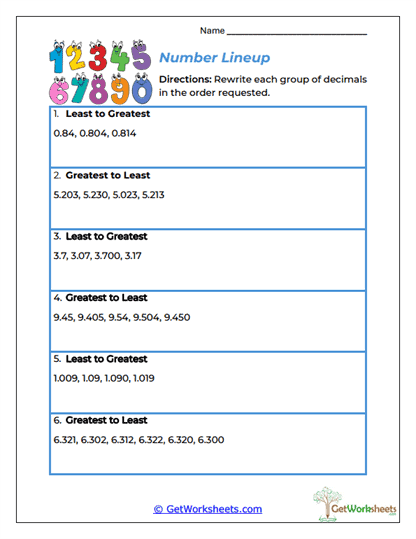
Number Lineup
Groups of decimals are arranged from least to greatest or greatest to least. Students compare several values at once, including numbers that may differ only in the hundredths or thousandths place. Adding placeholder zeros can help them line up the place values before ordering. This activity builds precision and extends pairwise comparison into full sequencing.
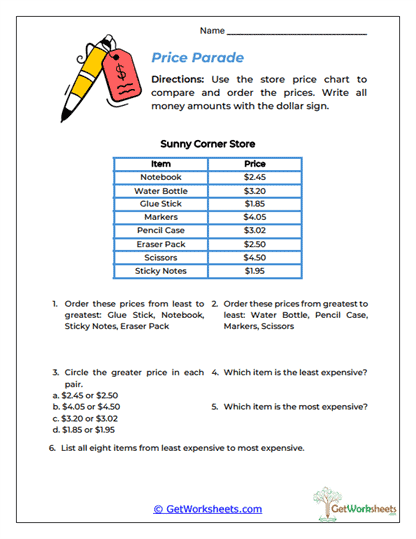
Price Parade
A store price chart gives learners practical experience comparing and ordering money amounts. Students identify the cheapest and most expensive items, compare individual prices, and arrange groups of costs in order. The familiar dollar-and-cent format makes decimal place value especially meaningful. This activity also supports basic financial awareness and shopping skills.
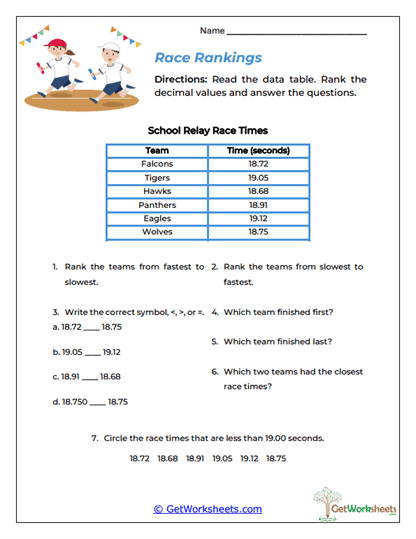
Race Rankings
Decimal race times are ranked from fastest to slowest and in reverse order. Students must remember that a smaller time represents a faster performance, so the real-world meaning matters as much as the numerical comparison. Close times encourage careful work with hundredths. The activity combines table reading, decimal ordering, context awareness, and logical reasoning.
Bookmark Us Now!
New, high-quality worksheets are added every week! Do not miss out!