Place Value of Decimals Worksheets
-
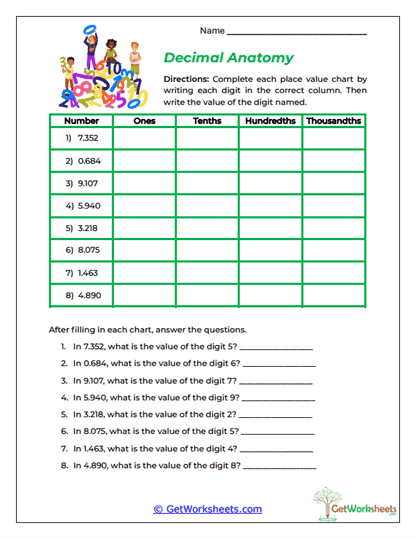
Decimal Anatomy
-
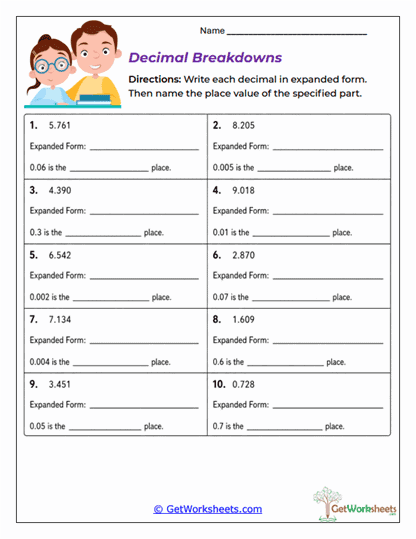
Decimal Breakdowns
-
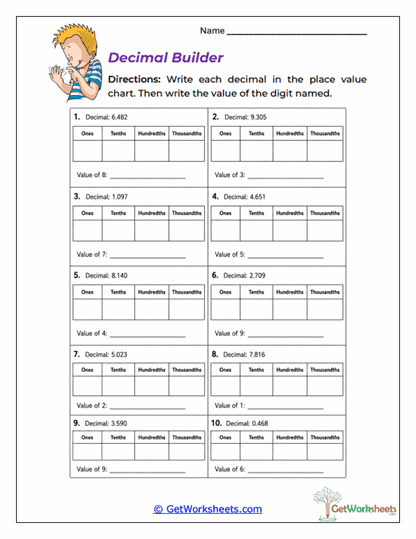
Decimal Builder
-
-
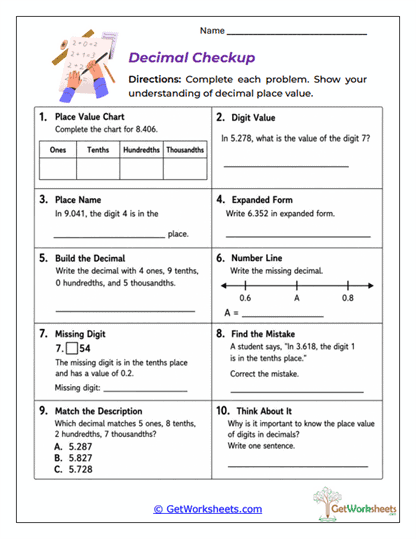
Decimal Checkup
-
Decimal Designer
-
Decimal Form Quiz
-
Decimal Links
-
Decimal Makers
-
Decimal Match
-
Decimal Model Quest
-
Decimal Place Values
-
Decimal Quiz
-
Decimal Search
-
Decimal Secrets
-
Decimal Tracks
-
Decimal Trio
-
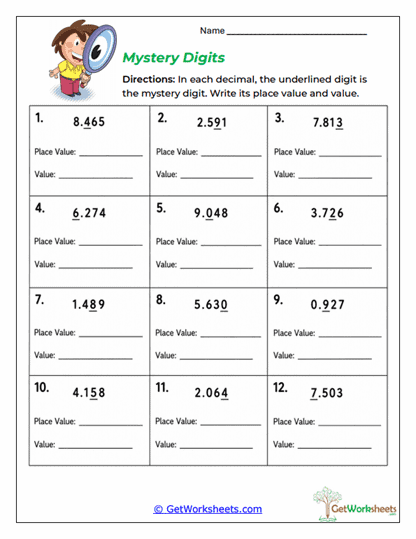
Mystery Digits
-
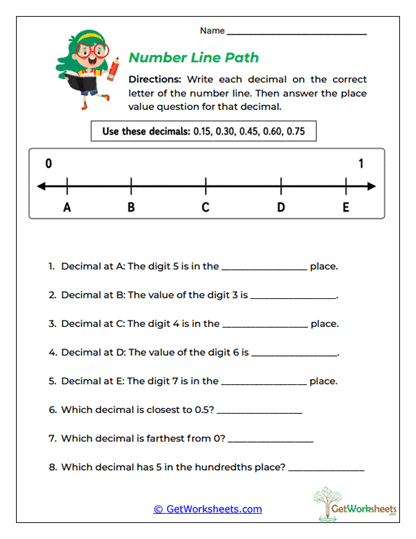
Number Line Path
-
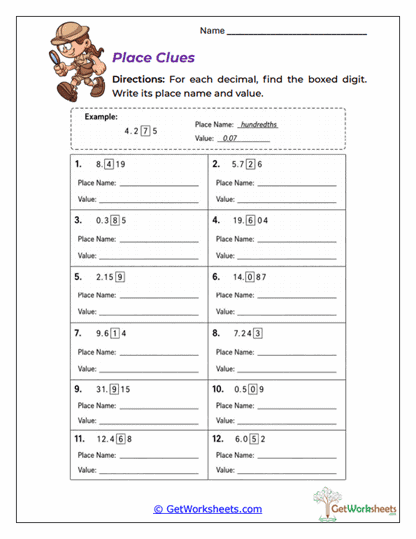
Place Clues
-
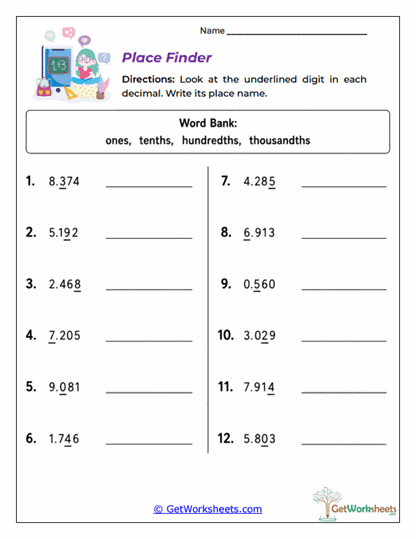
Place Finder
-
Place Value Corrections
-
Place Value Mistake
-
The Missing Digit
-
Two-Form Mastery
About This Worksheet Collection
Decimal place value helps students understand what each digit in a decimal number actually represents. Digits to the right of the decimal point have specific positions such as tenths, hundredths, and thousandths, while digits to the left represent whole-number places. Learning to distinguish a digit's place from its value gives students a stronger foundation for reading, writing, comparing, rounding, and calculating with decimals.
This collection gives learners many ways to explore decimal place value through charts, matching activities, models, number lines, expanded form, word form, missing-digit puzzles, real-world examples, and error analysis. Some worksheets focus on identifying a single digit, while others ask students to build complete decimals, connect several representations, or reason from clues. These pages work well for classroom lessons, math centers, homework, tutoring, intervention, independent practice, or homeschool instruction.
As students complete the collection, they strengthen place-value vocabulary, digit-value reasoning, decimal construction, number representation, and magnitude understanding. They also practice using placeholder zeros, interpreting decimals in context, moving among standard, word, and expanded forms, and checking incorrect reasoning. Together, these activities help learners understand not just where decimal digits appear, but why their positions matter.
Detailed Descriptions Of These Worksheets
Decimal Anatomy
Place-value charts help students separate decimals into ones, tenths, hundredths, and thousandths. Learners place each digit in the correct column and then answer questions about what selected digits are worth. The organized format makes decimal structure easier to see and understand. This activity builds a useful foundation for expanded form, comparison, rounding, and later decimal operations.
Decimal Breakdowns
Students break decimals into expanded form and then identify the place connected with selected values such as 0.06 or 0.005. This combination helps learners connect a digit's position with the actual amount it contributes to the number. Working through both tasks encourages a deeper understanding than simply naming columns on a chart. The page is especially helpful for reinforcing tenths, hundredths, and thousandths.
Decimal Builder
A place-value chart gives learners a clear way to organize digits in decimal numbers. Students place each digit into its correct column and then determine the value of a selected digit. Zeros receive special attention because they may hold an important position even when they add no quantity. The visual format supports students who need extra help seeing how decimal numbers are structured.
Decimal Checkup
This mixed review brings many important decimal place-value skills together on one page. Learners work with charts, digit values, place names, expanded form, number lines, missing digits, matching, and error correction. Because the tasks change throughout the worksheet, students must apply their understanding in several different ways. It works well as a final review or informal assessment. Teachers and parents can also use the results to identify skills that may need additional practice.
Decimal Designer
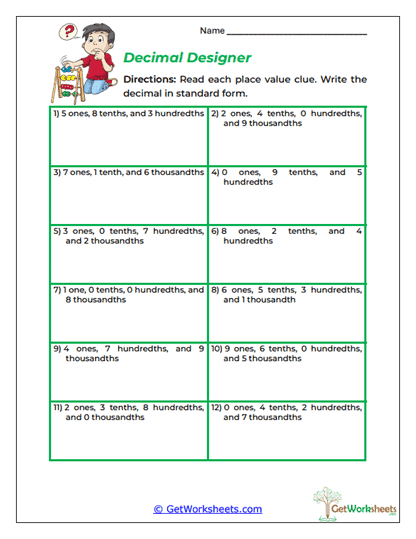
Written clues challenge students to build decimal numbers one place at a time. Learners interpret information about ones, tenths, hundredths, and thousandths before writing the number in standard form. Placeholder zeros become important whenever a place has no stated value. This activity helps reveal whether students truly understand decimal construction rather than simply recognizing numbers that are already written.
Decimal Form Quiz
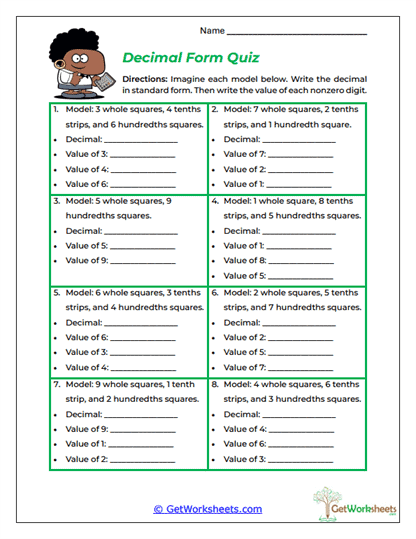
Visual place-value models are translated into standard decimal notation on this practice page. Students interpret wholes, tenths, and hundredths, write the matching decimal, and then identify what selected digits are worth. Moving from a model to symbols helps make abstract place-value ideas more concrete. The worksheet strengthens both visual number sense and decimal vocabulary.
Decimal Links
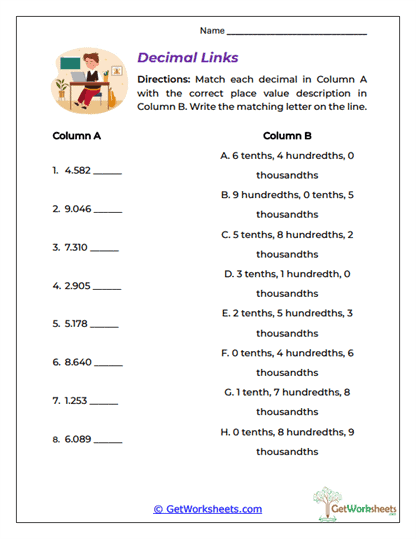
Learners match decimal numbers with written descriptions of their tenths, hundredths, and thousandths digits. Careful attention is needed because similar-looking decimals may represent very different place-value arrangements. Zeros also play an important role when a position is empty. The matching format offers a helpful way for students to check whether they are reading every decimal place accurately.
Decimal Makers
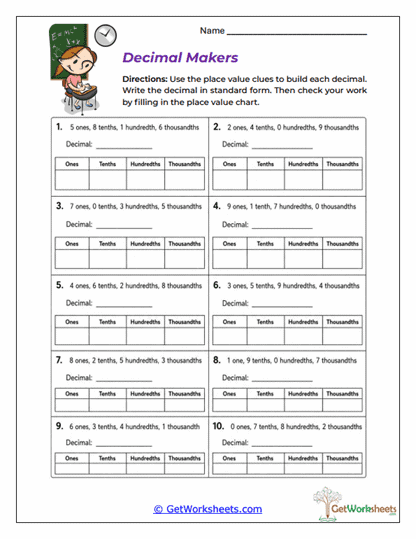
Students construct decimals from written place-value information and then verify their work with a chart. Each problem asks learners to organize ones, tenths, hundredths, and thousandths in the proper positions. Using the chart as a second representation gives students a built-in way to check their answer. This activity reinforces number composition and the importance of placeholder zeros. It is especially useful for learners who benefit from building numbers step by step.
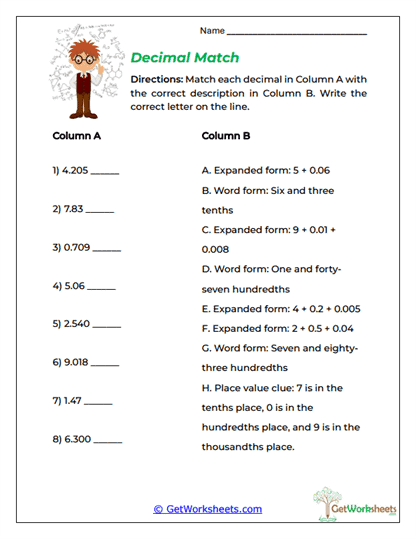
Decimal Match
Several forms of decimal representation appear together in this matching activity. Students connect standard decimals with expanded forms, word forms, or written place-value clues that describe the same value. The variety keeps learners from relying on one repeated strategy. Careful comparison strengthens flexible understanding of how the same decimal can be represented in different ways.
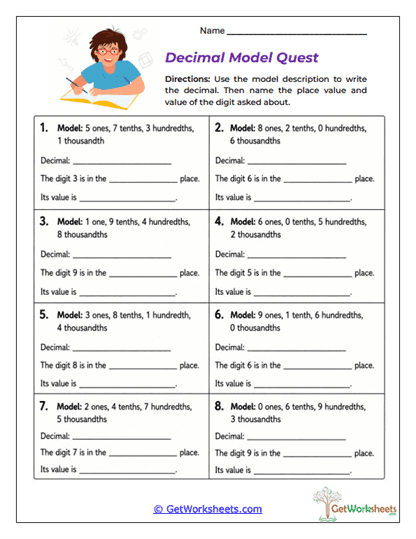
Decimal Model Quest
Place-value descriptions are used to build complete decimal numbers in this activity. After writing each number, students identify the position and value of selected digits. This gives learners practice combining several place-value skills within the same problem. Placeholder zeros can also appear, encouraging careful number construction. The worksheet provides a useful bridge between charts, models, and symbolic decimal notation.
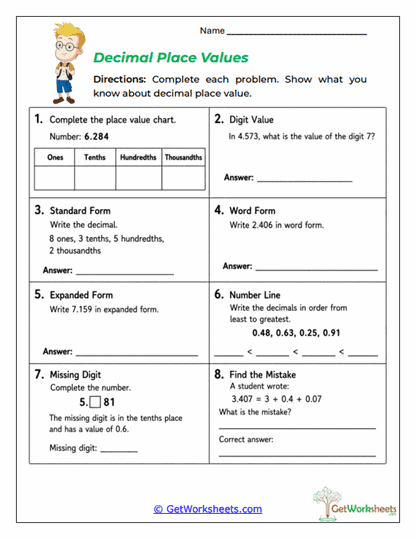
Decimal Place Values
This review page combines several core place-value tasks in one activity. Students work with charts, standard form, expanded form, word form, number lines, missing digits, and error analysis. Moving among these formats requires learners to apply the same underlying place-value concepts in different ways. The worksheet works well for review, assessment preparation, or identifying areas that still need reinforcement.
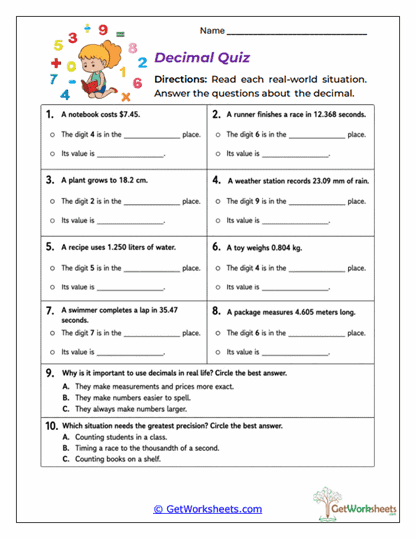
Decimal Quiz
Real-world decimal values give students a chance to apply place-value knowledge to money, measurements, recipes, race times, rainfall, and other familiar situations. Learners identify the place and value of selected digits and consider why some situations require greater decimal precision than others. The context helps make tenths, hundredths, and thousandths feel more meaningful. This page also encourages students to think about why decimal accuracy matters outside the classroom.
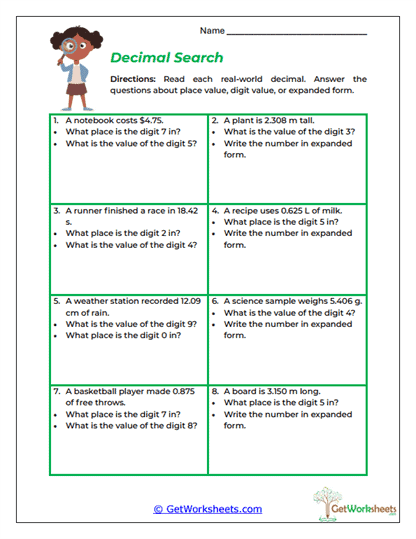
Decimal Search
Students investigate decimals found in practical situations such as prices, measurements, recipes, weights, and scientific data. They identify the place and actual value of selected digits before writing some numbers in expanded form. Using familiar contexts helps students connect place value with quantities they may encounter in everyday life. The activity strengthens both decimal vocabulary and practical number sense.
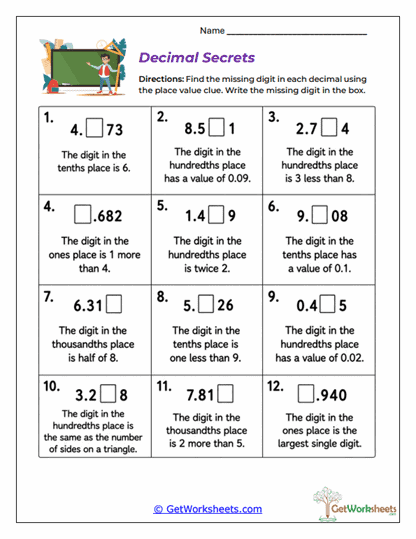
Decimal Secrets
Missing-digit puzzles ask learners to use place-value clues to complete decimal numbers. Some clues describe a digit's exact value, while others involve relationships such as one more, one less, or the same as another digit. Students must consider both position and value before choosing an answer. The puzzle-like format adds logical reasoning to regular place-value practice. It is a strong choice for students who are ready for a little more challenge.
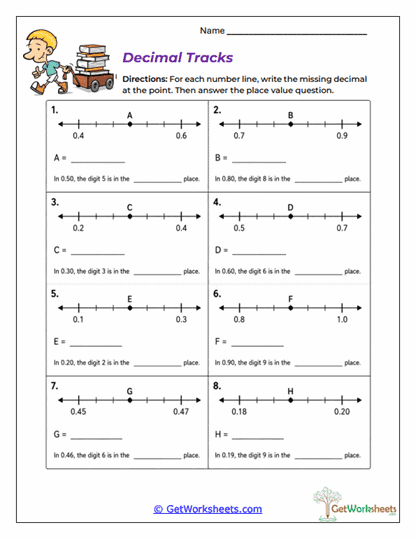
Decimal Tracks
Number lines help students see decimal values as positions rather than simply strings of digits. Learners determine the value of marked points and then answer related questions about decimal places. Reading the intervals carefully reinforces tenths and hundredths while also building magnitude awareness. This activity connects place-value understanding with comparison and ordering skills.
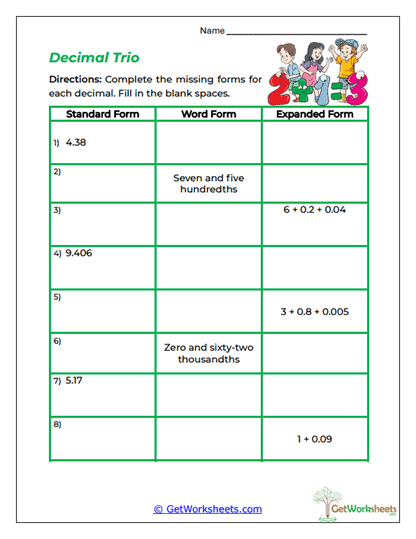
Decimal Trio
Standard form, word form, and expanded form come together in a three-part representation activity. Students fill in missing forms so that each row describes the same decimal value in three different ways. Switching between representations strengthens both place-value understanding and mathematical vocabulary. The activity helps learners become less dependent on seeing decimals in only one format.
Mystery Digits
An underlined digit becomes the focus of each problem on this worksheet. Students name the digit's place and then write the amount it actually represents. This helps clarify the important difference between answers such as "hundredths" and "0.06." Repeated practice builds precision and prepares students for more advanced work with expanded form, rounding, and comparison.
Number Line Path
Students plot decimal values between zero and one and then answer questions about selected digits. The number line gives learners a visual way to connect place value with the actual size of a decimal. Benchmark values such as one-half help students reason about position and distance. This activity is especially helpful for children who can name decimal places but still need a stronger sense of magnitude.
Place Clues
Boxed digits give students focused practice identifying both decimal place names and digit values. Learners determine whether each digit is in the ones, tenths, hundredths, or thousandths place and then state what it is worth. Treating place and value as two separate questions helps prevent a common source of confusion. The simple format works well for review, intervention, or independent practice.
Place Finder
This worksheet concentrates on one foundational skill: naming the place of an underlined decimal digit. Learners use a word bank containing ones, tenths, hundredths, and thousandths to identify each position. Repeated practice helps the sequence of decimal places become more familiar. It is a useful starting point before students are asked to determine the actual value of each digit.
Place Value Corrections
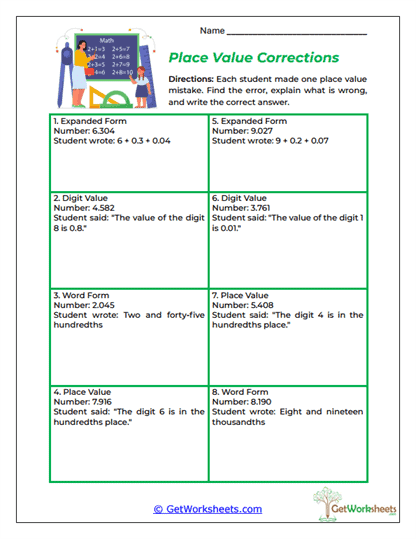
Incorrect decimal statements give students an opportunity to investigate common place-value mistakes. Learners identify what is wrong, explain the misconception, and write the correct answer. Errors may involve expanded form, digit value, word form, or place names. Studying mistakes helps students become more careful when checking their own work. It can also show teachers exactly which concepts need reteaching.
Place Value Mistake
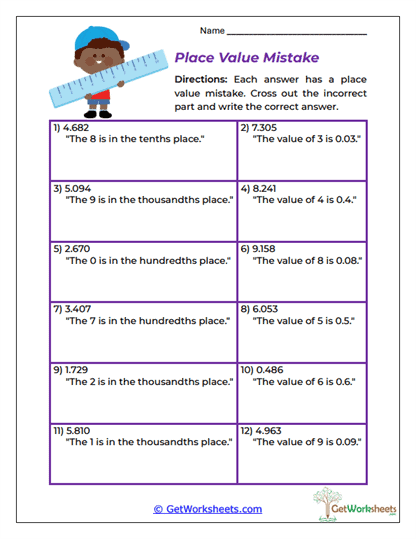
Students examine statements containing incorrect decimal place names or digit values and replace them with accurate information. Each correction requires learners to pay close attention to how far a digit appears from the decimal point. The activity is particularly useful for distinguishing between position and value. It also promotes stronger self-checking habits and mathematical precision.
The Missing Digit
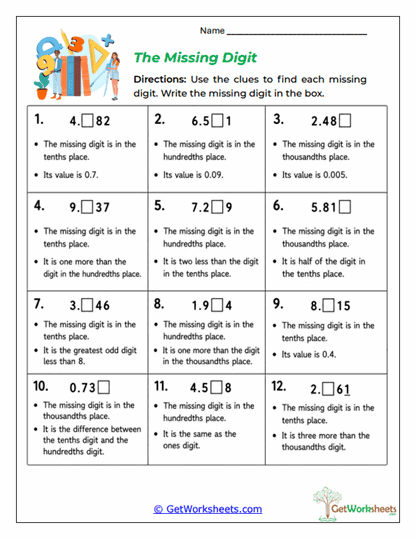
Place-value clues guide students as they determine an unknown digit inside a decimal number. Some clues describe the missing digit's value, while others compare it with another digit in the number. Learners must identify the blank's position before reasoning toward the answer. The puzzle-style format strengthens place-value knowledge while also developing logical thinking. It provides a useful step beyond straightforward place identification.
Two-Form Mastery
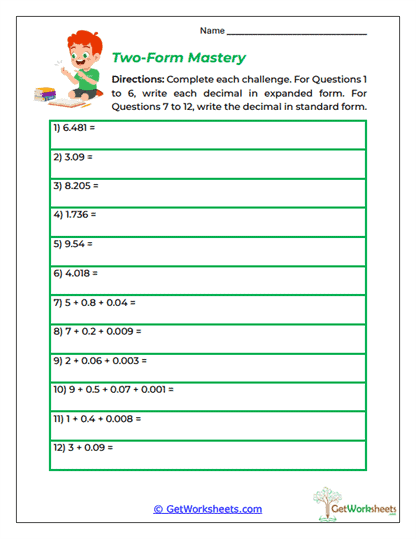
Students practice moving in both directions between standard decimal notation and expanded form. One section asks learners to break numbers into their place-value parts, while another requires them to rebuild decimals from expanded expressions. Working both ways strengthens the relationship between digit position and digit value. Placeholder zeros receive useful practice when certain place values are missing.
Bookmark Us Now!
New, high-quality worksheets are added every week! Do not miss out!