Multiplying Decimals Worksheets
About This Worksheet Collection
Multiplying decimals helps students understand how place value changes when decimal quantities are repeated, scaled, or combined to find an area or total. Learners need to use multiplication facts accurately, place the decimal correctly in the product, and decide whether the answer is reasonable based on the size of the factors. Building this understanding helps students move beyond simply counting decimal places and develop a stronger sense of what decimal products actually represent.
This collection develops decimal multiplication through visual grids, standard algorithms, powers-of-ten patterns, estimation, decimal-placement practice, error analysis, missing-factor equations, money problems, measurement situations, pattern exploration, matching activities, and mixed review. Some worksheets focus on conceptual understanding, while others build computational fluency or apply multiplication to practical situations. The pages can be used during direct instruction, guided math, centers, intervention, tutoring, homework, assessment, review, or homeschool lessons.
As students complete the collection, they strengthen decimal place value, multiplication fluency, product estimation, inverse operations, pattern recognition, and mathematical reasoning. They also practice checking whether products are reasonable, interpreting money and measurement contexts, solving for unknown factors, correcting errors, and explaining how powers of ten affect decimal values. These skills prepare learners for rates, ratios, proportions, area problems, scientific notation, and more advanced decimal applications.
Detailed Descriptions Of These Worksheets
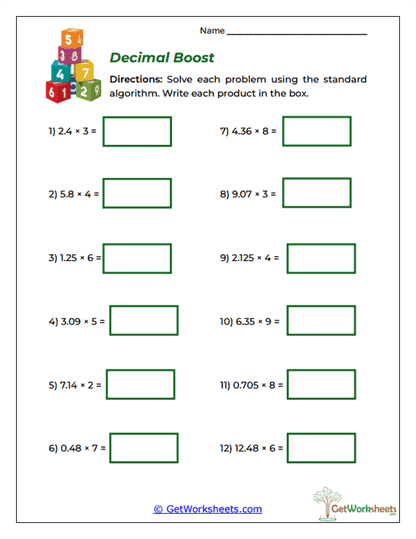
Decimal Boost
Students multiply decimal values by whole numbers using the standard multiplication algorithm. They complete the whole-number multiplication first, place the decimal correctly in the product, and use estimation to check whether the answer makes sense. The focused format gives learners repeated practice without introducing two decimal factors at once. This page provides a strong bridge from whole-number multiplication to more advanced decimal products.
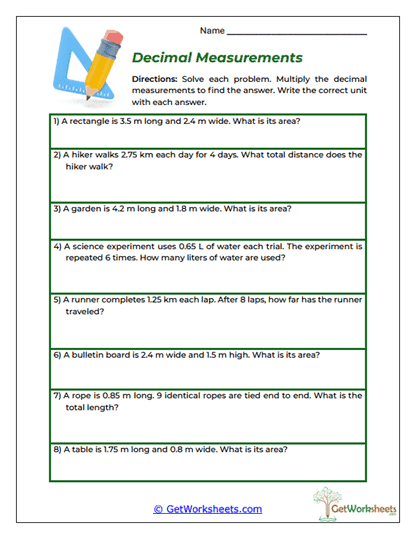
Decimal Measurements
Real-world problems involving length, distance, volume, repeated measurements, and area require students to multiply decimal quantities. Learners determine what the product represents and include the correct unit, including square units when finding area. The varied contexts connect decimal multiplication with science, geometry, and everyday measurement. Estimation can also help students judge whether each result is reasonable.
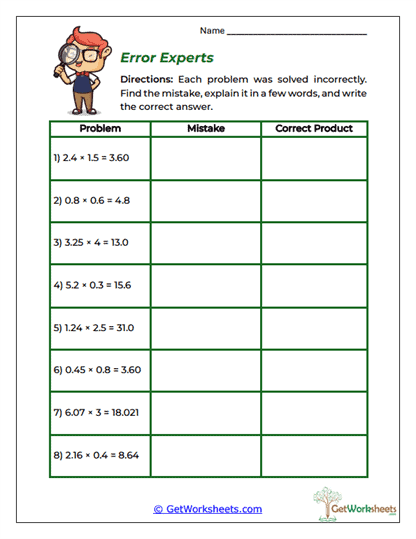
Error Experts
Incorrectly solved decimal multiplication problems must be examined, explained, and corrected. Students determine whether the mistake involves basic multiplication, decimal placement, or an unreasonable understanding of product size. They then calculate the correct answer and check whether it fits the factors. This activity strengthens error analysis and encourages learners to question answers that do not make mathematical sense.
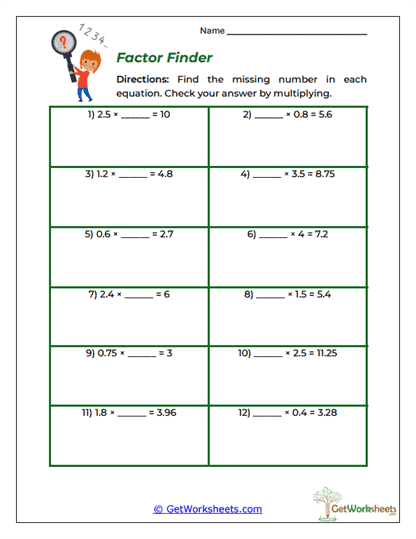
Factor Finder
One factor is missing from each decimal multiplication equation. Students use division as an inverse operation to determine the unknown and then multiply to verify the result. Because the task works backward from the product, it builds a deeper understanding of how multiplication equations are structured. The activity also provides useful preparation for algebraic reasoning and rates.
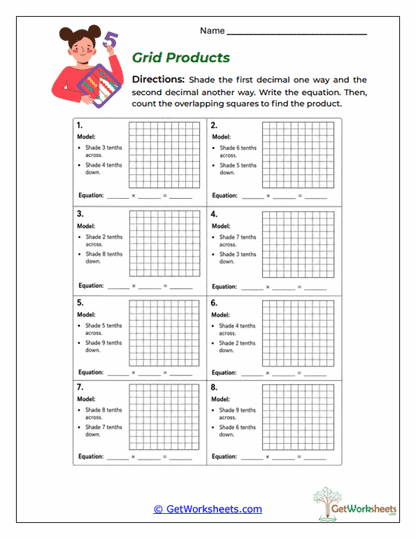
Grid Products
Hundred grids provide a visual model for multiplying two decimal values. Students shade each factor in a different direction and use the overlapping region to represent the product. The model makes it clear why multiplying tenths can create hundredths and why a product may be smaller than either factor. This conceptual practice gives meaning to the standard algorithm before learners rely only on procedural steps.
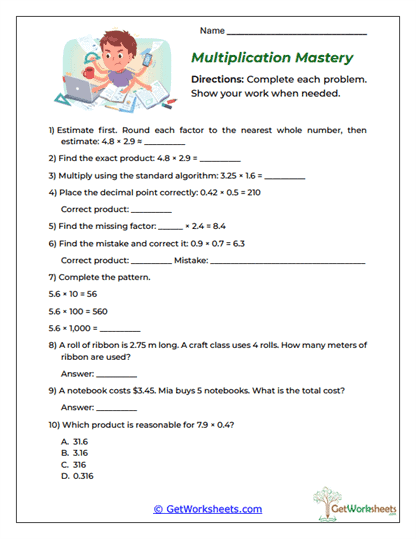
Multiplication Mastery
This cumulative review brings estimation, exact computation, decimal placement, missing factors, error analysis, powers-of-ten patterns, and real-world applications together. Students must switch among several strategies rather than completing one repeated type of problem. Money and measurement questions also show whether learners can apply multiplication outside a basic equation. The page works well as a final review, assessment, or checkpoint.
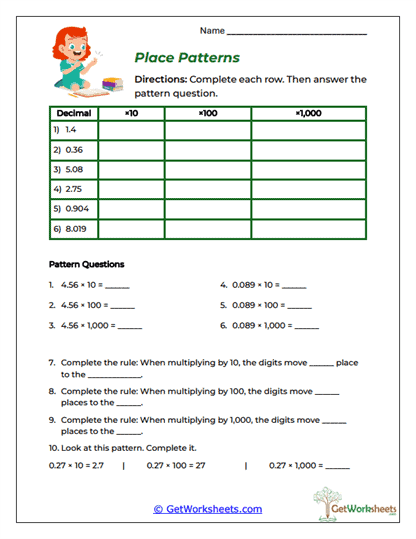
Place Patterns
Students examine how decimal values change when multiplied by 10, 100, or 1,000. Tables and numerical patterns help them see that each digit moves into a place worth ten, one hundred, or one thousand times as much. Learners explain the pattern in words instead of relying only on a shortcut about moving the decimal point. This activity builds a strong foundation for metric conversions and scientific notation.
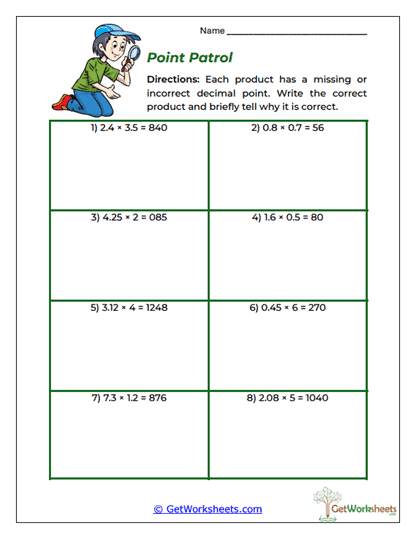
Point Patrol
Products with incorrectly placed decimal points must be repaired. Students count the decimal places in the factors, estimate the expected size of the answer, and determine where the decimal belongs. They then explain why the corrected value is reasonable. The combination of procedural and estimation strategies helps make decimal placement more dependable.
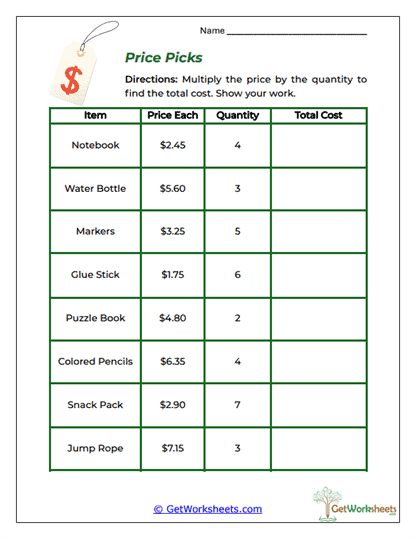
Price Picks
A shopping table asks students to multiply the price of one item by the number purchased. Learners calculate total costs and record their answers using accurate dollar-and-cent notation. The repeated-item structure makes multiplication easy to interpret as equal groups of the same price. This practical activity strengthens decimal fluency while building everyday financial reasoning.
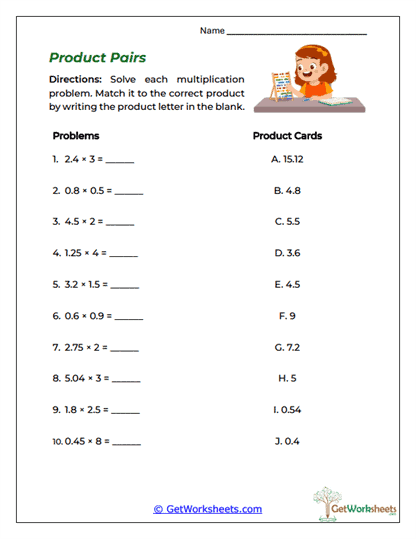
Product Pairs
Decimal multiplication expressions are solved and matched with the correct products from an answer bank. Students must calculate accurately and place the decimal correctly before making each match. If a product does not appear, the format naturally encourages them to revisit the multiplication and decimal placement. The matching structure provides repeated practice with a built-in self-checking feature.
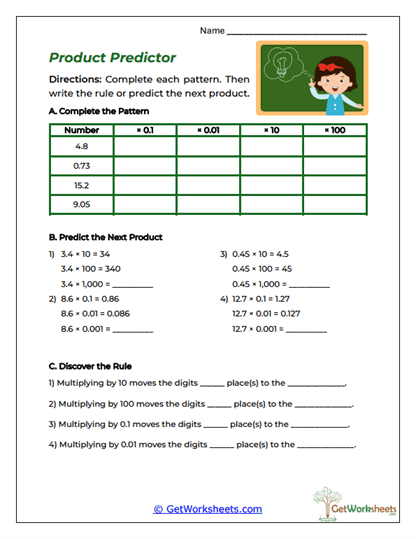
Product Predictor
Students explore patterns created by multiplying decimals by 10, 100, 0.1, and 0.01. They complete a table, predict later products, and explain whether the digits are becoming more or less valuable. Comparing multiplication by whole-number powers of ten with decimal factors helps students see both growth and reduction patterns. This activity strengthens place-value reasoning and number sense.
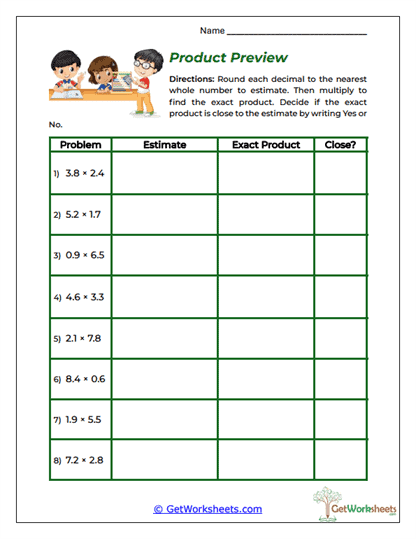
Product Preview
Students estimate decimal products before finding the exact answers. They round the factors to nearby whole numbers, make a prediction, complete the multiplication, and compare the two results. A product that is far from the estimate can signal a misplaced decimal or calculation error. This routine builds the habit of checking whether an answer is reasonable before accepting it.
Bookmark Us Now!
New, high-quality worksheets are added every week! Do not miss out!