Expanded Form of Decimals Worksheets
About This Worksheet Collection
Expanded form helps students understand how each digit in a decimal contributes to the number's total value. Instead of seeing a decimal as one long string of digits, learners break it into place-value parts such as ones, tenths, hundredths, and thousandths. This makes the structure of decimal numbers easier to understand and gives students a stronger foundation for later work with comparing, rounding, estimating, and performing operations with decimals.
This collection approaches expanded form from several directions so students can build a flexible understanding of decimal place value. Activities include converting between standard and expanded form, using place-value charts, matching equivalent representations, building decimals from clues, working with visual models and number lines, correcting errors, and interpreting decimals in everyday situations. The worksheets can be used during classroom lessons, math centers, independent practice, homework, tutoring, intervention, or homeschool instruction.
As learners complete the collection, they strengthen their understanding of digit value, decimal notation, number composition, number decomposition, and placeholder zeros. They also practice moving among standard form, expanded form, word form, models, and real-world representations. These varied activities encourage students to explain what each digit means rather than simply memorizing where it belongs.
Detailed Descriptions Of These Worksheets
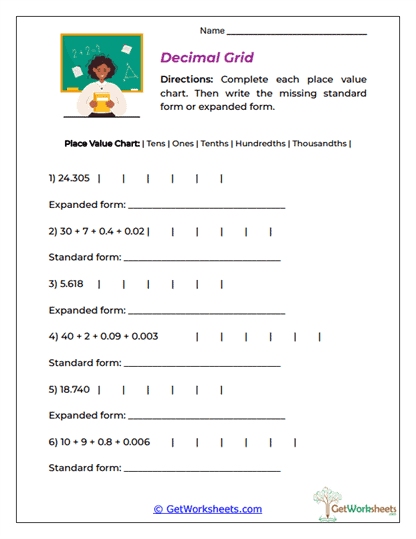
Decimal Grid
A structured place-value chart helps learners organize decimal digits into tens, ones, tenths, hundredths, and thousandths. Students use the chart to move between standard notation and expanded form while keeping each digit in its correct position. The visual layout is particularly helpful when zeros or missing place values are involved. It gives students a clear way to see how a decimal is built before they write it in another form.
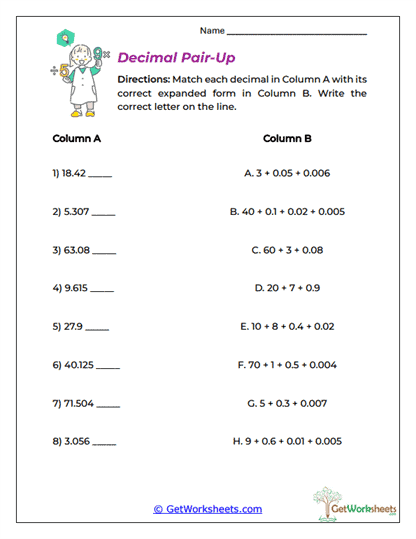
Decimal Pair-Up
Students match decimals written in standard form with expanded expressions that represent the same value. To find each pair, learners must consider what every digit is worth rather than simply looking for similar numbers. The matching format encourages careful checking and helps reveal misunderstandings about tenths, hundredths, or thousandths. Repeated practice makes decomposing decimals more familiar and automatic.
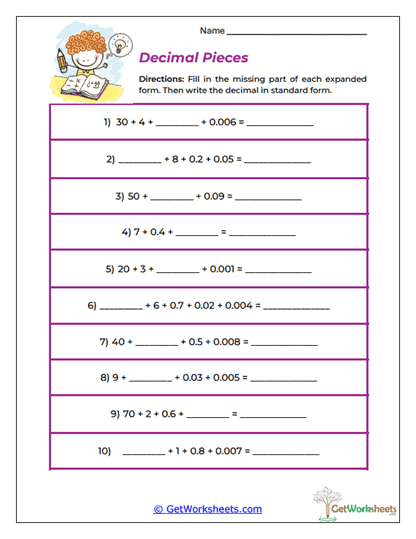
Decimal Places
Missing pieces in expanded-form expressions challenge students to reason about which place value has been left out. Learners complete each expression and then combine the parts to write the decimal in standard form. Placeholder zeros become especially important when one position has no value. The activity strengthens number construction and encourages students to think carefully about how every decimal place functions.
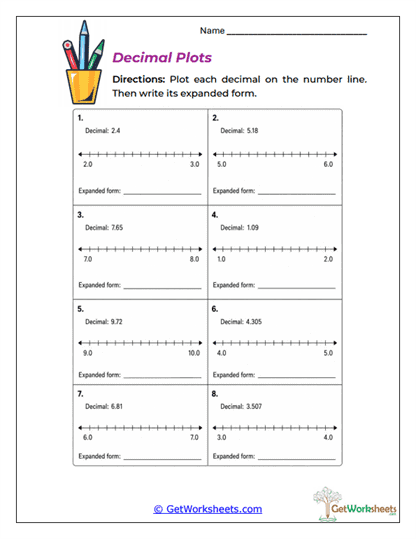
Decimal Plots
Number-line practice is combined with expanded form so students can think about both the size and structure of decimal numbers. Learners plot each value between neighboring whole numbers and then break the decimal into its place-value parts. Seeing where a number belongs helps reinforce whether its written form makes sense. This activity connects decimal magnitude, estimation, and decomposition in one exercise.
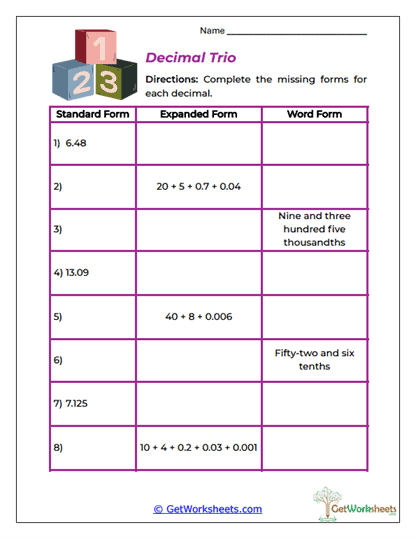
Decimal Trio
Three common decimal representations come together in this chart-based activity. Students work among standard form, expanded form, and word form, filling in whichever representation is missing. Moving back and forth among these forms helps learners recognize that they all describe the same quantity. The practice also strengthens vocabulary involving tenths, hundredths, and thousandths. It is a useful way to build flexibility with how decimal numbers can be expressed.
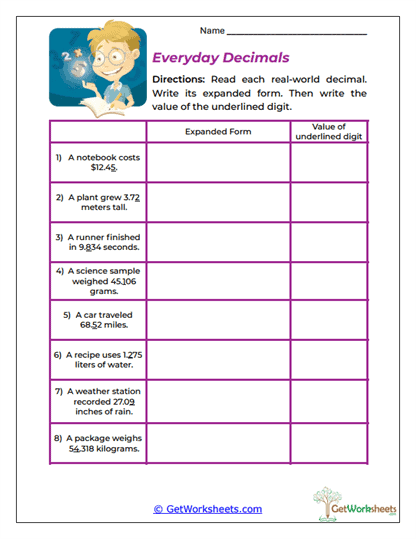
Everyday Decimals
Real-world examples show students how decimal place value appears in money, measurements, sports, recipes, weather, and other familiar situations. Learners rewrite each decimal in expanded form and identify the value of a selected digit. Connecting the numbers to meaningful contexts helps students see why place value matters outside of a math lesson. The activity also reinforces careful reading of units and decimal notation.
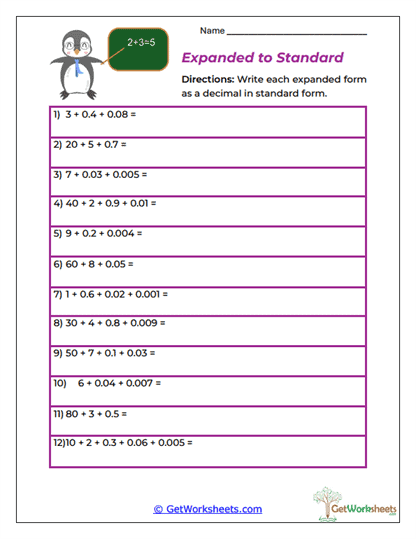
Expanded to Standard
This page reverses the usual expanded-form task by asking students to build a decimal from its separate place-value parts. Learners combine values such as ones, tenths, hundredths, and thousandths into one correctly written number. Special attention is given to situations where zero must hold an empty place. Working in this direction strengthens students' ability to compose decimals rather than only break them apart. It also helps prevent common errors caused by placing digits in the wrong position.
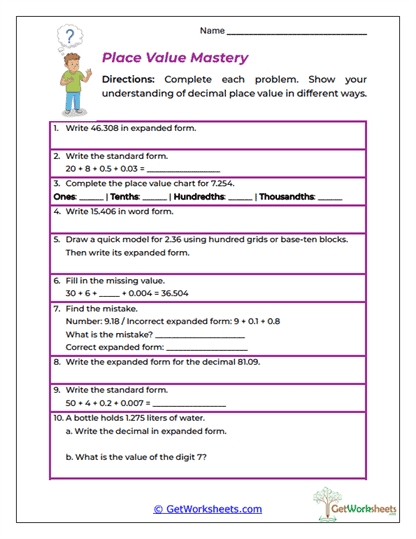
Place Value Mastery
A broad review brings several decimal place-value skills together on one page. Students convert between forms, work with a place-value chart, interpret word form, create a model, complete missing values, correct an error, and apply their understanding to a real-world problem. The variety of tasks requires learners to show their knowledge in more than one way. This makes the worksheet useful as a review, assessment, or final checkpoint. It can also help teachers and parents identify which place-value concepts may still need reinforcement.
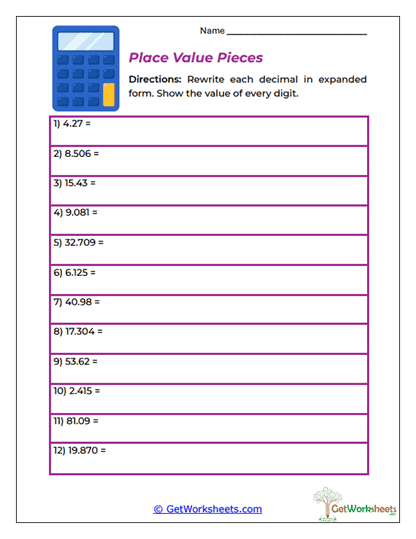
Place Value Pieces
Learners break decimal numbers into individual place-value amounts to see what each digit contributes. Writing a number as the sum of its tens, ones, tenths, hundredths, and thousandths makes decimal structure much easier to understand. The activity encourages students to think about value rather than simply read the digits in order. This foundational practice supports later work with decimal comparison, rounding, and computation.
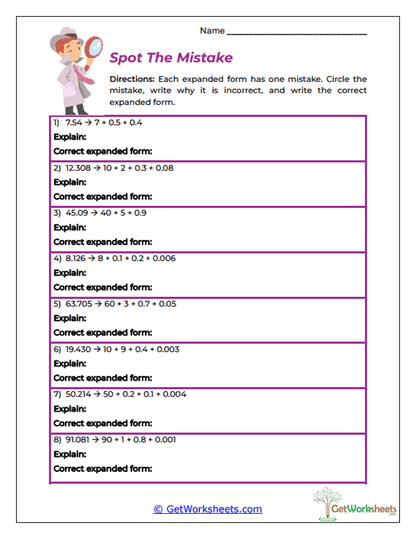
Spot the Mistake
Incorrect expanded-form examples give students an opportunity to analyze mathematical reasoning instead of simply completing routine conversions. Learners identify which digit has been assigned the wrong value, explain the problem, and rewrite the expression correctly. Catching these errors requires close attention to the difference between tenths, hundredths, and thousandths. The activity encourages stronger self-checking habits and a deeper understanding of decimal place value.
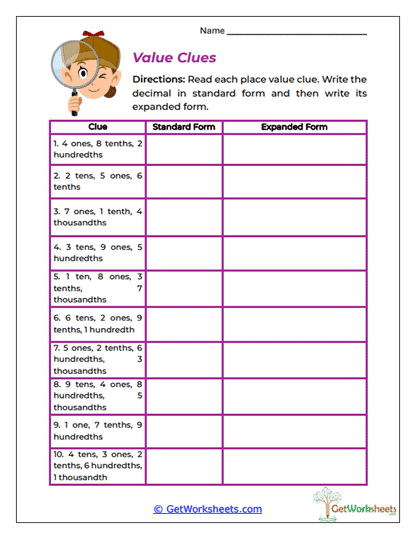
Value Clues
Written place-value clues challenge students to construct decimals from the ground up. Learners interpret descriptions involving ones, tenths, hundredths, and thousandths, then write the number in both standard and expanded form. Empty positions may require placeholder zeros, so careful organization is important. This activity strengthens place-value vocabulary while giving students practice composing numbers instead of only decomposing them. It also provides a gentle introduction to solving problems from mathematical clues.
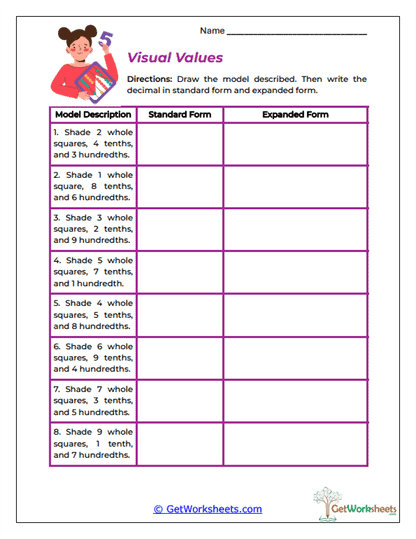
Visual Values
Pictures and models help students connect decimal quantities with the symbols used to represent them. Learners shade or interpret wholes, tenths, and hundredths, then write the amount in both standard and expanded form. Moving from a visual model to numerical notation makes abstract place-value ideas more concrete. The activity is especially helpful for students who benefit from seeing the quantity before working with digits and expressions.
Bookmark Us Now!
New, high-quality worksheets are added every week! Do not miss out!