Fraction Mistakes
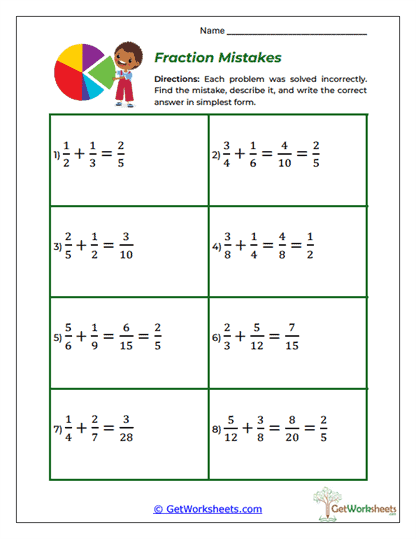
Fraction Mistakes gives students a chance to study fraction addition problems that were solved incorrectly and explain what went wrong. Students examine each equation, identify the error, find a common denominator, rewrite the fractions correctly, and simplify the final answer. This practice strengthens error analysis, equivalent fractions, least common denominators, numerator addition, simplification, and mathematical reasoning. It is especially helpful for students in grades 5-6 who need to understand the process deeply instead of simply memorizing a set of steps.
Instructional Objectives
- Identify common errors: Students notice mistakes such as adding unlike denominators directly or renaming fractions incorrectly.
- Build equivalent fractions: Learners rewrite both addends so they have matching denominators and equal-sized parts.
- Correct the calculation: Students add the new numerators while keeping the common denominator.
- Simplify the answer: Children reduce each corrected sum to its simplest form when possible.
How This Helps
- Turns mistakes into lessons: Students learn that an incorrect answer can show exactly which idea needs more practice.
- Supports thoughtful discussion: Parents and teachers can ask children to explain the error before correcting it.
- Useful for targeted intervention: The problems reveal whether a student struggles with common denominators, multiplication, addition, or simplification.
- Fits classroom and home learning: Use it for small groups, corrections, review, tutoring, homework, or homeschool instruction.
- Ready to print: No special materials or preparation are required.
Children often make predictable mistakes when adding fractions with different denominators. Some add the top numbers and bottom numbers separately, while others change the denominator without changing the numerator by the same factor. This worksheet helps students slow down, compare each incorrect equation with the proper method, and explain why the original result cannot be correct. As learners complete the page, they strengthen fraction fluency, equivalent-fraction understanding, denominator reasoning, calculation accuracy, self-correction, and confidence. In classroom and homeschool settings, this kind of error analysis reinforces the important idea that understanding why a method works is more valuable than simply remembering a rule.
Bookmark Us Now!
New, high-quality worksheets are added every week! Do not miss out!