Everyday Fractions
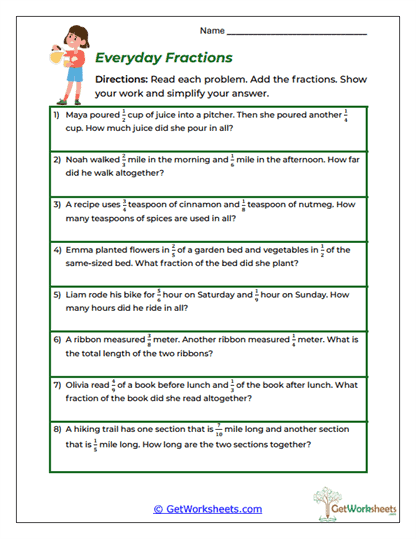
Everyday Fractions connects unlike-denominator addition to situations children can recognize from daily life. Students read each word problem, identify the fractional amounts, find a common denominator, add the fractions, simplify the result, and answer the question in context. The worksheet develops reading comprehension, fraction addition, equivalent fractions, common denominators, simplification, operation choice, and problem-solving skills. It is a strong choice for students in grades 5-6 who can complete fraction calculations but need practice deciding how those calculations apply in real situations.
Key Learning Objectives
- Identify the quantities: Students locate the two fractions and determine what each amount represents.
- Recognize addition situations: Learners understand that the problem asks for a combined or total amount.
- Add unlike fractions: Students create equivalent fractions with a common denominator before adding.
- Write meaningful answers: Children simplify the sum and include the correct measurement or context.
Classroom & Home Use
- Makes fractions practical: Problems involve familiar ideas such as juice, distance, ingredients, gardening, time, ribbon, and reading.
- Combines math and reading: Students must understand the story before choosing and completing the operation.
- Provides helpful structure: Adults can guide children to underline the fractions and circle words such as “total” or “in all.”
- Works across settings: The page is useful for classwork, homework, intervention, tutoring, or homeschool practice.
- No-prep design: Teachers and parents can print the worksheet and begin immediately.
Many children can solve a written equation but become unsure when the same skill appears inside a paragraph. A helpful strategy is to ask what two amounts are being combined and what unit the answer should describe. Students then find a common denominator, rename the fractions, add the numerators, and simplify the result. This process builds word-problem comprehension, fraction fluency, operation selection, denominator knowledge, reasoning, and mathematical communication. In classroom and homeschool lessons, the worksheet reinforces why fraction addition matters and helps students connect abstract procedures to measurements, recipes, distances, and other everyday experiences.
Bookmark Us Now!
New, high-quality worksheets are added every week! Do not miss out!