Fraction Checkpoint
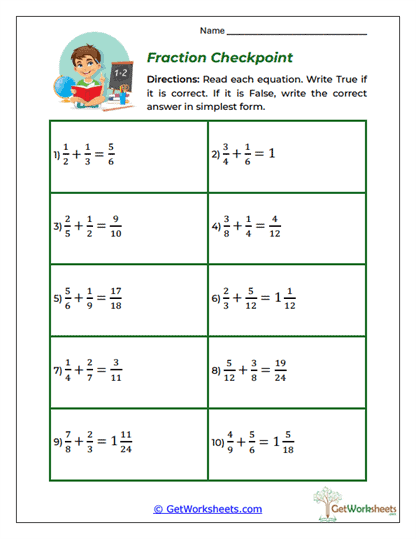
Fraction Checkpoint asks students to judge whether unlike-denominator addition equations have been solved correctly. Students read each equation, write True when the result is accurate, and correct the answer in simplest form when it is false. This activity reinforces common denominators, equivalent fractions, numerator addition, mixed numbers, simplification, error analysis, and mathematical reasoning. It is well suited for students in grades 5-6 who need to show that they understand both the calculation process and how to check a completed answer.
Academic Focus
- Evaluate each equation: Students independently solve or verify the fraction addition shown.
- Create common denominators: Learners rename unlike fractions using equal-sized parts.
- Check final forms: Students confirm whether answers are simplified correctly or written properly as mixed numbers.
- Correct inaccurate work: Children replace false answers with mathematically accurate solutions.
Teaching Advantages
- Encourages careful checking: Students must inspect every step rather than accept the printed answer automatically.
- Reveals misconceptions: Teachers and parents can see whether errors come from denominators, numerators, or simplification.
- Builds mathematical explanation: Learners can describe why an equation is true or where the mistake occurred.
- Supports flexible use: The worksheet works for review, assessment, homework, tutoring, or homeschool practice.
- No-prep resource: It can be printed and used immediately.
True-or-false work teaches children that solving a problem and checking a problem are closely connected skills. Students must find common denominators, create equivalent fractions, add accurately, and examine whether the answer has been simplified. Some equations also produce values greater than one, giving learners practice interpreting improper fractions and mixed numbers. This worksheet builds fraction fluency, error-detection skills, computational accuracy, denominator sense, simplification habits, and confidence. In both classroom and homeschool settings, it reinforces the important idea that a mathematically correct answer should be reasonable, equivalent to the original expression, and written in an acceptable final form.
Bookmark Us Now!
New, high-quality worksheets are added every week! Do not miss out!