Equivalent Fractions
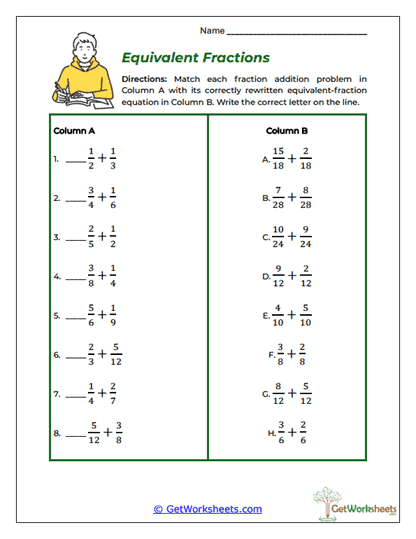
Equivalent Fractions helps students recognize when two fraction addition equations have the same value. Students examine each incomplete equation in Column A, compare it with the rewritten equations in Column B, and match the correct equivalent form by letter. This practice strengthens equivalent fractions, common denominators, numerator scaling, denominator relationships, multiplication facts, and equation comparison. It is especially useful for students in grades 5-6 who are learning that fractions may look different while still representing the same amount.
Learning Goals
- Recognize equivalent forms: Students identify equations that use different numerators and denominators but have equal values.
- Find common denominators: Learners determine how each fraction can be renamed using matching-sized parts.
- Scale fractions correctly: Students multiply the numerator and denominator by the same factor.
- Compare complete equations: Children consider both addends rather than looking at only one fraction.
Educational Value
- Builds flexible fraction thinking: Students learn that there can be more than one correct way to write the same value.
- Provides built-in checking: The letter-matching format helps learners notice when their answer does not fit an available choice.
- Supports partner discussion: Students can explain which multiplication factor was used to rename each fraction.
- Fits many learning settings: Use it for classroom review, math centers, tutoring, homework, or homeschool practice.
- Requires no preparation: The page is ready to print and complete.
Equivalent fractions are a major part of adding fractions with unlike denominators. Before students can add the fractions, they must understand how to rename them without changing their actual value. Parents can explain that cutting the same amount into more pieces changes the number of pieces, but not the total amount represented. This worksheet develops common-denominator fluency, multiplication accuracy, equation reasoning, fraction comparison, pattern recognition, and confidence. In classroom and homeschool lessons, it helps students see the connection between equivalent fractions and successful fraction addition instead of treating the renaming step as a rule with no meaning.
Bookmark Us Now!
New, high-quality worksheets are added every week! Do not miss out!