Fraction Mystery
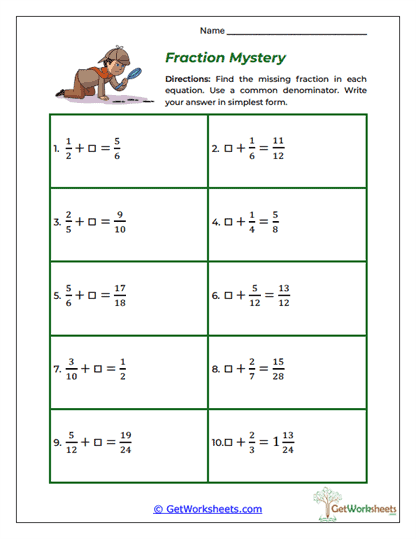
Fraction Mystery challenges students to find an unknown fraction in each addition equation. Students use a common denominator, rewrite the known fractions when necessary, subtract the known amount from the total, and express the missing fraction in simplest form. The worksheet develops missing-addend reasoning, unlike-denominator addition, equivalent fractions, inverse operations, simplification, and equation sense. It is a strong choice for students in grades 5-6 who are ready to apply fraction skills in a more demanding problem-solving format.
Targeted Skills
- Interpret the unknown: Students understand that the box represents a missing fraction addend.
- Rename fractions: Learners create common denominators before comparing or subtracting fractional amounts.
- Use inverse operations: Students subtract the known addend from the total to find the missing value.
- Simplify solutions: Children reduce each answer to its simplest equivalent form.
Instructional Support
- Moves beyond routine addition: Students must reason backward rather than follow a single forward procedure.
- Reinforces several skills together: Each problem combines common denominators, equivalent fractions, subtraction, and simplification.
- Offers clear parent guidance: Adults can ask, “What amount must be added to the known fraction to reach the total?”
- Works for assessment or practice: The page fits independent work, small groups, intervention, homework, or homeschool instruction.
- Print-and-go design: No extra tools or preparation are required.
Missing-fraction equations may look complicated, but they connect to familiar whole-number facts. For example, children already understand that a blank plus three equals seven can be solved by subtracting three from seven. The same idea works with fractions, but the pieces must first be renamed with a common denominator. As students complete the worksheet, they strengthen inverse-operation knowledge, denominator reasoning, equivalent-fraction fluency, simplification, problem-solving persistence, and mathematical confidence. This practice is valuable in classroom and homeschool settings because it prepares learners for algebraic thinking, multi-step equations, fraction subtraction, and more advanced work with rational numbers.
Bookmark Us Now!
New, high-quality worksheets are added every week! Do not miss out!