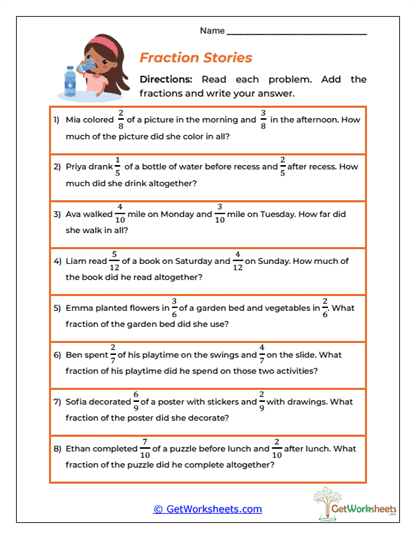
Fraction Stories
Fraction Stories helps students understand how adding fractions shows up in ordinary situations, not just in rows of numbers. Students read each short problem, identify the two fractions being combined, add the numerators, keep the like denominator, and write the total amount. The worksheet practices fraction addition, word-problem comprehension, key-information identification, numerators, denominators, mathematical reasoning, and written answers. It is especially appropriate for students in grades 4-5 who can add basic fractions but need help deciding when and how to use that skill in a story problem.
Key Learning Objectives
- Find the important information: Students identify the two fractional amounts that must be combined in each story.
- Choose the correct operation: Learners recognize words and situations that show the amounts should be added.
- Add like denominators: Students combine the numerators while keeping the common denominator unchanged.
- Answer in context: Children write a complete response that matches what the problem is asking about.
How This Helps
- Makes fractions feel useful: The stories connect fraction addition to pictures, water, walking, reading, gardening, playtime, posters, and puzzles.
- Supports reading and math together: Students must understand the sentence before they can solve the equation.
- Works well for guided practice: Teachers and parents can model how to underline the fractions and circle the question.
- Easy to use anywhere: The worksheet fits classroom lessons, homework, tutoring, intervention, or homeschool practice.
- Ready to print: No preparation or extra materials are needed.
Word problems can be difficult for children even when the calculation itself is simple. A helpful approach is to ask, “What happened first, what happened next, and what are we trying to find altogether?” Once the child sees that the two fractions describe parts of the same kind of whole, the addition becomes much easier to understand. This worksheet builds reading comprehension, fraction fluency, operation choice, number sense, problem-solving confidence, and clear mathematical communication. In classroom and homeschool settings, it reinforces the valuable habit of connecting numbers to meaning instead of treating every equation like an unrelated set of symbols.
Bookmark Us Now!
New, high-quality worksheets are added every week! Do not miss out!