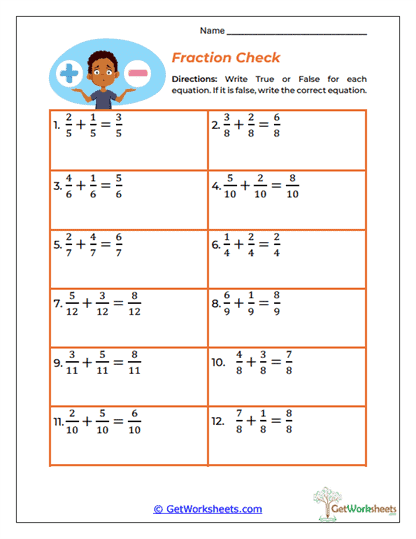
Fraction Check
Fraction Check helps students decide whether completed fraction addition equations are correct or incorrect. Students read each equation, add the numerators, keep the common denominator, and then write True or False based on whether the stated sum is accurate. This practice strengthens fraction addition, equation analysis, numerator fluency, denominator understanding, error detection, mathematical reasoning, and self-checking. It is a useful grades 4-5 activity for children who need to slow down, examine someone else’s work, and explain why an answer does or does not make sense.
Instructional Objectives
- Evaluate completed work: Students determine whether each fraction equation has been solved correctly.
- Apply the addition rule: Learners add the numerators while keeping the like denominator unchanged.
- Notice common mistakes: Students identify errors such as incorrect numerator totals or changed denominators.
- Check for reasonableness: Learners consider whether the final fraction matches the size of the two addends.
Learning Benefits
- Builds careful thinking: Students cannot simply calculate and move on; they must compare their answer with the one shown.
- Supports math discussion: Parents and teachers can ask children to explain exactly what makes an equation true or false.
- Works as an assessment: The format makes it easy to see whether students understand the fraction addition rule.
- Useful in many settings: The page fits independent work, small groups, homework, review, tutoring, or homeschool lessons.
- No-prep practice: The worksheet can be printed and used immediately.
True-or-false problems are valuable because they teach children that checking work is part of doing mathematics. A student may know how to add fractions but still rush, overlook a numerator, or accidentally change the denominator. This worksheet encourages learners to inspect every part of the equation and defend their decision using fraction vocabulary and number sense. As students complete the page, they develop addition fluency, denominator awareness, error analysis, reasoning, accuracy, and confidence. In classroom and homeschool instruction, this type of practice helps children become more independent because they learn not to accept an answer automatically without first proving that it is correct.
Bookmark Us Now!
New, high-quality worksheets are added every week! Do not miss out!