Whole or More
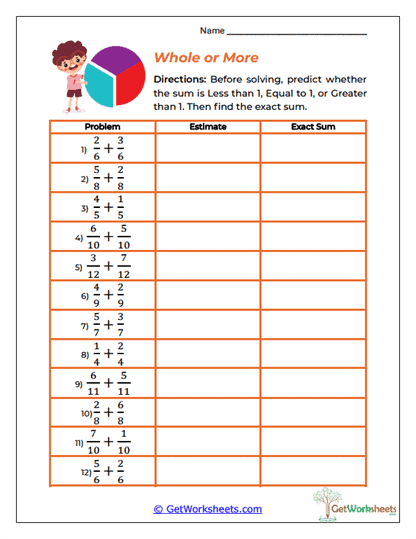
Whole or More asks students to predict the size of each fraction sum before finding the exact answer. Students first decide whether the total will be less than one, equal to one, or greater than one, and then add the fractions to confirm their estimate. This activity strengthens estimation, benchmark fractions, fraction magnitude, like-denominator addition, numerator reasoning, comparison, and number sense. It is a strong grades 4-5 worksheet for helping children understand not only how to calculate a sum, but also how large that answer should be.
Academic Focus
- Estimate before solving: Students make a prediction about whether the combined fractions will be below, at, or above one whole.
- Use one as a benchmark: Learners compare the total numerator with the denominator to judge the size of the sum.
- Calculate exact sums: Students add the numerators and keep the common denominator.
- Connect estimate and answer: Learners check whether the exact result agrees with their original prediction.
Classroom & Home Use
- Builds strong number sense: Students learn to think about the size of an answer instead of relying only on a procedure.
- Supports meaningful discussion: Adults can ask whether the two fractions together are close to filling one whole.
- Useful for differentiation: Some learners may use drawings or fraction bars, while others work mentally.
- Appropriate for review or assessment: The table format clearly separates estimation from exact computation.
- Low-prep resource: The page is ready for classroom, homework, intervention, or homeschool use.
Estimating first teaches children to pause and think before calculating. For example, when the numerators together are smaller than the denominator, the sum will be less than one; when they match the denominator, the sum equals one; and when they are larger, the sum is greater than one. This simple comparison helps students catch unreasonable answers and better understand improper fractions and whole numbers. As learners work, they strengthen fraction magnitude, benchmark reasoning, addition fluency, estimation, comparison skills, and mathematical confidence. In classroom and homeschool lessons, this worksheet reinforces the idea that a correct calculation should also make sense, which is an important habit for later work with mixed numbers, unlike denominators, and real-world fraction problems.
Bookmark Us Now!
New, high-quality worksheets are added every week! Do not miss out!