Draw the Sum
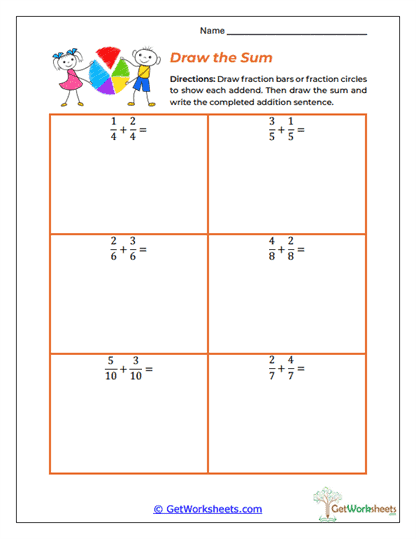
Draw the Sum asks students to create their own fraction bars or fraction circles before solving each addition problem. Students read two fractions with the same denominator, draw equal parts, shade each amount, combine the shaded sections, and complete the addition sentence. The activity strengthens fraction representation, like-denominator addition, numerators, denominators, equal partitioning, visual modeling, and equation writing. It is a helpful grades 4-5 worksheet for children who learn best when they can draw and physically show what the numbers mean.
Learning Goals
- Partition a whole: Students divide a bar or circle into the correct number of equal sections.
- Represent both fractions: Learners shade the amount named by each numerator.
- Find the combined amount: Students count all shaded parts to determine the sum.
- Record the equation: Each drawing is connected to a complete and accurate fraction addition sentence.
Educational Value
- Encourages active thinking: Students must build the model themselves instead of simply counting a model that is already provided.
- Supports different learning styles: Drawing can help visual and hands-on learners understand fraction relationships.
- Useful across settings: The page works for classroom lessons, homeschool practice, tutoring, or additional support.
- Easy to differentiate: Students who need help can use fraction bars, while more confident learners may choose circles.
- No-prep format: Teachers and parents can print the page and begin immediately.
Creating a model takes more thinking than looking at one that has already been drawn. Students must decide how many equal pieces are needed, shade the correct numerators, and make sure both fractions use the same-sized parts. This process helps children understand why the denominator remains unchanged when like fractions are added. A parent can gently guide the work by saying, “The bottom number tells us how many equal pieces to draw, and the top number tells us how many to shade.” With practice, students improve fraction comprehension, spatial reasoning, addition fluency, model accuracy, mathematical communication, and confidence. This worksheet reinforces a strong foundation for later work with equivalent fractions, unlike denominators, mixed numbers, and fraction word problems.
Bookmark Us Now!
New, high-quality worksheets are added every week! Do not miss out!