Find the Piece
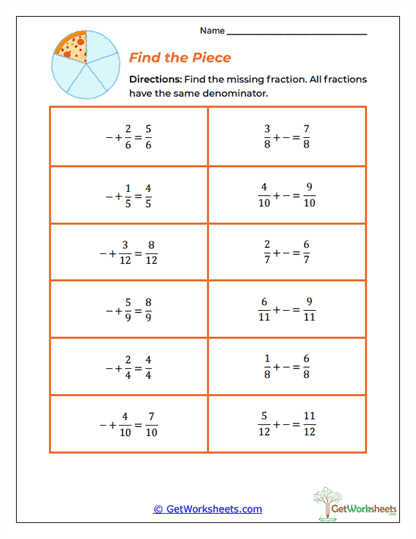
Find the Piece introduces fraction addition from a slightly different direction by asking students to find a missing addend. Each equation shows one unknown fraction, one known fraction, and a completed sum, with all fractions using the same denominator. Students reason backward to determine how many fractional parts must be added to reach the total. This grades 4-5 practice builds missing-addend reasoning, fraction subtraction, inverse operations, numerator fluency, denominator recognition, equation sense, and problem-solving skills.
Key Learning Objectives
- Understand missing addends: Students recognize that one part of the addition equation is unknown.
- Use inverse reasoning: Learners subtract the known numerator from the total numerator to find the missing amount.
- Keep equal-sized parts: Students preserve the common denominator because the fraction pieces remain the same size.
- Check solutions: The missing fraction can be added back to confirm that it produces the stated sum.
Instructional Support
- Develops deeper reasoning: Students move beyond straightforward addition and think about how the parts relate to the whole.
- Parent-friendly strategy: Adults can ask, “What number plus this numerator gives the total numerator?”
- Helpful for assessment: Teachers can quickly see whether students truly understand fraction equations.
- Works in many settings: Use the page for independent practice, small groups, homework, intervention, or homeschool instruction.
- Ready to use: The clean, print-and-go design requires no additional preparation.
Missing-addend problems can look unfamiliar at first, but they use the same idea children already know from whole-number facts. For example, when a child sees a blank plus two sixths equals five sixths, the question is simply, “What plus two equals five?” The denominator stays six because every amount is still measured in sixths. This connection makes the worksheet an excellent bridge between addition, subtraction, fact families, and fraction reasoning. Students build equation fluency, inverse-operation knowledge, numerator accuracy, denominator understanding, problem-solving confidence, and self-checking habits. In classroom and homeschool lessons, the page helps adults see whether a learner understands the structure of fraction addition rather than merely following a memorized rule.
Bookmark Us Now!
New, high-quality worksheets are added every week! Do not miss out!