Payday Pair-Up
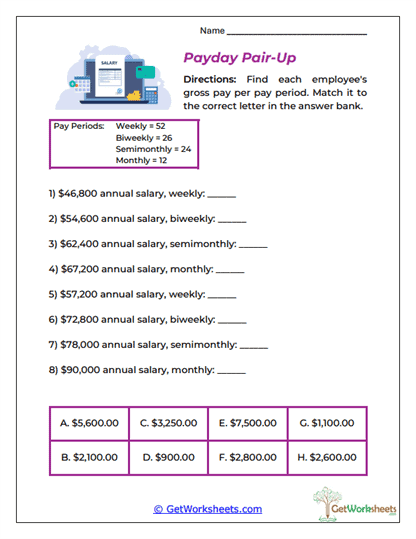
Payday Pair-Up gives students an engaging matching activity that connects annual salaries with the gross earnings employees receive during different pay periods. Across eight problems, learners divide yearly salaries by the appropriate number of weekly, biweekly, semimonthly, or monthly payments and match their calculations to lettered answers. A convenient payroll reference chart supports division accuracy, financial literacy, income conversion, money calculations, and an understanding of employee compensation. Suitable for middle school financial literacy and introductory high school business math, this activity turns routine salary conversions into an interactive exercise in mathematical reasoning.
Academic Focus
- Salary-to-Paycheck Conversions: Calculate gross earnings per pay period by dividing annual salaries by the correct number of yearly payments.
- Payroll Schedule Recognition: Distinguish between weekly, biweekly, semimonthly, and monthly compensation arrangements.
- Matching and Verification: Compare calculated dollar amounts against an answer bank and select the corresponding letter.
- Financial Problem Solving: Apply division, currency calculations, and numerical reasoning to realistic employee earnings scenarios.
Teaching Advantages
- Engaging Matching Format: Eight salary situations encourage students to calculate carefully before identifying the correct answer.
- Built-In Payroll Reference: A pay-period chart provides helpful guidance without requiring students to memorize payroll frequencies.
- Flexible Classroom Practice: Incorporate the activity into financial literacy lessons, independent assignments, math centers, or homeschool instruction.
- Easy Progress Monitoring: The letter-matching format allows teachers and parents to identify errors in salary conversion calculations.
Payday Pair-Up strengthens students’ understanding of the relationship between annual income and individual paycheck amounts. Working with different payroll frequencies develops division fluency, mathematical accuracy, financial vocabulary, and confidence in handling monetary values. The matching component adds an opportunity for answer verification while encouraging learners to recognize why payment schedules affect paycheck size. Teachers can extend the activity through discussions about employment compensation, gross earnings, and the difference between biweekly and semimonthly payments. These practical business math skills establish a useful foundation for future lessons involving payroll management, personal budgeting, salary comparisons, and financial planning.
Bookmark Us Now!
New, high-quality worksheets are added every week! Do not miss out!