Paycheck Schedule
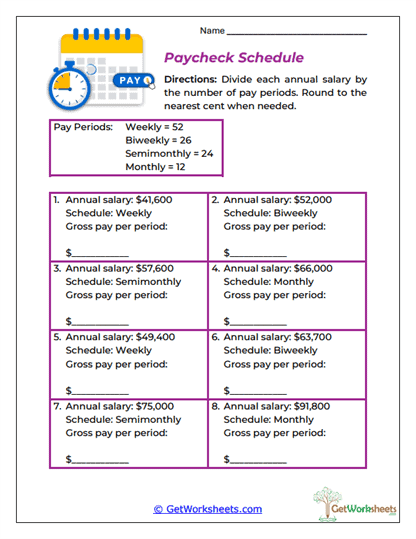
Paycheck Schedule challenges students to calculate gross earnings per paycheck by converting annual salaries into weekly, biweekly, semimonthly, and monthly payment amounts. The worksheet provides a convenient reference showing 52 weekly pay periods, 26 biweekly periods, 24 semimonthly periods, and 12 monthly periods per year. Across eight salary problems, learners practice division, income conversion, decimal rounding, financial reasoning, and interpreting different payroll schedules. Appropriate for middle school financial literacy and introductory high school business math courses, this activity helps students understand how payment frequency affects individual paycheck amounts without changing total annual earnings.
Key Learning Objectives
-
Understanding Pay Frequencies: Distinguish among weekly, biweekly, semimonthly, and monthly payroll schedules and identify their corresponding annual payment counts.
-
Calculating Gross Pay: Divide annual salaries by the appropriate number of pay periods to determine earnings for each paycheck.
-
Decimal and Currency Accuracy: Perform monetary calculations and round results to the nearest cent when necessary.
-
Financial Reasoning: Recognize that employees receiving the same annual salary may have different paycheck amounts depending on their payment schedules.
Instructional Benefits
-
Multiple Payroll Scenarios: Eight problems cover four common pay frequencies, allowing students to compare different methods of salary distribution.
-
Built-In Reference Guide: A clearly displayed pay-period chart supports students as they select the correct divisor.
-
Practical Financial Application: Relate arithmetic operations to employee compensation and everyday financial planning.
-
Versatile Learning Resource: Incorporate the worksheet into classroom instruction, homework assignments, homeschool activities, or targeted math review.
Paycheck Schedule helps students develop confidence in interpreting salary information and calculating gross earnings across different payment arrangements. By working through weekly, biweekly, semimonthly, and monthly examples, learners strengthen division fluency, proportional reasoning, financial vocabulary, and monetary precision. The activity also reinforces an important distinction between biweekly payments, which occur 26 times annually, and semimonthly payments, which occur 24 times. Teachers can use the exercises to encourage discussions about how paycheck frequency influences budgeting schedules, recurring expenses, and income management. These foundational payroll calculations prepare students for more advanced business math topics involving compensation comparisons, salary analysis, and personal financial planning.
Bookmark Us Now!
New, high-quality worksheets are added every week! Do not miss out!