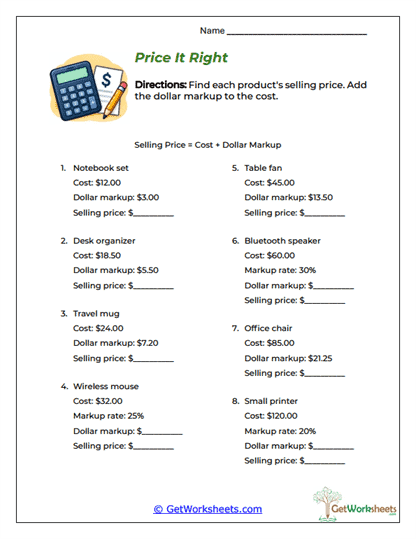
Price It Right
Determining a product’s selling price is an important business math skill that connects basic arithmetic with the financial decisions retailers make every day. Designed for Grades 6-9, this engaging printable presents eight merchandise pricing scenarios involving notebook sets, desk organizers, travel mugs, wireless mice, table fans, Bluetooth speakers, office chairs, and small printers. Students examine each product’s original cost and either a specified dollar markup or markup percentage, then calculate the final selling price using the provided relationship between cost and markup. The exercises reinforce monetary addition, percentage multiplication, decimal operations, financial reasoning, and the ability to distinguish between a markup amount and the complete retail price.
Key Learning Objectives
-
Calculating Selling Prices: Add a product’s original cost and dollar markup to determine the final retail selling price.
-
Working with Markup Percentages: Multiply product costs by percentage rates when the dollar markup is not directly provided.
-
Applying Multistep Calculations: Combine percentage conversion, multiplication, and addition to solve pricing problems accurately.
-
Understanding Pricing Relationships: Recognize how original cost, dollar markup, and selling price are mathematically connected.
Educational Value
-
Eight Varied Pricing Exercises: Combines problems with predetermined dollar markups and problems requiring percentage calculations.
-
Progressive Mathematical Practice: Allows students to begin with direct addition before completing more involved pricing calculations.
-
Everyday Retail Applications: Uses familiar merchandise to demonstrate how businesses establish prices above product costs.
-
Financial Literacy Development: Helps learners understand the difference between the cost of obtaining an item and the price charged to customers.
-
Versatile Instruction: Appropriate for classroom business math, independent assignments, guided practice, and homeschool education.
Learning how selling prices are calculated helps students understand an important part of retail business operations. Through monetary addition, markup calculations, percentage conversions, and decimal multiplication, learners develop stronger computational accuracy and practical financial awareness. Teachers can extend the activity by asking students to compare the selling prices of similar products or explain why two items with the same percentage markup may have different dollar markups. This printable strengthens mathematical confidence, proportional reasoning, problem-solving independence, and retail pricing comprehension while preparing students for more advanced applications involving wholesale costs, profit margins, discounts, and business revenue.
Bookmark Us Now!
New, high-quality worksheets are added every week! Do not miss out!