Rate Showdown
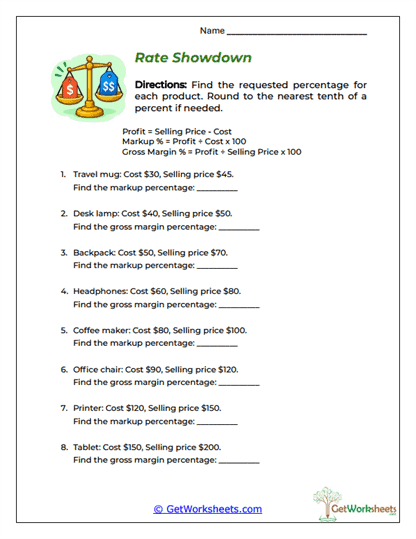
Understanding the difference between markup percentage and gross margin percentage helps students recognize how businesses measure pricing increases and gross profitability. This practical financial literacy activity for Grades 8-11 presents eight retail product scenarios involving travel mugs, desk lamps, backpacks, headphones, coffee makers, office chairs, printers, and tablets. Students examine each product’s original cost and selling price, calculate the dollar profit difference, and determine either the markup percentage or gross margin percentage using the appropriate formula. Through these exercises, learners strengthen percentage calculations, decimal division, monetary subtraction, financial comparisons, proportional reasoning, and their ability to distinguish between two important retail pricing measures.
Academic Focus
-
Calculating Dollar Profit: Subtract the original product cost from its selling price to determine the difference used in each percentage calculation.
-
Finding Markup Percentages: Divide the dollar profit by the original product cost and multiply by 100 to express the markup rate.
-
Calculating Gross Margin Percentages: Divide the dollar profit by the selling price and multiply by 100 to determine the gross margin percentage.
-
Distinguishing Pricing Measures: Recognize that markup uses product cost as its denominator, while gross margin uses selling price.
Educational Value
-
Eight Comparative Calculations: Provides targeted practice identifying and applying the correct percentage formula for different products.
-
Formula Reference Support: Clearly presented equations help students distinguish markup percentage from gross margin percentage.
-
Business Profitability Connections: Demonstrates how retailers describe pricing relationships and gross profit using different mathematical measures.
-
Decimal Accuracy Practice: Reinforces division, percentage conversions, and rounding to the nearest tenth when necessary.
-
Flexible Instruction: Appropriate for business math courses, financial literacy lessons, guided calculations, independent assignments, and homeschool education.
Comparing markup and gross margin percentages helps learners understand why two calculations using the same product cost and selling price can produce different results. Through profit calculations, percentage conversions, decimal division, and financial interpretation, students develop stronger mathematical fluency and commercial awareness. Teachers can extend the activity by asking students to calculate both measures for the same product and explain why gross margin is expressed relative to selling price rather than cost. This printable reinforces computational accuracy, proportional reasoning, financial literacy, and analytical confidence while preparing students for more advanced business mathematics involving gross profit, retail pricing strategies, profitability analysis, and financial decision-making.
Bookmark Us Now!
New, high-quality worksheets are added every week! Do not miss out!