Color Patterns Worksheets
-
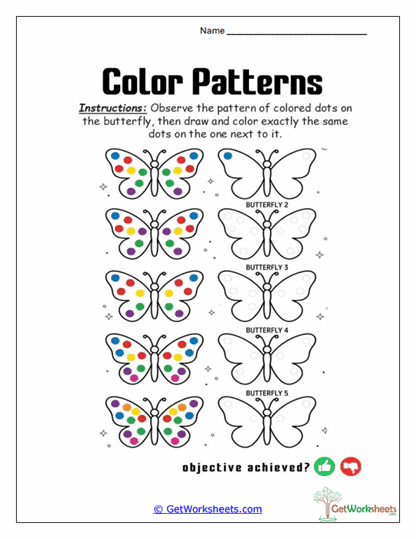
Butterfly Dot Mirror
-
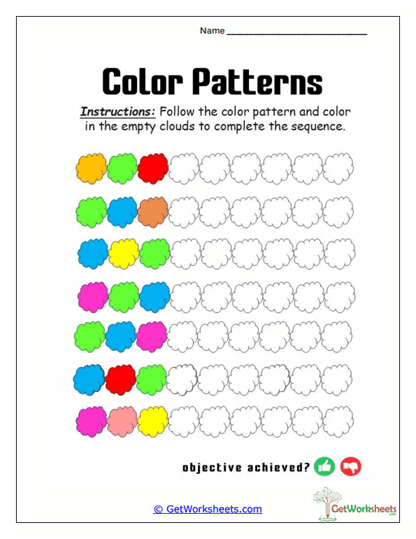
Cloudburst Color Chain
-
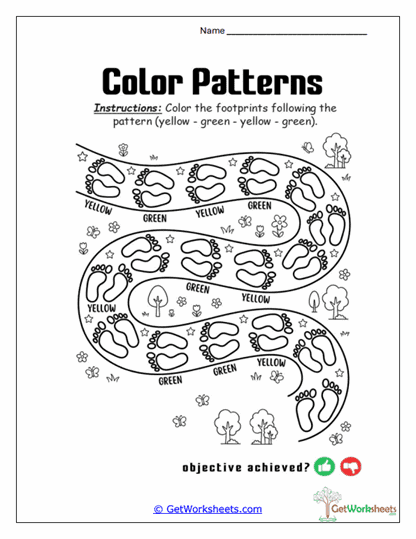
Footprint Color Path
-
-
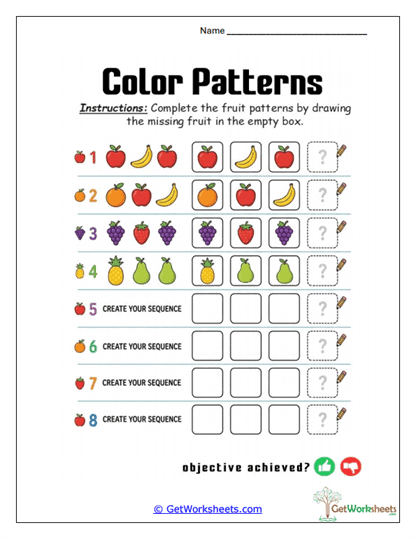
Fruit Basket Prediction
-
Heartbeat Color Cycle
-
Ice Cream Scoop Logic
-
Patterned Sock Parade
-
Rainbow Circle Sequence
-
Shooting Star Color Trail
-
Snake Stripe Sequence
-
Sock Pair Pattern
-
Sock Style Echo
-
Sunshine Sequence Trail
-
Vehicle Sequence Choice
-
Wing Spot Match
About This Worksheet Collection
Color patterns help young learners recognize order, repetition, and predictable relationships. By studying how colors repeat across shapes and pictures, children learn to identify a pattern rule and use it to decide what should come next. These early skills support sequencing, visual memory, classification, prediction, and later mathematical thinking.
This collection gives preschool and kindergarten students many ways to practice recognizing, copying, extending, and completing color patterns. Activities use circles, stars, hearts, clouds, suns, footprints, snakes, ice cream scoops, socks, fruit, vehicles, and butterflies to keep the practice visually engaging. Some worksheets focus on simple alternating patterns, while others involve three-part sequences, detailed design copying, missing items, pattern creation, or symmetrical color arrangements.
As students complete the collection, they strengthen color recognition, sequencing, visual discrimination, working memory, spatial awareness, prediction, and fine-motor control. They also practice identifying repeating units, maintaining correct order, copying designs accurately, using visual evidence to make choices, and explaining what comes next. Together, these activities help children understand that patterns follow dependable rules that can be recognized and applied in many different situations.
Detailed Descriptions Of These Worksheets
Butterfly Dot Mirror
Students study colored dots on one butterfly and reproduce the same arrangement on a matching butterfly. They must pay attention to color, position, spacing, and overall placement rather than simply copying the colors themselves. The side-by-side format strengthens spatial awareness and visual memory. Careful dot placement also provides useful fine-motor practice.
Cloudburst Color Chain
Rows of cloud shapes introduce repeating three-color sequences. Students identify the opening color order and continue the same pattern through the remaining clouds. Keeping the shape consistent allows learners to concentrate entirely on color, position, and repetition. The activity strengthens working memory and prediction while giving children repeated practice following a three-part rule.
Footprint Color Path
A winding trail of footprints gives students practice with a simple AB color pattern. Learners alternate between yellow and green while carefully following the path from beginning to end. The curved layout adds a visual-tracking challenge beyond a traditional straight row. This activity provides a strong foundation before children move into more complicated AAB, ABB, or ABC sequences.
Fruit Basket Prediction
Fruit pictures turn pattern recognition into a prediction and creation activity. Students analyze repeating sequences, determine which fruit belongs in a missing space, and may also create patterns of their own. The open-ended portions require children to understand the rule well enough to build a consistent sequence independently. This worksheet strengthens classification, logical reasoning, and early pattern creation skills.
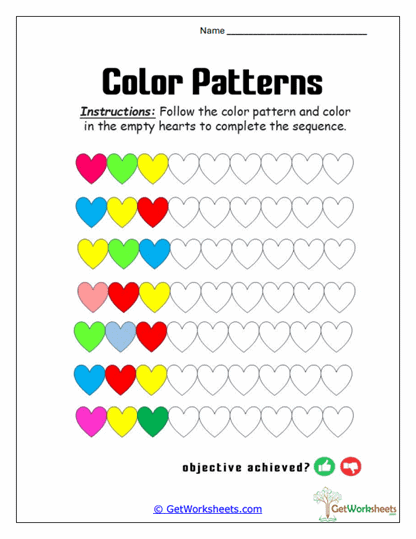
Heartbeat Color Cycle
Heart shapes are used to practice ABC color patterns in which three different colors repeat in a consistent order. Students identify the first-second-third sequence and continue it across each row. Because the heart shape does not change, learners can focus completely on remembering the color cycle. Repeated practice builds sequencing fluency and confidence with three-part patterns.
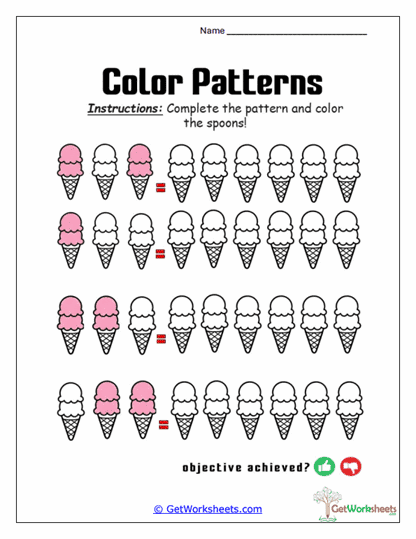
Ice Cream Scoop Logic
Colorful ice cream scoops give students an engaging setting for identifying several types of repeating sequences. Learners study the beginning of each row, determine the repeating unit, and color the remaining scoops accordingly. Because the pattern structure may vary, children need to inspect more than one example before making a prediction. The activity strengthens careful observation, memory, and flexible pattern reasoning.
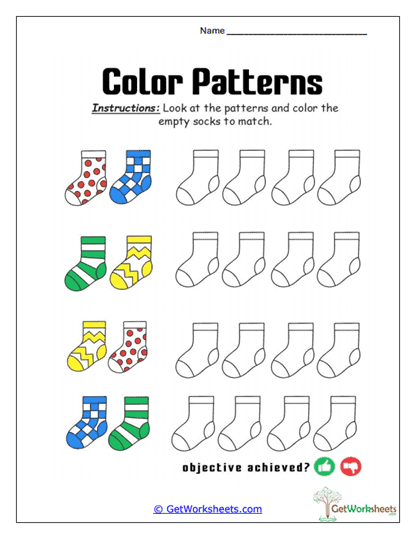
Patterned Sock Parade
Two detailed sock designs alternate across each row in an AB structure. Students determine which design comes next and reproduce its colors, stripes, dots, or other visual features. This combines basic sequencing with more detailed visual copying. The activity helps children understand that an entire design can act as one part of a repeating pattern.
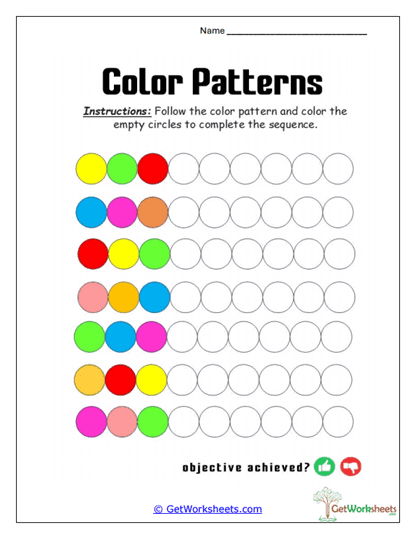
Rainbow Circle Sequence
Simple circles provide focused practice with repeating three-color sequences. Students use the first three colored circles as the repeating unit and continue the same order throughout each row. The uncluttered format makes this worksheet especially useful for children developing early pattern-recognition skills. It also reinforces color identification, prediction, and short-term visual memory.
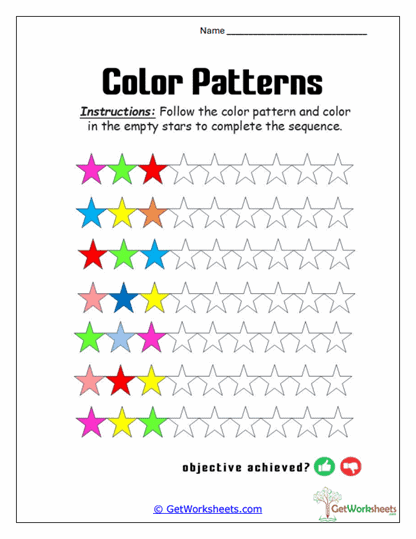
Shooting Star Color Trail
Rows of stars give students repeated practice extending three-color patterns. Each row begins with a different color combination, encouraging children to identify the rule rather than memorize one specific sequence. Learners track which color belongs in the first, second, and third positions of each cycle. Multiple examples help build greater independence and pattern fluency.
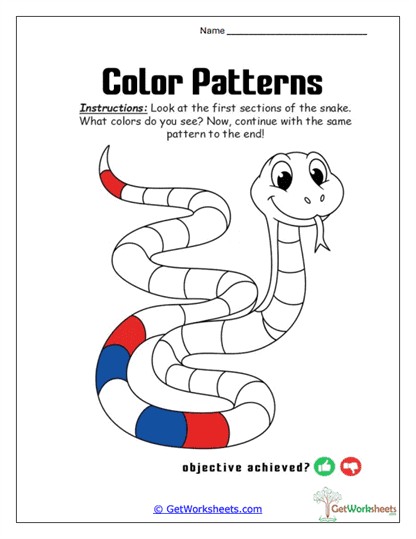
Snake Stripe Sequence
A long snake creates an extended alternating color pattern that students must maintain across many connected sections. Learners identify the opening rule and continue it carefully along the snake's body. The longer sequence challenges children to remember the pattern for more steps without losing their place. This strengthens visual tracking, concentration, and pattern stamina.
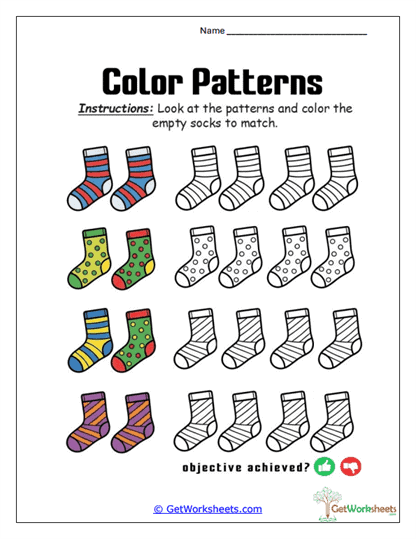
Sock Pair Pattern
Students examine decorated sock examples and reproduce their colors, stripes, dots, and other design features across additional socks. The task emphasizes matching and visual discrimination rather than color sequence alone. Children must notice which details make the sample design unique before copying it accurately. This activity strengthens observation and precise visual pattern reproduction.
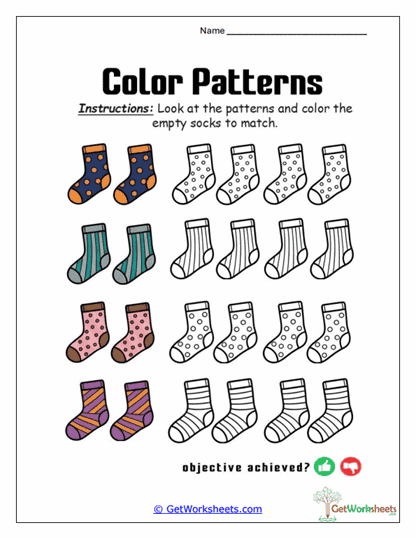
Sock Style Echo
Detailed sock designs ask students to copy several visual features at the same time. Learners study colors, dots, stripes, and their placement before decorating blank socks to follow the same rule. This gives children practice noticing small differences and maintaining consistency across an entire row. It also supports fine-motor control through more detailed coloring tasks.
Sunshine Sequence Trail
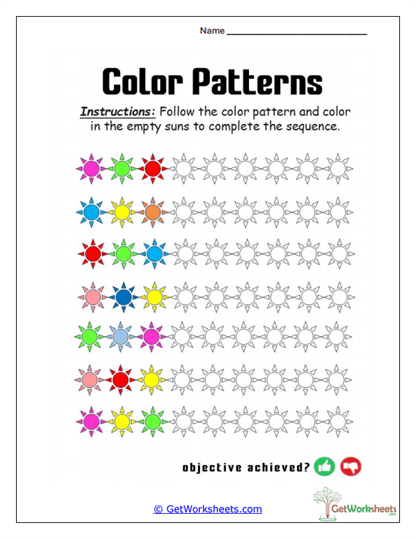
Bright sun shapes provide another setting for practicing three-part color sequences. Students determine which colors belong in the first, second, and third positions before continuing the pattern across each row. Saying the sequence aloud can help learners maintain the correct order. The activity strengthens prediction, position awareness, and visual memory.
Vehicle Sequence Choice
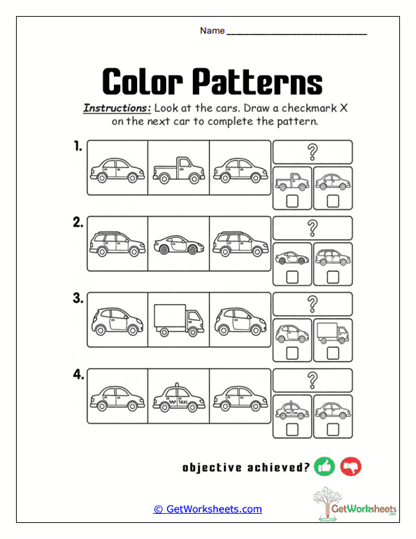
Cars and trucks create short visual sequences that students complete by choosing the correct next vehicle. Rather than simply coloring a continuation, learners compare answer choices and select the one supported by the pattern. This adds an important reasoning step because children must use evidence from the existing sequence. The activity strengthens prediction, visual discrimination, and decision-making.
Wing Spot Match
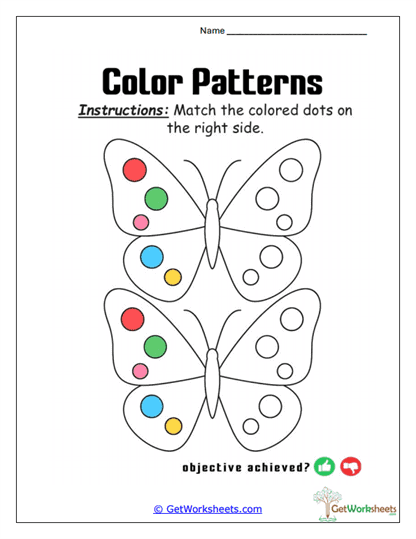
Students reproduce colored spots from one butterfly wing onto the opposite side to create a matching design. They compare color, size, position, and spacing while exploring the early idea of symmetry. The task combines color-pattern work with spatial reasoning and visual matching. It provides a natural introduction to how two sides of a shape can mirror one another.
Bookmark Us Now!
New, high-quality worksheets are added every week! Do not miss out!