Growing Patterns Worksheets
-
Arrow Direction Sequence
-
Bear Size Ladder
-
Cake Slice Sequence
-
-
Circle Count Challenge
-
Circle Pair Builder
-
Cupcake Alternation
-
Flower Turn-Taking
-
Frozen Treat Rotation
-
Next Number Finder
-
Pair-and-Check Number
-
Picture Pair Rhythm
-
Polygon Color Relay
-
Shape Growth Sketch
-
Smiley Switch Pattern
-
Tree Pattern Picker
About This Worksheet Collection
Growing patterns help young learners recognize how a sequence changes according to an organized rule. Some patterns increase in size or number, while others develop through predictable visual or numerical relationships that students can identify and extend. Understanding these patterns strengthens sequencing, prediction, comparison, counting, and early algebraic reasoning.
This collection gives preschool through early first-grade students several ways to investigate and continue patterns. Activities include extending size sequences, drawing missing shapes, finding the next number, choosing the next picture in alternating visual patterns, comparing colors and geometric forms, and using pairs to investigate even and odd quantities. The worksheets can be used for classroom centers, morning work, independent practice, small groups, intervention, homework, or homeschool lessons.
As students work through the collection, they strengthen visual reasoning, pattern recognition, number sense, size comparison, prediction, classification, and working memory. They also practice identifying pattern rules, comparing multiple visual features, representing numbers with objects, and using evidence to determine what belongs next. These varied activities encourage learners to look for mathematical structure instead of treating each picture or number as an unrelated example.
Detailed Descriptions Of These Worksheets
Arrow Direction Sequence
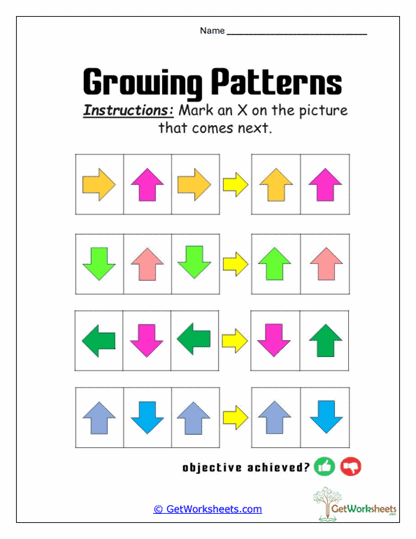
Students examine arrows that change in direction and color and determine which picture correctly continues each sequence. The activity requires learners to track more than one visual feature at a time, including position, color, and directional movement. Comparing possible answers encourages careful observation rather than guessing. It also reinforces spatial vocabulary such as up, down, left, and right.
Bear Size Ladder
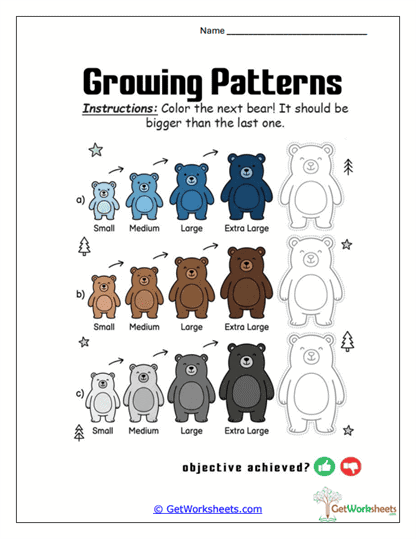
A sequence of bears gradually increases from small to larger sizes. Students study the progression and use the established size rule to determine how the final bear should fit the pattern. Keeping the picture itself consistent allows learners to focus entirely on growth and relative size. The activity strengthens comparison vocabulary, visual sequencing, and early measurement readiness.
Cake Slice Sequence
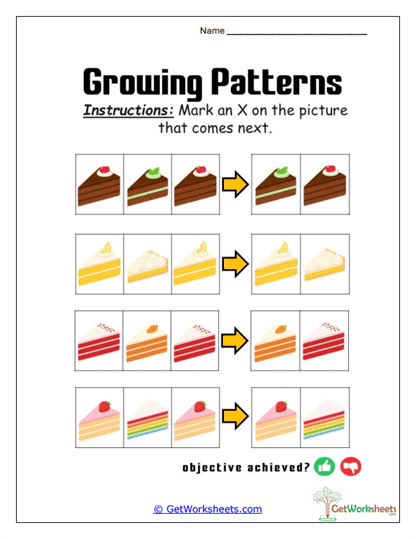
Decorated cake slices alternate according to an AB pattern. Students compare frosting, layers, toppings, and colors before selecting the slice that correctly continues each row. The detailed pictures require careful visual discrimination while the underlying sequence remains simple. This activity builds confidence applying familiar pattern rules to more complex-looking objects.
Circle Count Challenge
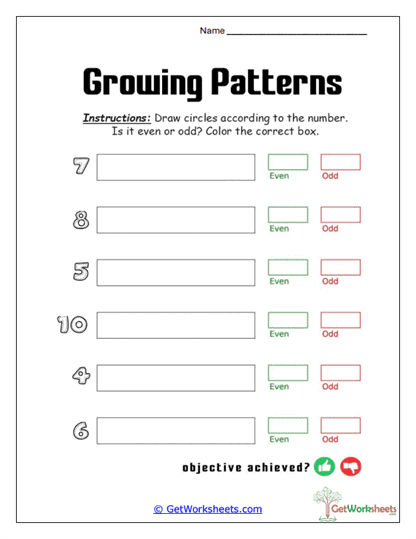
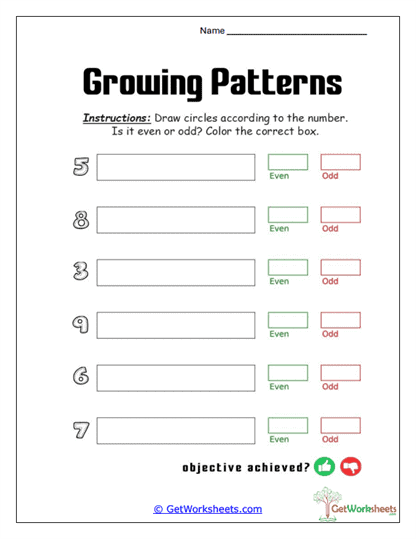
Students draw circle sets to represent given numbers and organize the circles into pairs. They then determine whether each quantity is even or odd based on whether every circle has a partner. The visual model gives learners concrete evidence for their classification. This activity strengthens counting, equal grouping, and early number reasoning.
Circle Pair Builder
Written numerals are represented with circles so students can test whether each quantity forms complete pairs. Learners identify numbers with no leftovers as even and those with one unpaired circle as odd. Drawing the quantities themselves helps connect numeral recognition with actual amounts. The worksheet provides a useful hands-on bridge from counting to number properties.
Cupcake Alternation
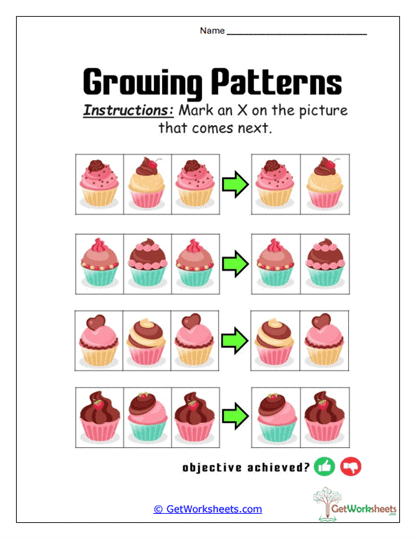
Different cupcake designs take turns across each visual sequence. Students compare frosting, toppings, wrappers, and colors to determine which cupcake belongs next. The familiar AB structure keeps the mathematics accessible while the detailed designs add a stronger observation challenge. Learners practice prediction, memory, and attention to visual features.
Flower Turn-Taking
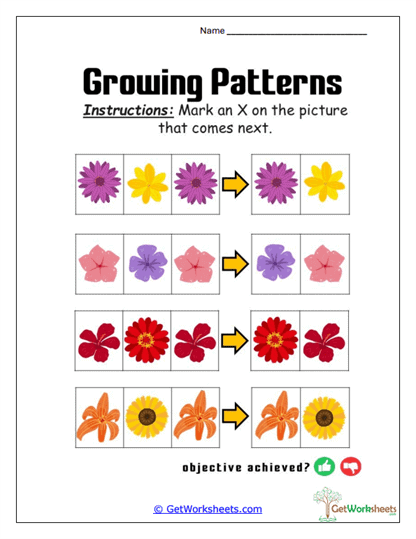
Two different flower designs alternate throughout each row. Students identify the repeating pair and choose the flower that maintains the established order. Variations in shape and color help learners understand that the same AB rule can appear in many visual forms. This activity reinforces flexible pattern recognition and sequence memory.
Frozen Treat Rotation
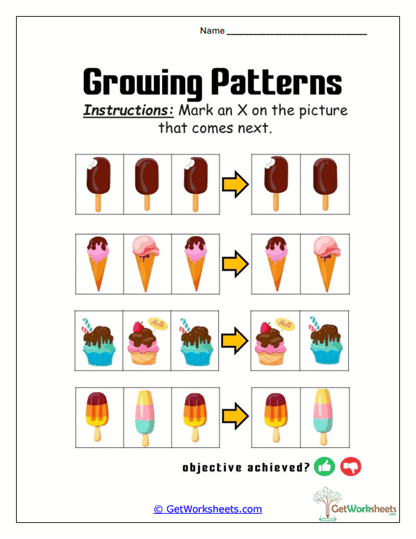
Popsicles, cones, and other frozen treats appear in alternating visual sequences. Students study the design details and determine which treat should continue each repeating pair. The playful theme adds variety while still requiring learners to rely on the pattern rather than personal preference. This worksheet strengthens comparison, prediction, and visual sequencing.
Next Number Finder
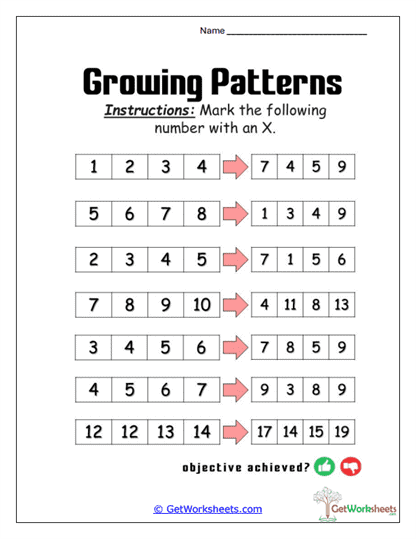
Short counting sequences introduce growing numerical patterns that increase by one. Students determine the next value and select it from several choices. Recognizing the plus-one relationship connects ordinary counting with the idea of a mathematical rule. The activity strengthens number order, counting fluency, and early addition thinking.
Pair-and-Check Number
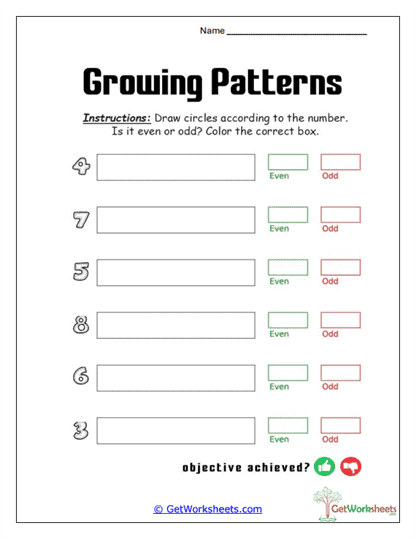
Students draw a set of circles for each given numeral and organize the quantity into pairs. The completed model is then used to classify the number as even or odd. Repeating the same process with several values helps learners develop a dependable strategy rather than relying only on memorization. This worksheet strengthens number representation, grouping, and classification.
Picture Pair Rhythm
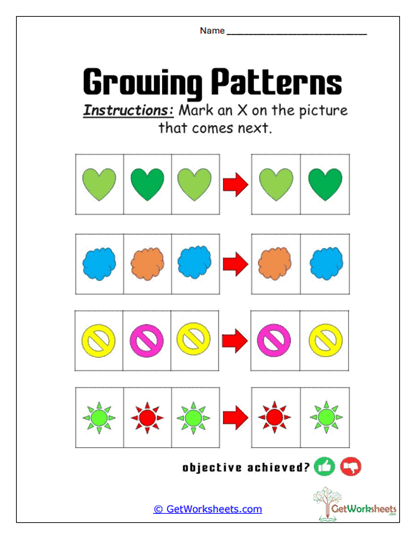
Hearts, clouds, suns, and other pictures create alternating visual patterns. Students identify the two-item repeating unit and choose the picture that correctly continues each sequence. Using several types of images helps children see that an AB structure remains the same even when the objects change. The activity develops flexible thinking and visual prediction.
Polygon Color Relay
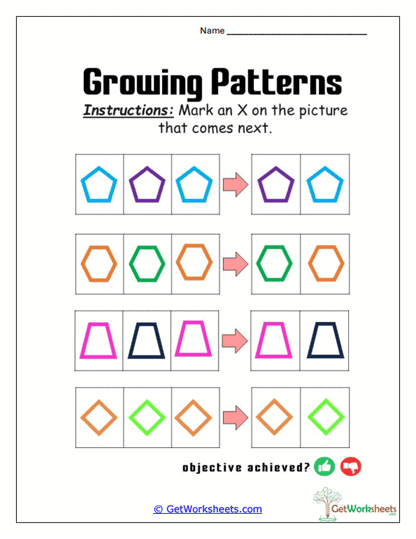
Geometric shapes and colors alternate across each sequence. Students compare pentagons, hexagons, trapezoids, diamonds, and their colors to determine what comes next. Tracking both shape and color makes the pattern more challenging than a single-feature sequence. The worksheet also reinforces basic geometry vocabulary alongside pattern recognition.
Shape Growth Sketch
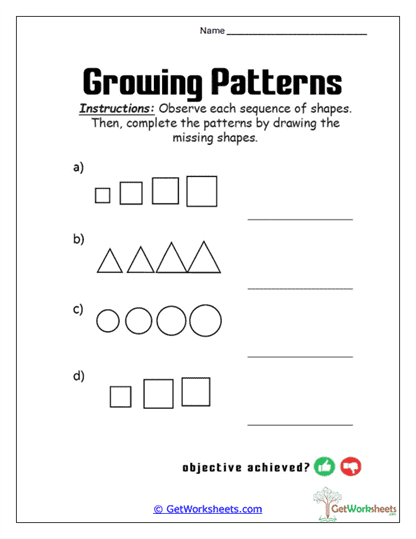
Simple geometric shapes increase in size from one step to the next. Students examine the progression and draw the missing shape at an appropriate larger size. Producing the next step themselves requires learners to understand the direction of growth rather than simply identify it. The activity combines pattern reasoning, geometry, and fine-motor practice.
Smiley Switch Pattern
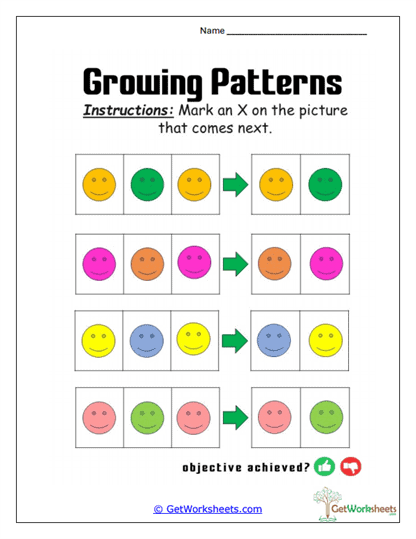
Colored smiley faces introduce simple alternating AB sequences. Students study the first few faces and choose the color that should appear next. The consistent picture shape keeps the focus on color order and repetition. This worksheet provides approachable practice with prediction and visual memory.
Tree Pattern Picker
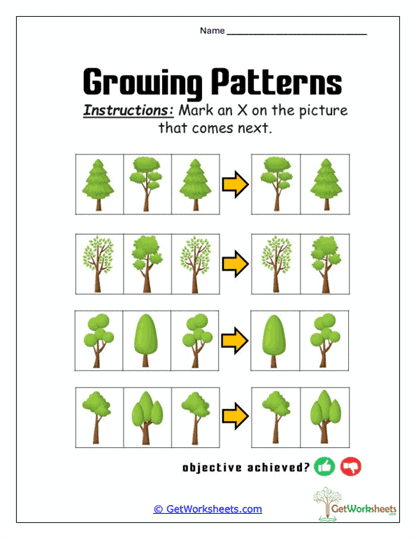
Different tree designs alternate across visual rows. Students compare shape, leaf style, color, and position before choosing the image that correctly continues the pattern. Because all of the choices are trees, learners must pay attention to the smaller details that distinguish the two repeating designs. This activity strengthens observation, comparison, and independent pattern reasoning.
Bookmark Us Now!
New, high-quality worksheets are added every week! Do not miss out!