Input-Output Tables Worksheets
-
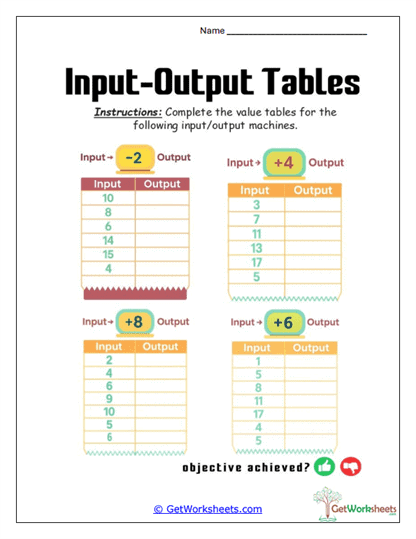
Add-and-Subtract Rule Grid
-
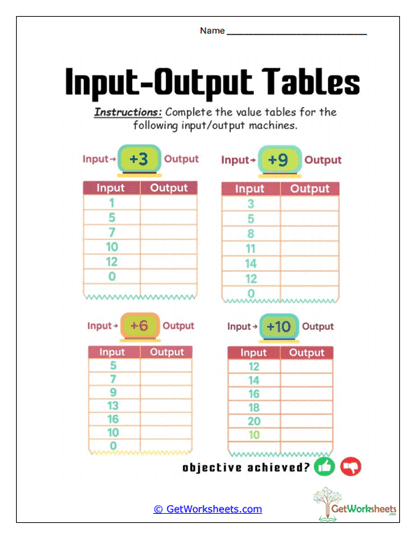
Add-On Table Practice
-
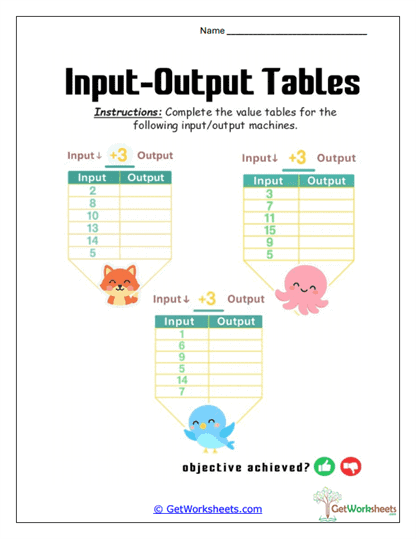
Animal Add-Three Tables
-
-
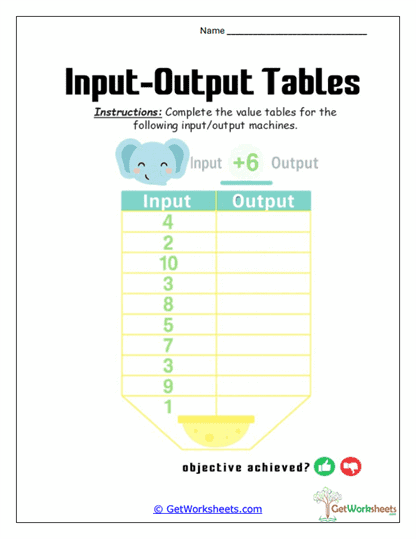
Elephant Plus-Six Machine
-
Flower Rule Table
-
Four-Rule Output Machines
-
Frog Plus-Eight Table
-
Hippo Plus-Ten Table
-
Kangaroo Plus-Seven Machine
-
Lion Plus-Five Table
-
Number Rule Stations
-
Rule Machine Mix
-
Subtraction Rule Practice
-
Woodland Take-Away Machines
-
Zoo Rule Builders
About This Worksheet Collection
Input-output tables help students understand how a consistent mathematical rule connects one number to another. A value enters the table as the input, a rule such as adding or subtracting a fixed amount is applied, and the result becomes the output. This structure gives learners an early introduction to number relationships, patterns, functions, and algebraic thinking.
This collection gives students many ways to practice completing input-output tables using addition and subtraction rules. Activities include applying mixed rules, working with single-operation tables, comparing growing and decreasing outputs, practicing mental-math facts, and using themed number machines to reinforce consistent relationships. The worksheets are well suited for grades 2-3 and can be used for classroom lessons, math centers, independent practice, homework, intervention, tutoring, or homeschool instruction.
As students work through the collection, they strengthen addition and subtraction fluency, table reading, rule application, mental computation, number sense, and pattern recognition. They also practice predicting whether an output should be larger or smaller, identifying fixed differences, checking answers for reasonableness, and explaining how one rule can create many related number pairs. These skills build a useful foundation for later work with functions, equations, and algebraic relationships.
Detailed Descriptions Of These Worksheets
Add-and-Subtract Rule Grid
Students complete several input-output tables that use different addition and subtraction rules. They must check the rule for each table before calculating the corresponding outputs. Switching among operations encourages careful reading and flexible number sense. The activity strengthens computation fluency while reinforcing the idea that every row within a table follows the same relationship.
Add-On Table Practice
Addition-only tables help students see how a fixed rule creates larger outputs. Learners apply rules such as adding 3, 6, 9, or 10 to a variety of input values. The repeated format builds mental-math fluency while making the input-output relationship easy to observe. This worksheet also introduces growing numerical patterns in a structured way.
Animal Add-Three Tables
Friendly animal-themed tables provide focused practice with one consistent rule: add 3. Students apply the same change to several different inputs and record each result. Keeping the rule constant reduces the cognitive load and helps learners concentrate on how the relationship works. Repeated +3 practice also supports faster mental addition.
Elephant Plus-Six Machine
Students find 6 more than each input and record the corresponding output. The repeated rule encourages learners to use strategies such as counting on, decomposing 6, or making a ten. Because every result should be larger by the same amount, students can also check their work by comparing the two columns. This activity develops addition fluency and rule-based reasoning.
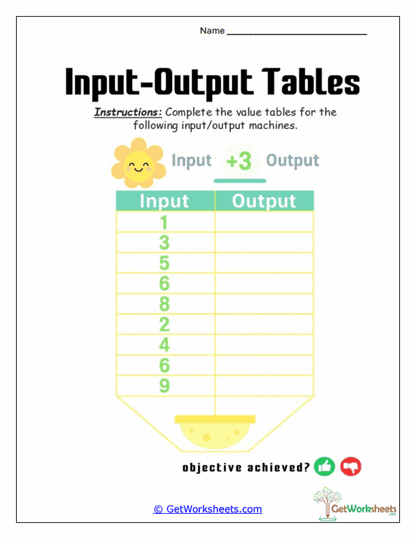
Flower Rule Table
A single add-3 rule guides students through a complete input-output table. Learners read each starting value, calculate 3 more, and write the result in the correct row. The simple structure makes the relationship between inputs and outputs especially clear. This page works well for students who are beginning to understand how number rules operate.
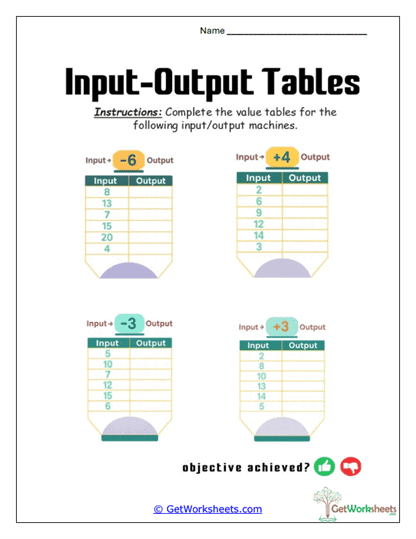
Four-Rule Output Machines
Four separate tables combine addition and subtraction rules so students can compare how different operations affect outputs. Learners decide whether each rule should make a number larger or smaller before calculating. This prediction step encourages stronger number sense and provides a useful self-check. The activity also reinforces consistent rule application across multiple examples.
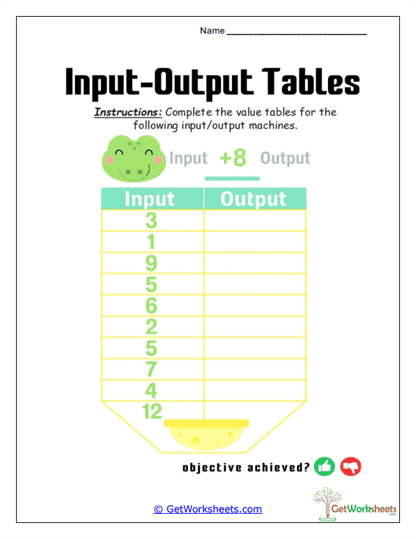
Frog Plus-Eight Table
Students apply an add-8 rule to a longer set of input values. The larger addition amount encourages the use of efficient strategies such as making ten or breaking 8 into smaller parts. Learners can verify their answers by checking that every output is exactly 8 greater than its input. This focused practice builds both computation fluency and early function understanding.
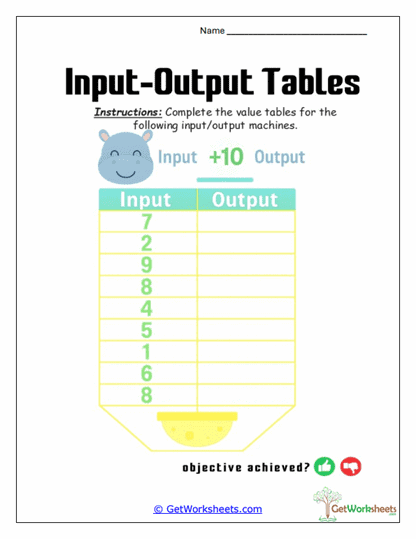
Hippo Plus-Ten Table
Adding 10 to each input gives students practice with one of the most important place-value relationships. Learners observe how the tens place changes while the ones place often remains the same. The repeated table format makes this pattern especially visible. This worksheet strengthens mental math, place value, and input-output reasoning at the same time.
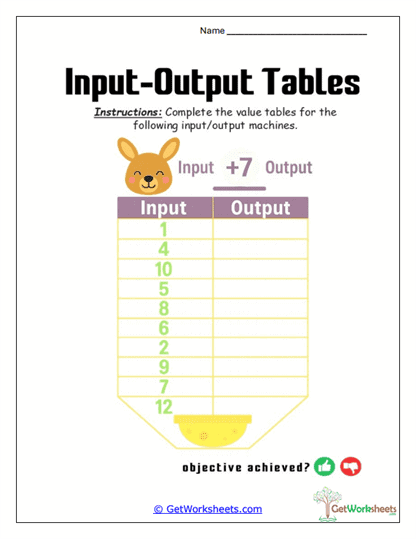
Kangaroo Plus-Seven Machine
Each input takes a numerical "jump" of 7 before becoming the output. Students may use counting on, making ten, or decomposition strategies to find each result. Repeated use of the same rule helps learners see that the difference between the two columns remains constant. The activity builds addition flexibility and confidence with less automatic facts.
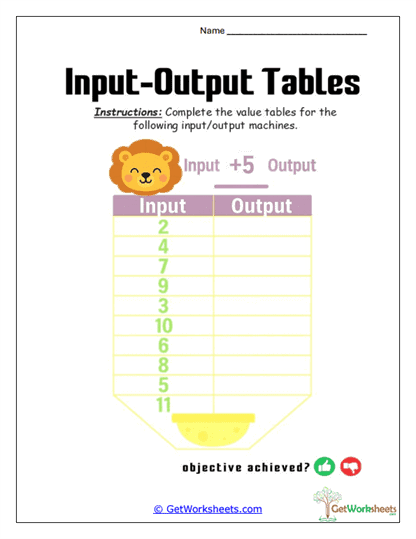
Lion Plus-Five Table
Students practice finding 5 more than a variety of input values. The rule connects naturally with counting by fives and familiar addition facts, making it a useful bridge between skip counting and function-style tables. Learners can check that each output is exactly 5 greater than its input. The activity strengthens mental calculation and pattern awareness.
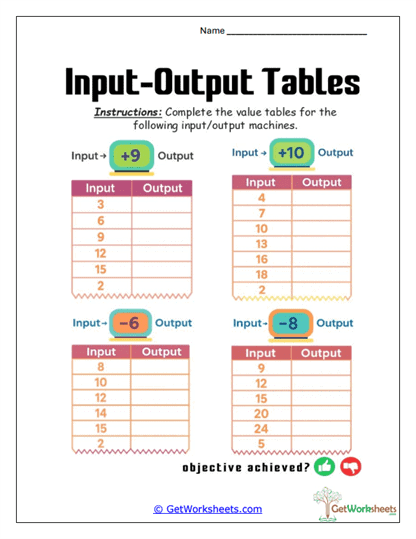
Number Rule Stations
Several tables use different addition and subtraction rules, requiring students to adjust their strategy from one section to the next. Learners read the input, apply the stated operation, and record the output accurately. The mixed format reinforces the importance of checking the rule before beginning. It also provides broad practice with number relationships and mental computation.
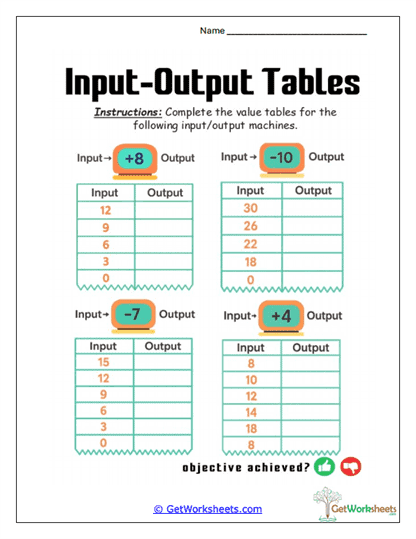
Rule Machine Mix
Students work through multiple number machines that use rules such as adding or subtracting a fixed amount. Each table shows how the same operation transforms several different inputs into predictable outputs. The machine concept makes early function thinking more concrete and accessible. This worksheet provides strong mixed practice with table reading, addition, subtraction, and rule consistency.
Subtraction Rule Practice
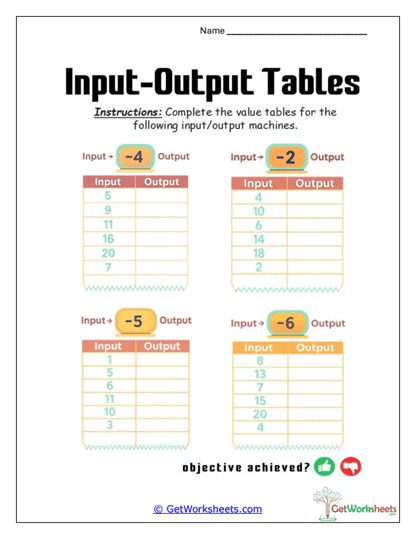
Every table on this page uses a subtraction rule, so students can focus on how fixed amounts make outputs smaller. Learners subtract values such as 2, 4, 5, or 6 from each input and record the result. The decreasing relationship provides a natural reasonableness check because an output larger than its input signals a likely error. This activity strengthens subtraction fluency and decreasing-pattern awareness.
Woodland Take-Away Machines
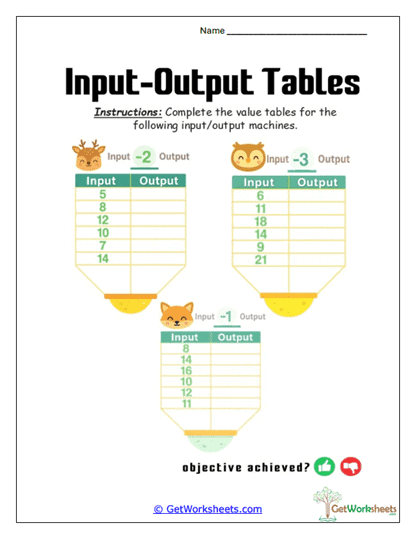
Woodland-themed number machines use simple subtraction rules such as taking away 1, 2, or 3. Students apply each rule consistently across the table and observe how every output becomes smaller. Comparing the different machines helps learners notice how changing the amount subtracted changes the relationship. The page is especially useful for building confidence with early subtraction patterns.
Zoo Rule Builders
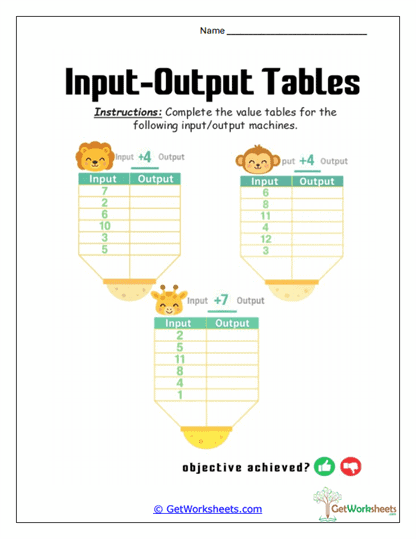
Animal-themed input-output tables use addition rules such as adding 4 or 7. Students calculate the larger output for each starting value and compare the resulting number pairs. The repeated differences make the underlying rule easier to recognize. This worksheet strengthens addition strategies while introducing the idea that one rule can describe an entire set of relationships.
Bookmark Us Now!
New, high-quality worksheets are added every week! Do not miss out!