Decreasing and Increasing Patterns Worksheets
-
Animal Train Count
-
Apple Basket Number Steps
-
Apple Tree Quantity Check
-
-
Bubble Count-Down
-
Candle Life Cycle
-
Circle Size Explorer
-
Cloud Size Forecast
-
Cookie Plate Countdown
-
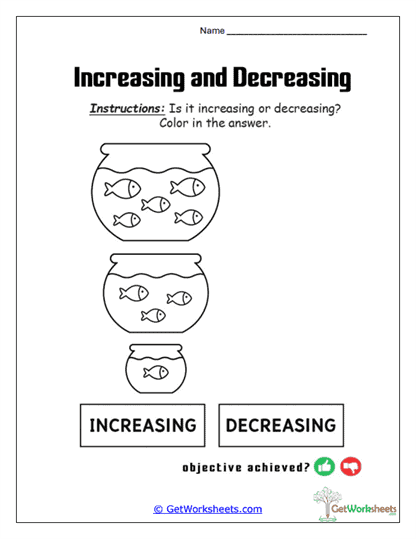
Fishbowl Quantity Drop
-
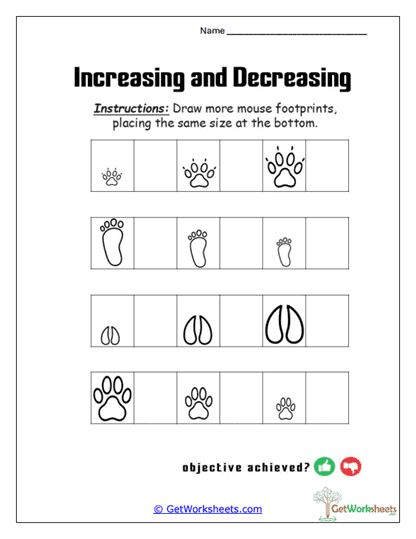
Footprint Size Steps
-
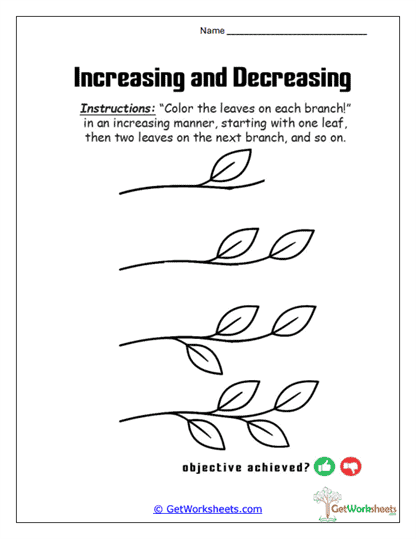
Growing Branches
-
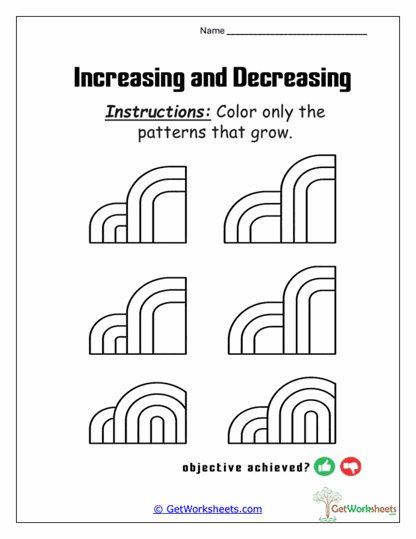
Growing Rainbow Shapes
-
Ice Cream Scoop Count
-
Passenger Count Cars
-
Star Growth Trail
About This Worksheet Collection
Increasing and decreasing patterns help young learners recognize how quantities, sizes, and visual features change in an organized direction. Instead of only repeating the same unit, these patterns may grow larger, become smaller, add more objects, or reduce the amount shown from one step to the next. Understanding these changes supports early counting, comparison, sequencing, prediction, and number sense.
This collection gives preschool and kindergarten students several ways to explore growth and shrinkage. Activities include comparing object sizes, counting sets that increase or decrease, ordering pictures from largest to smallest, drawing missing steps, identifying whether a pattern grows or shrinks, and connecting visual quantities with written numbers. The worksheets can be used for classroom centers, morning work, independent practice, small groups, intervention, homework, or homeschool instruction.
As students complete the collection, they strengthen counting fluency, quantity comparison, size vocabulary, visual sequencing, prediction, and one-to-one correspondence. They also practice using ideas such as more, fewer, bigger, smaller, increasing, decreasing, first, next, and last. These experiences help children understand that patterns can show gradual change as well as repetition, building an early foundation for addition, subtraction, measurement, and number sequences.
Detailed Descriptions Of These Worksheets
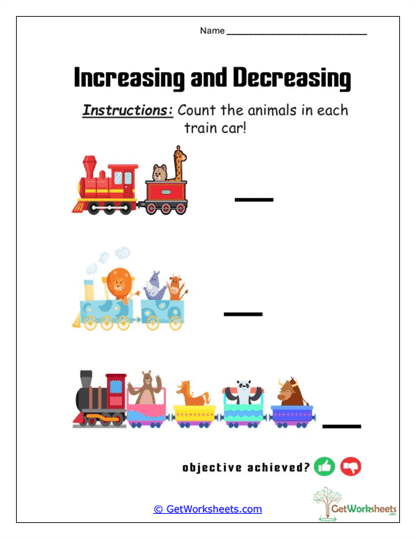
Animal Train Count
Students count the animals riding on different train cars and compare the size of each group. After finding each total, learners connect the picture with a number and decide which groups contain more or fewer animals. The activity helps children see how quantities can change from one example to the next. It strengthens counting, comparison, and early pattern awareness in an engaging visual setting.
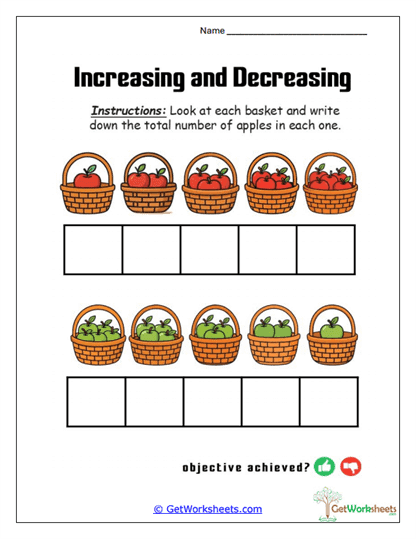
Apple Basket Number Steps
Baskets containing different numbers of apples give students practice counting and comparing changing sets. Learners record each total and determine whether neighboring groups are getting larger or smaller. Seeing the apples grouped together makes quantity differences easier to understand. This activity builds number sense while reinforcing increasing and decreasing patterns.
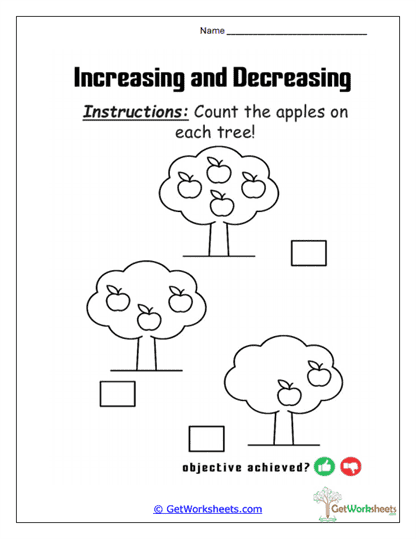
Apple Tree Quantity Check
Students count apples shown on different trees and write the matching numeral for each amount. They then compare the groups to decide which trees have more or fewer apples. The activity connects written numbers with real quantities and encourages careful one-to-one counting. It provides a simple foundation for later addition and subtraction thinking.
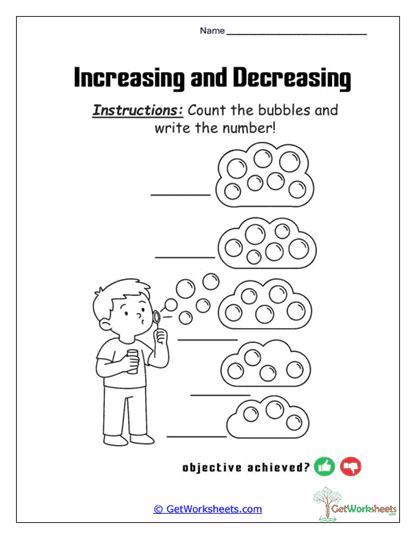
Bubble Count-Down
Groups of bubbles become smaller as students move through the activity. Learners count each group, record the matching number, and compare the totals to notice the decreasing pattern. The shrinking sets provide a clear visual introduction to quantities getting smaller. This worksheet also supports backward-counting and early subtraction readiness.
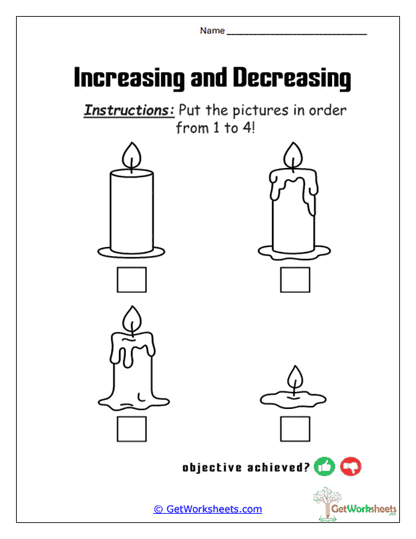
Candle Life Cycle
Students arrange candle pictures from newest and tallest to most melted and shortest. Comparing height and the amount remaining helps learners understand a decreasing sequence that happens over time. The activity also reinforces words such as first, next, then, and last. It combines visual comparison with logical ordering in a familiar real-world context.
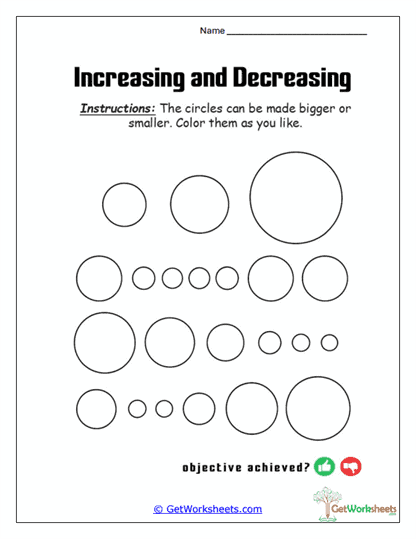
Circle Size Explorer
Different-sized circles give students focused practice comparing large, medium, and small shapes. Learners notice when a row grows larger or becomes smaller and use comparison words to describe what they see. The simple visual format keeps attention on relative size rather than other picture details. This activity supports measurement readiness and visual ordering.
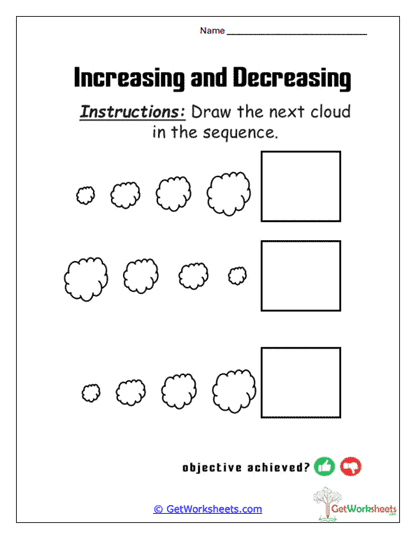
Cloud Size Forecast
Students study cloud sequences that either grow or shrink and draw the next cloud in the correct relative size. They must first determine the direction of change before predicting what belongs in the blank space. Creating the next step requires a deeper understanding than simply recognizing the pattern. The activity strengthens size comparison, prediction, and visual sequencing.
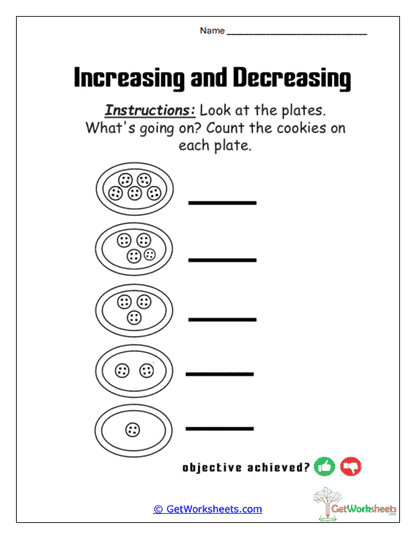
Cookie Plate Countdown
Plates with fewer cookies from one step to the next provide a clear decreasing pattern. Students count each group, write the corresponding numeral, and compare the totals. The activity introduces the idea that removing objects results in a smaller quantity. It is especially useful for building early subtraction and backward-counting concepts.
Fishbowl Quantity Drop
Fishbowls containing fewer fish help learners decide whether a pattern is increasing or decreasing. Students count the fish, compare the groups, and identify the direction of change. This simple format emphasizes that understanding a pattern involves noticing how the amount changes, not just counting each set separately. The worksheet strengthens quantity comparison and mathematical vocabulary.
Footprint Size Steps
Rows of footprints change from small to medium to large or in the reverse direction. Students compare the sizes and draw the missing footprint needed to complete each sequence. The activity reinforces words such as bigger, smaller, largest, and smallest without requiring number work. It also supports visual reasoning and fine-motor development.
Growing Branches
Branches gain one additional leaf at each step, creating an easy-to-see increasing pattern. Students count the leaves and observe how the quantity grows by one from branch to branch. This visual model introduces the concept of one more in a concrete way. The activity supports counting-on strategies and early addition understanding.
Growing Rainbow Shapes
Students examine sets of arched shapes and identify which arrangements show a true increasing pattern. They compare size, height, and order before deciding whether the shapes consistently grow larger. This classification task helps children understand that different sizes alone do not create an increasing sequence. The activity builds careful observation and logical reasoning.
Ice Cream Scoop Count
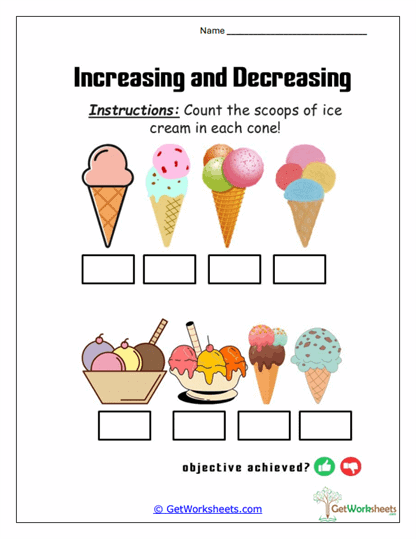
Cones, bowls, and sundaes contain different numbers of scoops for students to count and compare. Learners write each total and identify which treats have more or fewer scoops. The familiar pictures make quantity comparison approachable while reinforcing that numbers describe actual amounts. The worksheet strengthens counting fluency and early number sense.
Passenger Count Cars
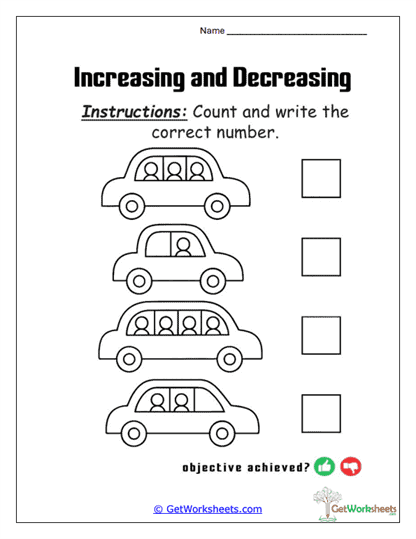
Students count passengers shown inside different cars and record the corresponding numerals. Comparing the groups helps learners notice which cars contain larger or smaller quantities. The activity reinforces one-to-one correspondence and the meaning of the final counting number. It also gives children practice identifying changes in group size.
Star Growth Trail
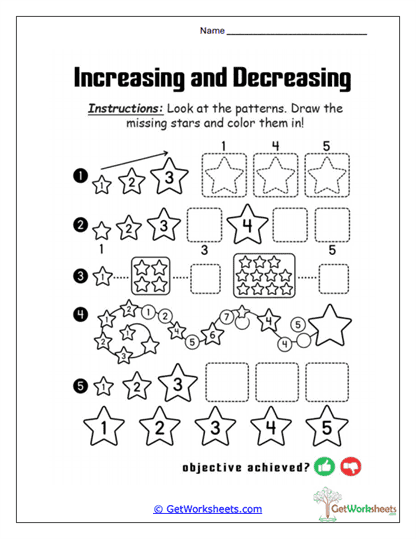
Stars change in size and quantity across visual sequences, asking students to decide whether each pattern is increasing or decreasing. Learners compare neighboring steps, draw missing stars, and use the surrounding information to predict what belongs next. Combining size and number ideas provides richer early pattern practice. This worksheet strengthens comparison, sequencing, and visual reasoning.
Bookmark Us Now!
New, high-quality worksheets are added every week! Do not miss out!