Model Makers
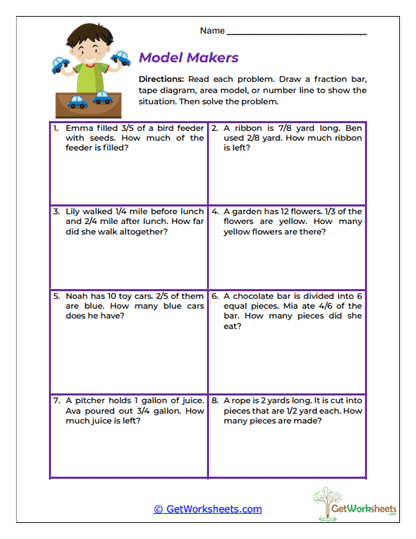
Model Makers asks students to represent fraction word problems with a drawing before solving them. Students read each situation, create a fraction bar, tape diagram, area model, or number line, and then use that model to determine the answer. The activity strengthens visual modeling, fraction operations, reading comprehension, equal partitioning, number-line reasoning, tape diagrams, and mathematical explanation. It is especially appropriate for students in grades 5-6 who benefit from seeing a problem before attempting a symbolic calculation.
Targeted Skills
- Represent the situation: Students translate the words in each problem into a clear mathematical picture.
- Choose a useful model: Learners decide whether a fraction bar, tape diagram, area model, or number line best shows the quantities.
- Connect models and operations: Students use their drawing to identify whether the problem involves addition, subtraction, multiplication, or division.
- Solve with evidence: Children use the completed representation to support and check their numerical answer.
Instructional Support
- Makes thinking visible: Teachers and parents can see how a student understands the quantities and relationships in the story.
- Supports developing readers: A drawing can make the meaning clearer when the wording feels difficult.
- Offers flexible strategies: Students are not limited to one model and can choose the representation that makes the most sense to them.
- Useful for discussion: Learners can compare different models and explain why more than one approach may work.
- Works at school or home: The page is suitable for guided groups, independent practice, tutoring, homework, or homeschool lessons.
Drawing a model helps children move from the story to the equation in a thoughtful way. Instead of guessing which operation to use, students can show the whole amount, the fractional parts, what was added or removed, and what remains unknown. Parents do not need advanced math knowledge to help; they can simply ask, “Can you draw what is happening?” As students complete the worksheet, they build visual reasoning, fraction comprehension, operation selection, model accuracy, problem-solving fluency, and confidence. This type of practice is valuable in classroom and homeschool settings because it teaches children to explain their thinking, check whether an answer makes sense, and approach unfamiliar fraction problems with a reliable strategy.
Bookmark Us Now!
New, high-quality worksheets are added every week! Do not miss out!