Equation Pair-Up
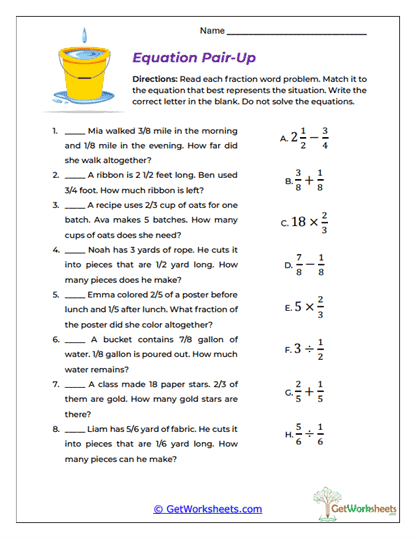
Equation Pair-Up asks students to match each fraction word problem with the equation that correctly represents the situation. Students read the story, determine which operation is needed, compare the available equations, and record the matching letter without solving the problem. This focused activity develops equation recognition, operation choice, fraction vocabulary, reading comprehension, mathematical modeling, and relationship analysis. It is a strong grades 5-6 worksheet for students who need practice understanding how real-life situations are translated into fraction equations.
Skills Reinforced
- Interpret the situation: Students determine what is happening to the quantities in each word problem.
- Select the operation: Learners distinguish among addition, subtraction, multiplication, and division.
- Match numbers correctly: Students pay attention to which fraction is the starting amount and which represents a change or group size.
- Read equations meaningfully: Children learn to view an equation as a description of a situation rather than as numbers to calculate automatically.
Learning Benefits
- Removes calculation pressure: Students can concentrate on comprehension and equation structure without also solving.
- Encourages careful comparison: Several equations may contain the same numbers, so learners must study the operation and order.
- Supports helpful discussion: Parents and teachers can ask students to explain why one equation fits and the others do not.
- Works as practice or assessment: The page can be used during instruction, independent work, tutoring, homework, or homeschool lessons.
- Print-and-go format: No additional materials are needed.
This worksheet helps children understand that using the correct numbers is not enough; the operation must also match what the story describes. For example, finding what remains after some ribbon is used requires subtraction, while finding how many short pieces can be cut from a longer rope requires division. A useful parent question is, “What does each number mean in the story, and what are we trying to find?” Students strengthen operation sense, equation comprehension, fraction reasoning, reading precision, mathematical vocabulary, and confidence. In classroom and homeschool settings, this practice prepares learners to write their own equations and solve more complicated fraction word problems independently.
Bookmark Us Now!
New, high-quality worksheets are added every week! Do not miss out!