Payday Spending Review
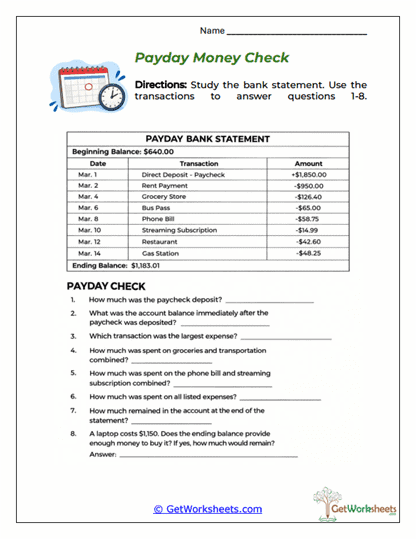
The Payday Spending Review Worksheet helps students look at a short bank statement and understand what happened to the money after a paycheck was deposited. Students examine a beginning balance, a direct-deposit paycheck, and several expenses such as rent, groceries, transportation, subscriptions, restaurant spending, and bills, then answer questions about the largest expense, remaining balance, total spending, and how much money was left by the end. This is especially useful for grades 6-8 because it connects addition and subtraction with the kind of monthly budgeting decisions people actually make. For parents, the big lesson is simple: earning money is only half the story; students also need to understand where it goes and how much remains after expenses.
Key Learning Objectives
- Identify Income: Students locate the paycheck deposit and understand how it increases the account balance.
- Analyze Expenses: Learners compare purchases and bills to determine which costs the most.
- Calculate Money Remaining: Students use the transaction history to determine how the balance changes.
- Evaluate Spending: The activity encourages learners to think about whether the account has enough money left for another purchase.
Classroom & Home Use
- Connects Math to Budgeting: Students see how income and expenses work together in a realistic account.
- Supports Financial Decision-Making: Learners think about whether an additional expense is affordable based on the ending balance.
- Easy for Parents to Discuss: Families can ask, “What took the biggest bite out of the paycheck?”
- Useful for Practical Math Lessons: The worksheet fits financial literacy, business math, consumer math, or homeschool instruction.
Students reinforce income, expenses, bank balances, budgeting, transaction analysis, and money comparison while answering the payday questions. This matters because students need to understand that a paycheck amount is not the same as the amount of money available after bills and purchases are paid. In the classroom, teachers can ask students to separate needs from optional spending and discuss how each transaction affects the balance. At home, parents can explain that this is basically what adults do when checking whether there is enough money left for something they want to buy. That makes the math easier to connect with real life. With practice, students become more confident reading statements, comparing expenses, and thinking ahead before spending money.
Bookmark Us Now!
New, high-quality worksheets are added every week! Do not miss out!