Rounding Fractions Worksheets
About This Worksheet Collection
Rounding fractions helps students move beyond seeing fractions as symbols and begin thinking about their actual size. By comparing values with familiar benchmarks such as 0, 1/2, and 1, learners develop a clearer sense of where a fraction belongs on a number line and how close it is to a whole or half. That intuition becomes especially valuable when students later estimate fraction operations, compare mixed numbers, or decide whether an exact answer is reasonable.
This collection approaches fraction estimation through several different lenses. Students sort and match fractions by benchmark, compare values with one-half, round mixed numbers to wholes and halves, estimate recipe and measurement quantities, approximate sums and differences, inspect incorrect benchmark choices, and compare estimated results with exact calculations. The variety keeps the work from becoming a repetitive rounding drill and instead encourages students to reason about fraction magnitude in meaningful ways.
As learners work across the collection, they strengthen benchmark-fraction knowledge, numerator-denominator relationships, number-line thinking, mixed-number sense, mental math, and estimation. They also learn to use approximation as a planning and checking tool, not merely as a shortcut. These experiences help students build the kind of flexible fraction sense that supports later work with operations, measurement, equivalence, and more advanced rational-number reasoning.
Detailed Descriptions Of These Worksheets
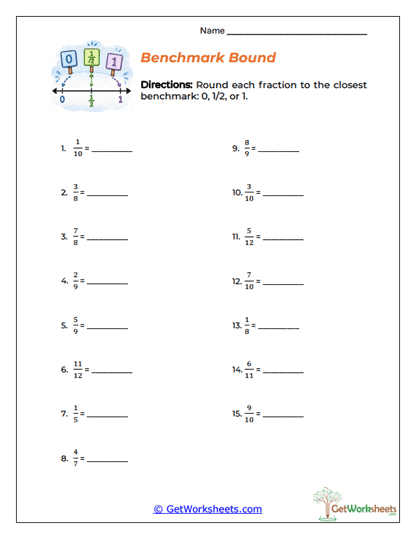
Benchmark Bound
Students decide whether each fraction lies closest to 0, 1/2, or 1. Rather than converting values into decimals or finding common denominators, they reason from the relationship between the numerator and denominator. This keeps the focus on size and helps learners build quick mental reference points for common fractions. The activity offers a strong introduction to benchmark-based fraction estimation.
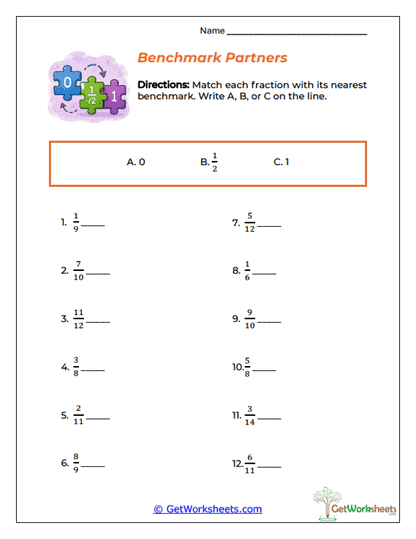
Benchmark Partners
Fractions are matched with the benchmark value they most closely resemble. Students must decide whether each amount is very small, near halfway, or close to one whole before making the connection. The matching format encourages quick recognition while still requiring meaningful comparison. It is especially useful for helping learners develop an immediate sense of fraction magnitude.
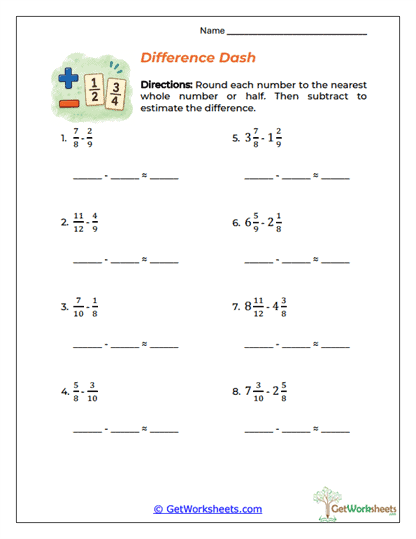
Difference Dash
Fraction and mixed-number subtraction problems are simplified by rounding each value to a nearby whole number or half. Students then subtract the friendlier estimates to predict the approximate size of the difference. This shifts attention away from exact procedures and toward how far apart two quantities really are. The activity is useful for building expectations before students complete exact fraction subtraction.
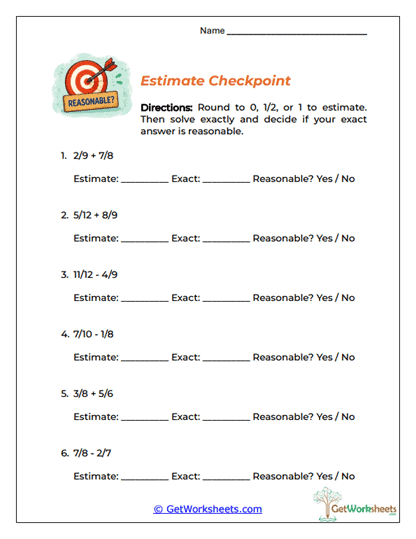
Estimate Checkpoint
Students estimate first, solve exactly, and then decide whether the two results make sense together. Fractions are rounded to 0, 1/2, or 1 before addition or subtraction, giving learners a rough target for the exact answer. If the calculated result falls far outside that expected range, students have a clear reason to recheck their work. This routine turns estimation into a practical self-checking strategy.
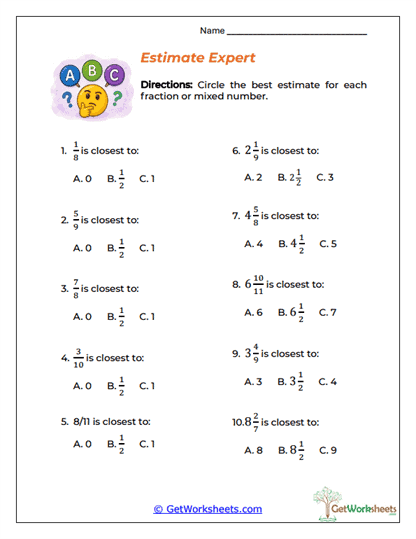
Estimate Expert
Proper fractions and mixed numbers are compared with several possible whole-number or half-unit estimates. Students choose the benchmark that best represents each value without relying on decimal conversion. Because both fractions below one and mixed numbers appear, learners must apply the same magnitude reasoning across different number forms. The multiple-choice structure provides a useful way to assess whether benchmark understanding has become automatic.
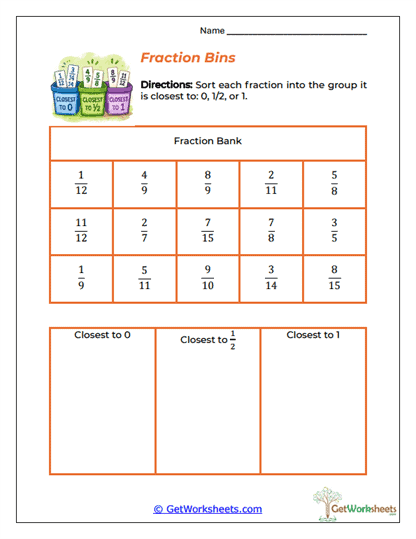
Fraction Bins
Students sort a mixed collection of fractions into groups closest to 0, 1/2, or 1. Seeing many fractions side by side helps learners notice patterns that may be harder to recognize in isolated problems. Small numerators, near-half relationships, and numerators close to the denominator begin to carry clearer meaning. The sorting format makes classification part of the mathematical reasoning.
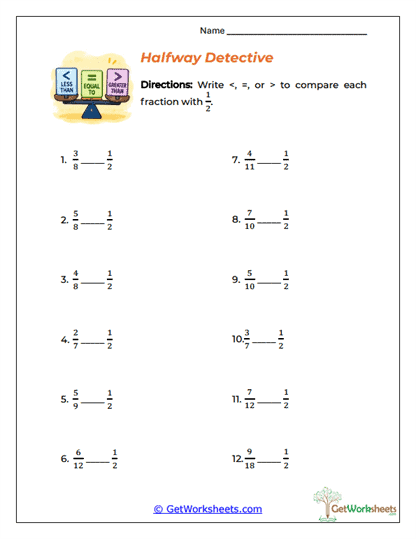
Halfway Detective
Every fraction is judged in relation to one-half. Students decide whether each value is less than, equal to, or greater than 1/2 and record the relationship with a comparison symbol. This highlights a particularly powerful benchmark and reinforces equivalent halves in forms such as 4/8 or 6/12. The activity gives students a fast comparison strategy they can reuse across many later fraction topics.
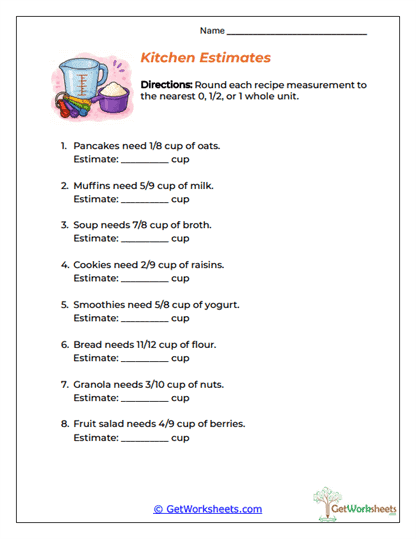
Kitchen Estimates
Recipe measurements provide a concrete setting for benchmark rounding. Students estimate fractional cup amounts as 0, 1/2, or 1 whole cup while thinking about how full a measuring cup would actually be. The kitchen context makes fraction magnitude easier to visualize and connects numerical reasoning with capacity. This worksheet helps learners see fractions as measurable quantities rather than abstract notation.
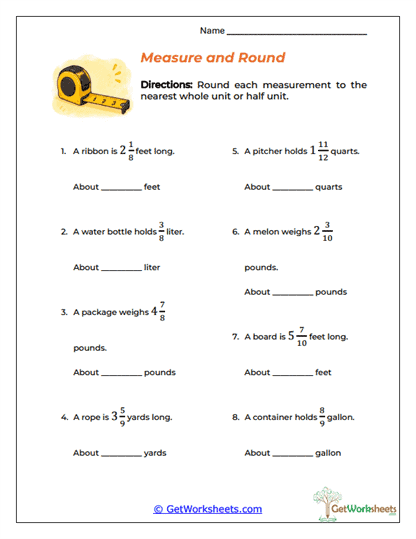
Measure and Round
Students estimate fractional and mixed-number measurements involving length, weight, and capacity. Values are rounded to nearby wholes or halves while units such as feet, liters, pounds, yards, quarts, and gallons keep the mathematics grounded in real quantities. The activity asks learners to coordinate fraction sense with measurement sense at the same time. It is especially useful for strengthening the idea that an approximate measurement can still be useful when exact precision is unnecessary.
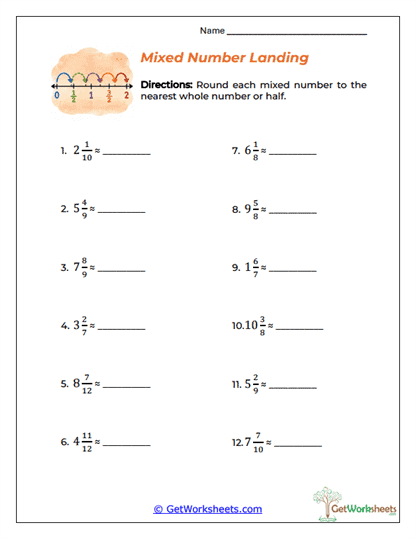
Mixed Number Landing
Students determine where mixed numbers would land when rounded to the nearest whole number or half. The fractional part becomes the key clue for deciding whether the value stays near the lower whole, falls around the midpoint, or approaches the next whole. This gives learners a number-line style way to reason about mixed numbers. It also extends benchmark thinking beyond values between 0 and 1.
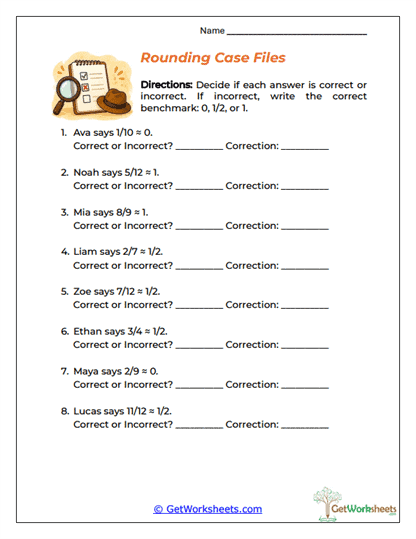
Rounding Case Files
Completed fraction estimates are investigated for accuracy. Students decide whether each fraction has been matched with the correct benchmark and replace weak estimates when necessary. The error-analysis format requires them to explain size relationships rather than simply generate another answer. This makes the worksheet a strong test of whether benchmark reasoning is truly understood.
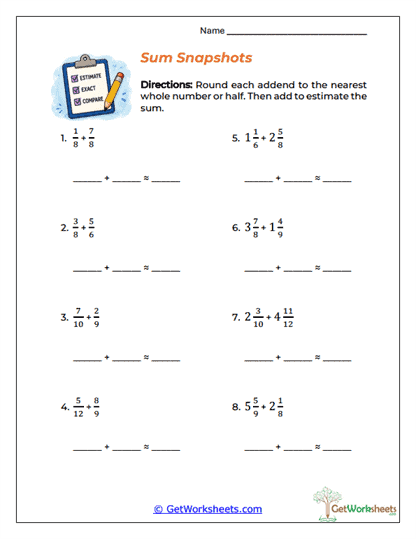
Sum Snapshots
Students estimate fraction and mixed-number sums by rounding each addend to a nearby whole or half first. Awkward fractional expressions are transformed into mental-math combinations such as 1/2 + 1 or 2 + 1/2. The resulting estimate gives learners a useful expectation before exact addition begins. This activity helps make fraction addition feel more manageable while strengthening reasonableness checking.
Bookmark Us Now!
New, high-quality worksheets are added every week! Do not miss out!