Round By Place Worksheets
About This Worksheet Collection
Rounding by place helps students see that the same number can change in different ways depending on which digit matters most. Instead of viewing rounding as a single rule, learners work with tens, hundreds, thousands, and ten-thousands while paying close attention to the target place, the digit beside it, and the size of the resulting estimate. This strengthens place-value understanding, number magnitude, estimation, and overall number sense.
The collection explores rounding through several formats so students do not simply repeat the same routine. Learners identify target digits, use number lines and benchmarks, complete charts, compare two rounded versions of the same number, work backward from rounded values, match numbers with results, inspect mistakes, and switch rapidly among different place values. These activities are well suited for grades 3-5 and can support direct instruction, independent practice, intervention, review, enrichment, or homeschool learning.
As students move through the worksheets, they develop a more precise understanding of why numbers round the way they do. They learn to distinguish the place being rounded from the digit that controls the decision, recognize the ranges of numbers that lead to the same rounded value, compare levels of precision, and question answers that do not fit the original number. Together, these activities build fluency while also encouraging careful reasoning and stronger confidence with multi-digit numbers.
Detailed Descriptions Of These Worksheets
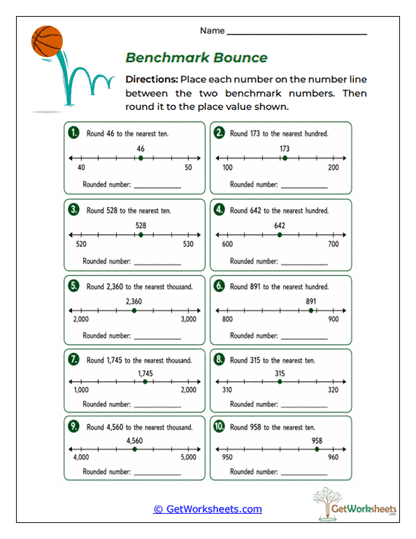
Benchmark Bounce
Students use number lines to place values between two nearby benchmarks before deciding which one is closer. This visual approach turns rounding into a question of distance rather than a rule students must memorize without context. Problems move among tens, hundreds, and thousands so learners can see the same idea operating at different scales. The activity is especially helpful for students who benefit from seeing why a number rounds up or down.
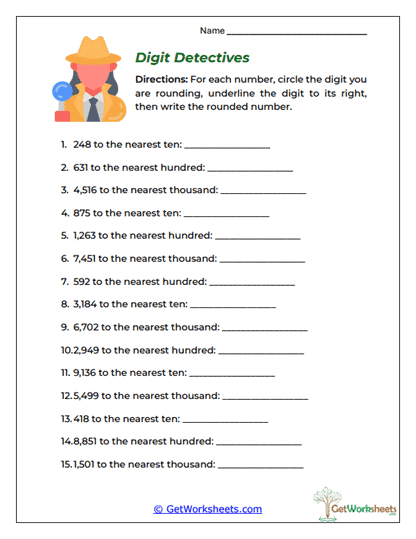
Digit Detectives
Rounding begins with identifying two different digits: the place being rounded and the digit that controls the decision. Students circle one, underline the other, and only then write the rounded value. That deliberate sequence slows the process down just enough to prevent one of the most common rounding mistakes. It also gives teachers and parents a clear way to see whether an error comes from place-value confusion or from applying the rounding rule incorrectly.
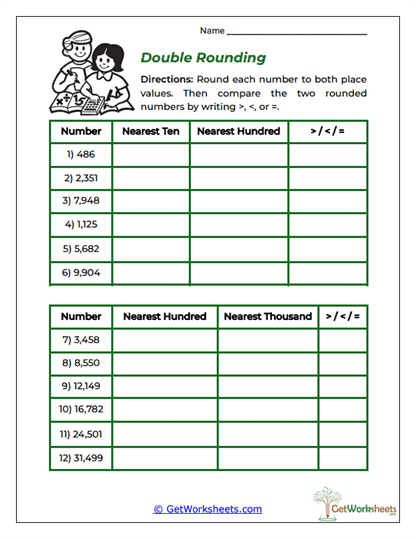
Double Rounding
Each number is rounded in two different ways and the resulting values are compared. Students may examine nearest-ten versus nearest-hundred estimates or nearest-hundred versus nearest-thousand estimates before using comparison symbols to describe the relationship. Seeing two approximations side by side makes the idea of precision much more visible. The worksheet reinforces that a broader rounding place can still be correct even though it preserves less detail.
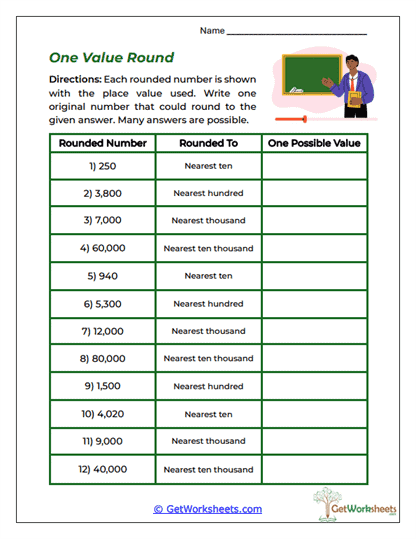
One Value Round
Students work backward from a rounded number and invent an original value that could reasonably have produced it. Because many answers may be possible, learners must think in terms of intervals rather than searching for one predetermined number. This creates a deeper understanding of the boundaries around tens, hundreds, thousands, and ten-thousands. The activity also introduces a flexible style of reasoning that connects naturally with later work involving ranges and inequalities.
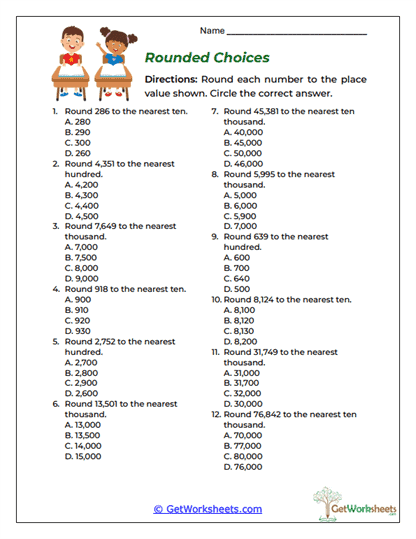
Rounded Choices
Multiple-choice questions ask students to round values across several different place values and then select the correct result. The answer options often reflect common mistakes, such as rounding to the wrong place or changing the number too much. This gives learners practice not only producing a rounded value but also rejecting alternatives that do not fit the number. The format works well for building both fluency and careful attention to directions.
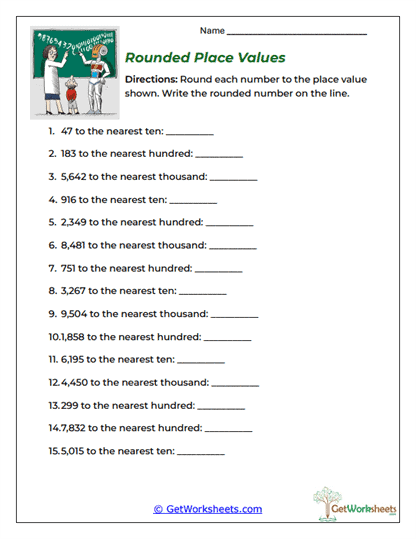
Rounded Place Values
This worksheet provides direct practice with rounding whole numbers to named places such as tens, hundreds, and thousands. The values gradually increase in size, allowing students to apply the same reasoning across increasingly complex numbers. Because the format stays straightforward, attention remains on digit position and the relationship between neighboring places. It serves as a strong foundation before students move into more analytical rounding tasks.
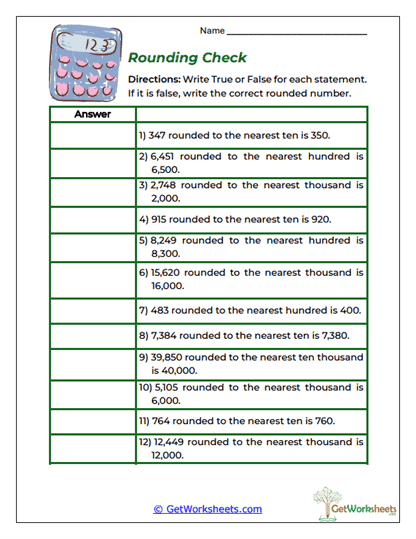
Rounding Check
Students evaluate completed rounding statements and decide whether each one is true or false. Incorrect results must be replaced with a correct rounded value, making students responsible for both judgment and repair. The mixed place values prevent them from slipping into one automatic pattern. This activity strengthens self-checking habits and encourages learners to verify an answer before accepting it.
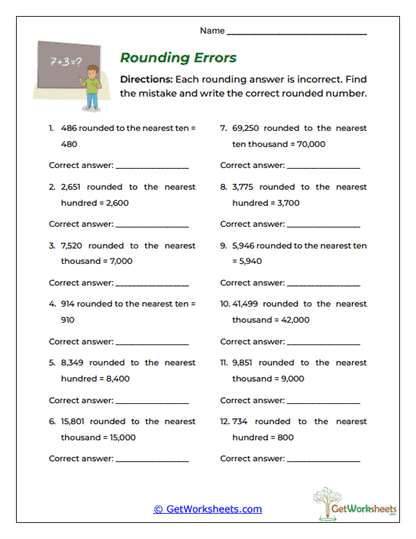
Rounding Errors
Every example contains a rounding mistake that students must locate and correct. Learners inspect the target place, study the decision digit, and determine exactly why the proposed answer fails. Because the mistake is already visible, attention shifts from simply getting an answer to understanding the reasoning behind it. This error-analysis format is especially useful for uncovering subtle place-value misunderstandings.
Rounding Pairs
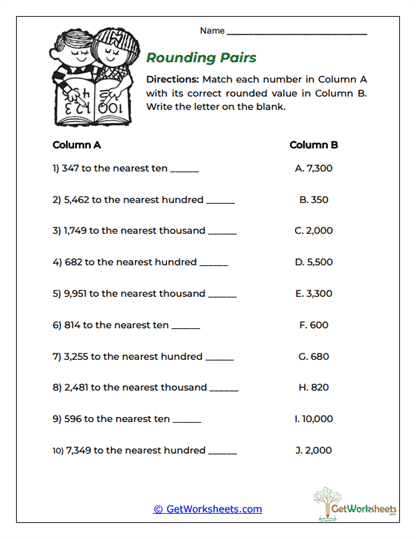
Students connect numbers with their correct rounded values through a matching activity. Tens, hundreds, and thousands appear together, so the target place must be read carefully before a match is made. As choices are used, the remaining possibilities provide additional clues and opportunities for self-correction. The format adds variety while still demanding accurate place-value reasoning.
Rounding Race
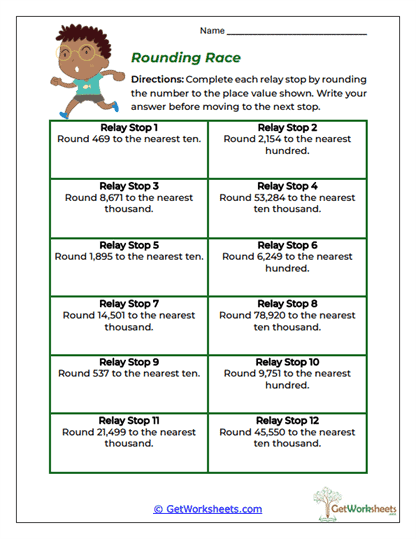
A relay-style sequence asks students to switch repeatedly among tens, hundreds, thousands, and ten-thousands. Because the target keeps changing, learners cannot simply repeat the same mental routine without reading closely. The activity encourages fluency while preserving the need for accuracy at every stop. It works especially well after students have learned each rounding place individually and are ready for mixed review.
Rounding Records
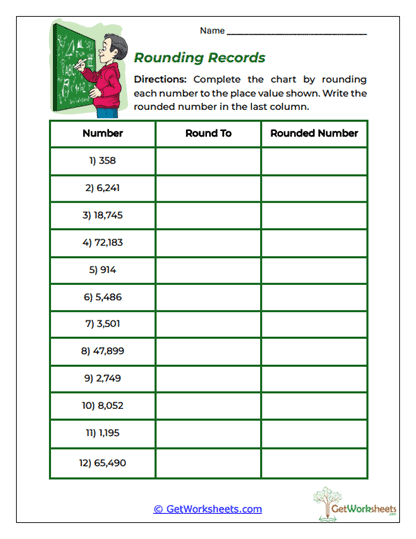
A chart organizes the original number, target rounding place, and resulting estimate into separate columns. This structure helps students see the relationship among the pieces of information instead of holding every step mentally at once. Multi-digit values give learners experience working with larger magnitudes while still following a predictable format. The worksheet is useful for students who benefit from visual organization and step-by-step thinking.
Rounding Relay
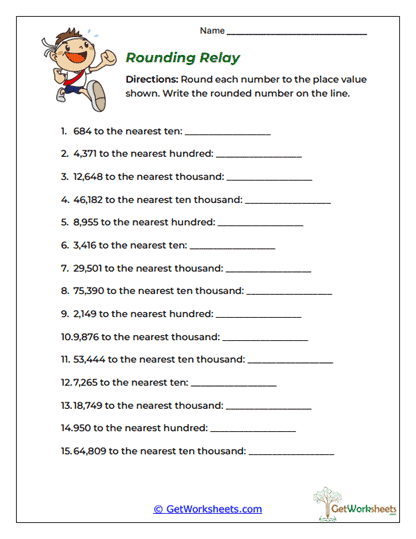
Students move through a mixed sequence of rounding problems that shift among several place values. Numbers grow from the hundreds into larger five-digit values, requiring learners to maintain the same underlying reasoning as the scale changes. The relay structure gives routine practice a sense of movement without sacrificing careful place-value work. It is a useful fluency builder for students who need to become comfortable changing targets quickly.
Bookmark Us Now!
New, high-quality worksheets are added every week! Do not miss out!