Rounding Numbers Worksheets
About This Worksheet Collection
Rounding numbers helps students replace exact values with nearby benchmarks that are easier to understand, compare, and use mentally. As learners work with tens, hundreds, thousands, decimals, and larger whole numbers, they begin to see rounding as a way of controlling precision rather than simply changing digits. That understanding supports stronger place value, estimation, number magnitude, and confidence with numbers of many different sizes.
This collection gives students many ways to explore what rounded values represent and why they are useful. Activities include identifying neighboring benchmarks, investigating halfway points, matching numbers with rounded results, sorting values into rounding "neighborhoods," working backward from an estimate, examining population and attendance data, rounding decimals, finding hidden ranges, correcting errors, and using rounded numbers to estimate sums and differences. The variety allows grades 3-5 learners to move from straightforward procedural practice into deeper reasoning about boundaries, intervals, magnitude, and approximation.
Across the worksheets, students learn that a rounded number carries information about both size and precision. They discover that many exact numbers can share the same rounded value, that the requested place determines how much detail is preserved, and that benchmark thinking can make complicated quantities easier to interpret. These experiences build a foundation for later work with estimation, decimal operations, measurement, data, inequalities, and mathematical decision-making.
Detailed Descriptions Of These Worksheets
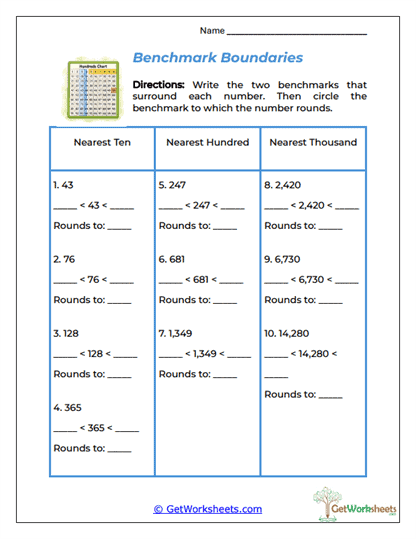
Benchmark Boundaries
Students identify the lower and upper benchmark numbers surrounding each value before deciding which one is closer. This reframes rounding as a question of location and distance instead of a rule applied mechanically to digits. Working across tens, hundreds, and thousands helps learners see how the same boundary idea changes scale without changing meaning. The activity provides especially strong conceptual support for students who can perform rounding but are less certain about why it works.
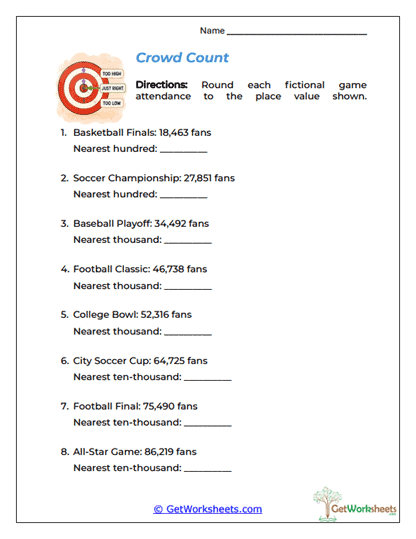
Crowd Count
Sports attendance figures give students a realistic reason to simplify five-digit numbers. Learners round crowd totals to hundreds, thousands, or ten-thousands while considering how approximate attendance might be communicated in everyday reporting. The context makes large values easier to picture and reinforces differences among several levels of precision. Students also gain practice reading and interpreting numbers in the tens of thousands.
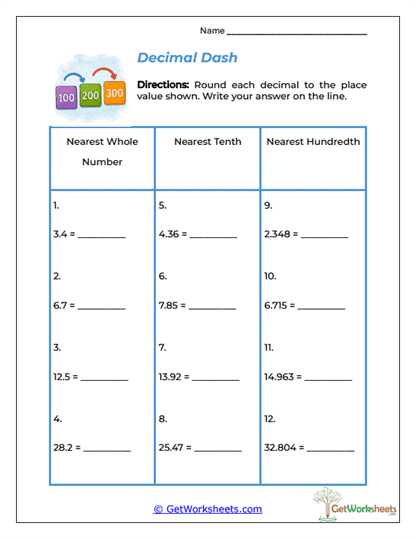
Decimal Dash
Rounding extends to the other side of the decimal point as students work with whole-number, tenth, and hundredth targets. They must locate the place being preserved and use the digit immediately to its right to determine what happens next. The progression helps learners recognize that decimal rounding follows the same place-value logic as whole-number rounding. This creates a useful bridge to later work involving prices, measurement, division, and decimal estimation.
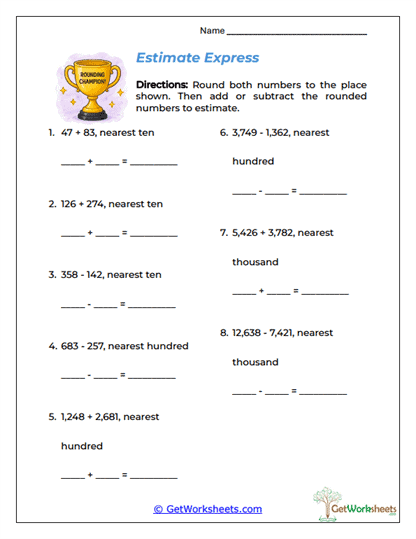
Estimate Express
Students round two values before using the simplified numbers to estimate an addition or subtraction result. The extra computation step gives rounding a clear purpose: making an otherwise awkward calculation easier to handle mentally. Problems shift among tens, hundreds, and thousands while also requiring attention to the operation sign. The worksheet helps students connect estimation with prediction and with checking the reasonableness of exact answers.
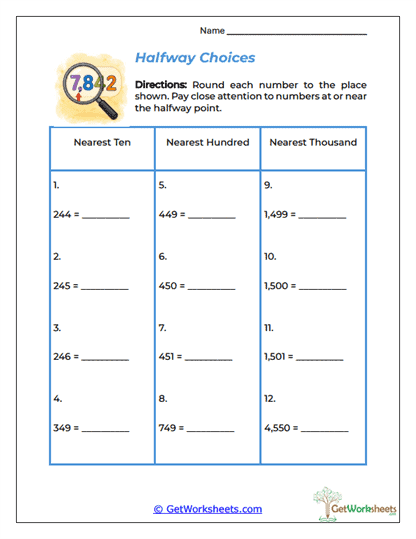
Halfway Choices
Carefully selected number groups focus attention on values just below, exactly at, and just above rounding midpoints. Seeing numbers such as 449, 450, and 451 together makes the boundary behavior much easier to notice. Students can observe precisely when the rounded result changes instead of encountering midpoint cases randomly. This concentrated practice is particularly valuable for learners who hesitate whenever the deciding digit is 5.
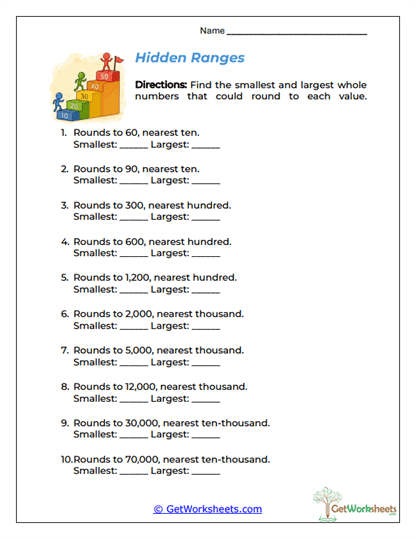
Hidden Ranges
Instead of rounding forward, students begin with a benchmark and determine the smallest and largest whole numbers that could round to it. This exposes the interval hidden behind an estimate and makes midpoint boundaries mathematically important. Learners see that a rounded value such as 2,000 represents many possible original numbers rather than one exact quantity. The activity provides a natural introduction to range thinking and ideas that later connect with inequalities.
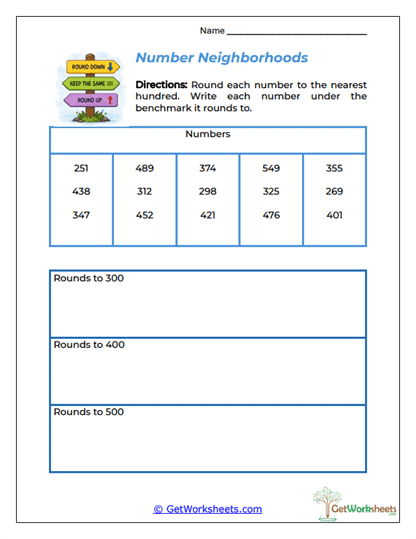
Number Neighborhoods
Students sort three-digit values according to the hundred they would round to. Placing several numbers into the same "neighborhood" makes it easier to see that benchmark hundreds represent entire ranges of nearby values. The classification format encourages comparison among numbers instead of treating every example as an unrelated exercise. It also creates a strong visual foundation for reverse rounding and number-line work.
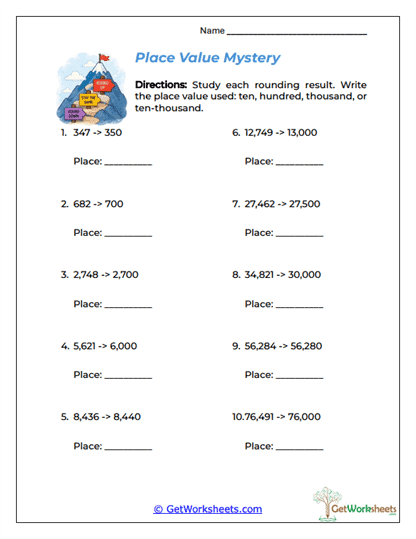
Place Value Mystery
The original number and rounded result are provided, but the rounding instruction is missing. Students study the transformation and determine whether the number must have been rounded to a ten, hundred, thousand, or ten-thousand. Working backward forces them to notice which digits were preserved and where zeros began appearing. This makes the activity a deeper test of place-value structure than a traditional forward-rounding problem.
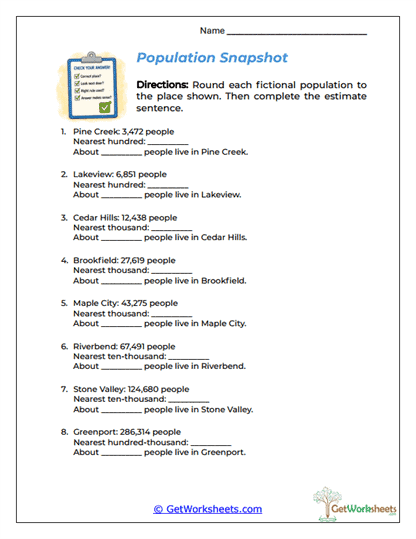
Population Snapshot
Fictional population data gives large-number rounding an authentic reporting purpose. Students simplify values in the thousands and hundred-thousands to different requested places, creating easier-to-read approximations. The work reinforces both place-value fluency and the idea that precision depends on what information someone needs to communicate. It also gives students experience interpreting numerical data that resembles figures found in maps, reports, and community statistics.
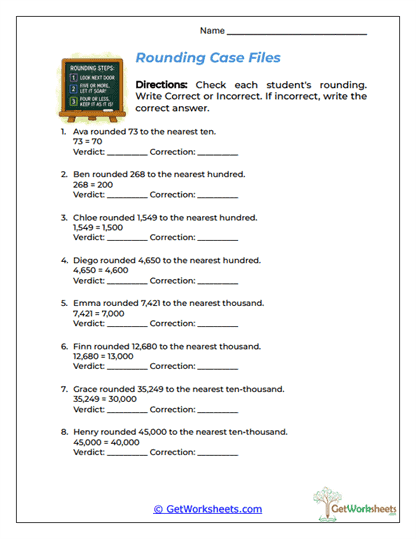
Rounding Case Files
Students inspect completed rounding work and determine which answers are correct and which need repair. Because the examples span tens through ten-thousands, each case requires attention to both the requested place and the deciding digit. The detective-style format shifts the focus from answer production to mathematical diagnosis. This helps learners develop stronger self-checking habits and a clearer understanding of why an estimate succeeds or fails.
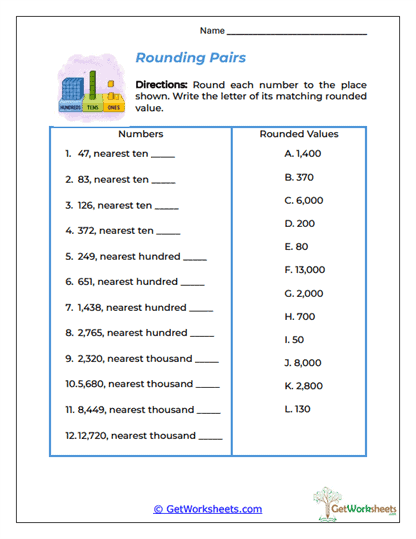
Rounding Pairs
Original numbers are matched with rounded values from a separate answer bank. Since the requested place changes throughout the activity, learners must complete the rounding thoughtfully before searching for a corresponding result. The matching structure adds a useful elimination strategy and creates natural feedback when an expected answer cannot be found. It provides varied practice without losing the core focus on benchmark values and place value.
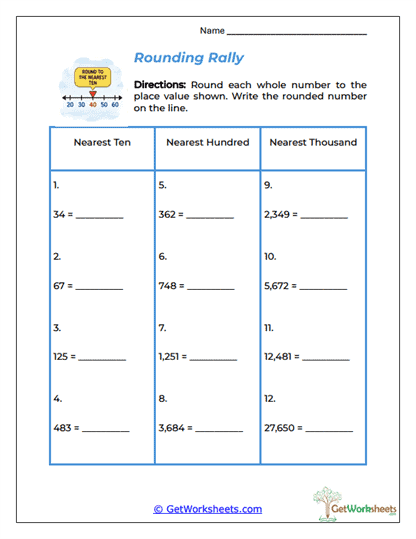
Rounding Rally
Students progress through distinct sections devoted to nearest-ten, nearest-hundred, and nearest-thousand rounding. The sequence begins with smaller numbers and gradually expands into larger values, allowing learners to see that the core decision process remains stable as magnitude increases. Keeping the place values separated makes patterns easier to recognize before students encounter mixed practice. This worksheet offers a clear foundation for building both accuracy and confidence with whole-number rounding.
Bookmark Us Now!
New, high-quality worksheets are added every week! Do not miss out!