Rounding and Comparing Numbers Worksheets
About This Worksheet Collection
Rounding and comparing numbers brings two closely related ideas together: approximation and numerical relationships. Students do more than round a value and move on; they examine how rounded numbers compare, whether relationships change after approximation, and why two different values can sometimes land on the same benchmark. This creates a stronger understanding of place value, magnitude, equality, and the meaning of an estimate.
The collection uses a wide range of formats to keep that reasoning active. Students compare values before and after rounding, order groups of estimates, use number lines, match pairs with comparison statements, inspect completed work for errors, judge true-or-false comparisons, work toward benchmark targets, and explain their thinking in writing. These activities are especially useful for grades 3-5 because they connect familiar rounding skills with deeper comparison work using <, >, and =.
As students progress, they begin to see rounded values as approximations that can change how numbers relate to one another. They learn to distinguish exact comparisons from approximate ones, recognize ties created by rounding, think about numerical distance, and defend why a comparison is reasonable. Those habits build stronger number sense and prepare learners for later work with estimation, inequalities, data analysis, and more advanced quantitative reasoning.
Detailed Descriptions Of These Worksheets
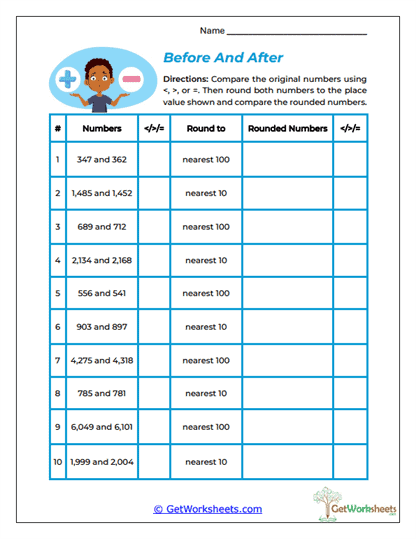
Before And After
Students compare each pair of numbers twice-first in exact form and then again after rounding. This side-by-side structure makes it easy to see whether the relationship stays the same or changes once the values are approximated. In some cases, two unequal numbers may become equal because they round to the same benchmark. The activity gives students a direct way to study the effect rounding has on numerical relationships.
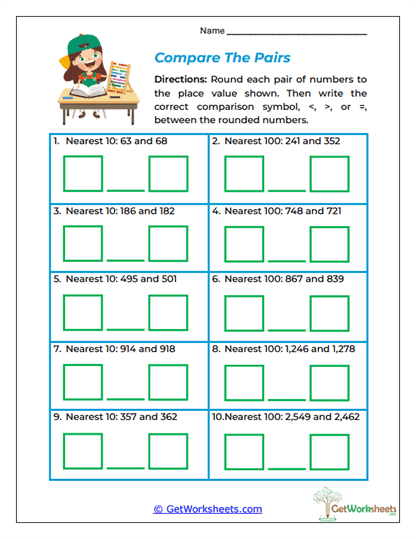
Compare The Pairs
Students round two values to the requested place and then compare the resulting estimates using <, >, or =. The repeated structure gives learners steady practice moving from place-value reasoning into comparison. Equal rounded values appear alongside greater-than and less-than relationships, reinforcing the idea that approximation can remove small differences. This worksheet is a useful fluency builder for students who need confidence combining both skills.
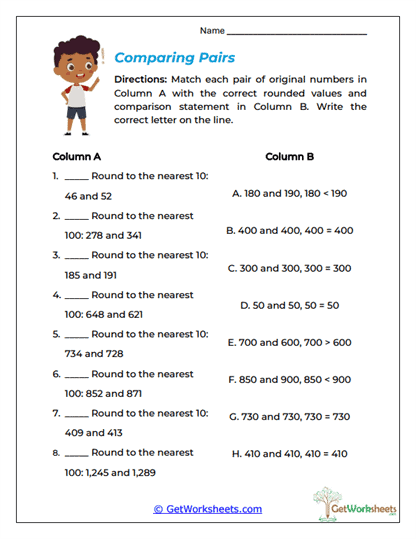
Comparing Pairs
Original number pairs are matched with complete rounded comparison statements. To make each match, students must round both values, decide which comparison symbol belongs, and locate the option that captures the entire relationship correctly. The matching format adds an extra layer of logical checking rather than ending with one isolated answer. It also gives students opportunities to use elimination when a result does not seem to fit.
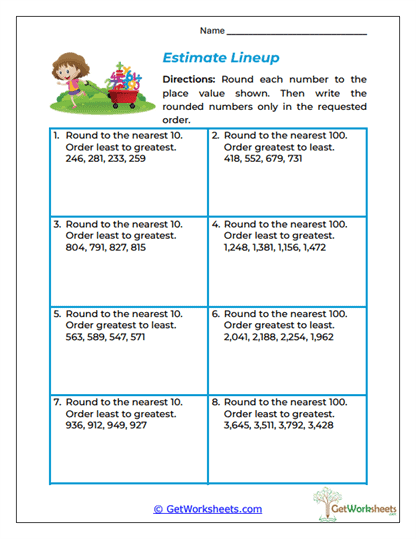
Estimate Lineup
Groups of numbers are rounded first and then arranged from greatest to least. Students must keep track of several estimates at once, including cases where different original numbers may produce identical rounded values. That makes the ordering step more thoughtful than simply sorting the numbers as originally written. The activity develops comparison fluency while encouraging careful organization of multiple approximations.
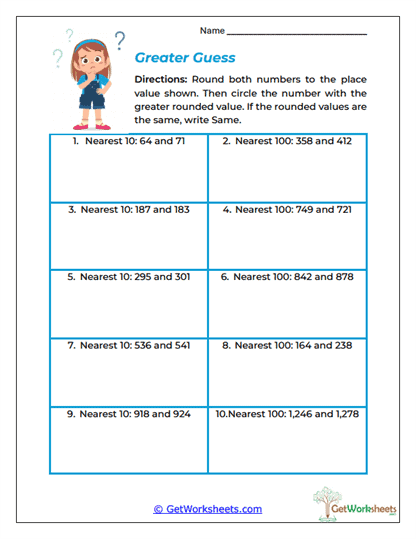
Greater Guess
Students round pairs of numbers and determine which one produces the larger estimate-or whether the estimates are equal. The quick comparison format feels simple, but it requires learners to ignore the temptation to judge by the original values alone. Nearby numbers may collapse onto the same benchmark once rounded. This makes the activity a useful exercise in thinking about the behavior of approximate values rather than exact ones.
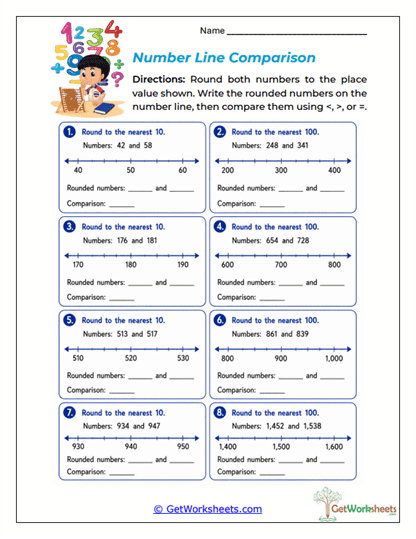
Number Line Comparison
Number lines give students a visual pathway from the original values to their rounded comparisons. Learners consider where each number sits between surrounding benchmarks, decide which one is closer, record the rounded values, and then compare them. The visual emphasis on distance provides a deeper explanation for why rounding works. It is especially helpful for students who understand numerical position more easily when they can see it represented spatially.
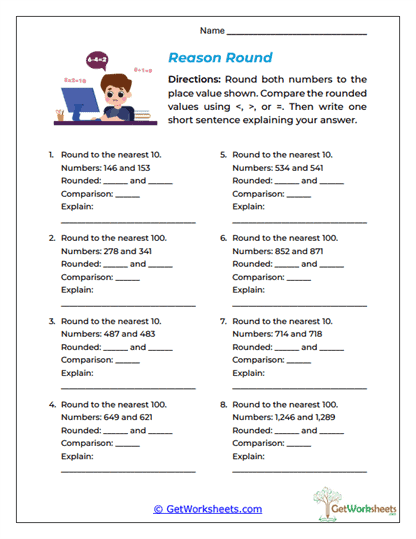
Reason Round
Students round, compare, and then explain the relationship in words. The written component requires them to move beyond placing the correct symbol and communicate why the rounded values support that choice. This strengthens both mathematical vocabulary and conceptual understanding. It is particularly useful for revealing whether a student understands the comparison or has simply arrived at the correct symbol by habit.
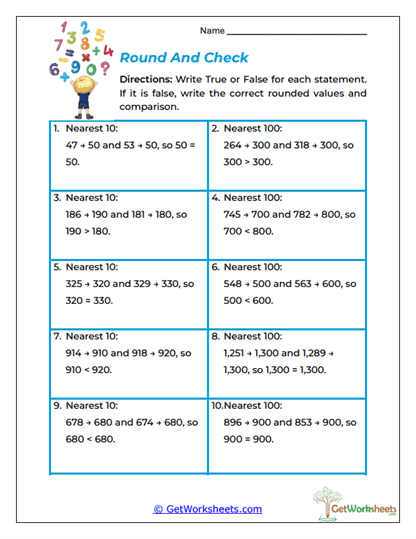
Round And Check
Completed rounded comparisons are evaluated as true or false. Students inspect both the rounding and the comparison symbol before deciding whether the statement can be trusted. False examples must be repaired, turning error detection into part of the learning process. The format develops stronger self-checking habits and gives students practice verifying an entire chain of reasoning.
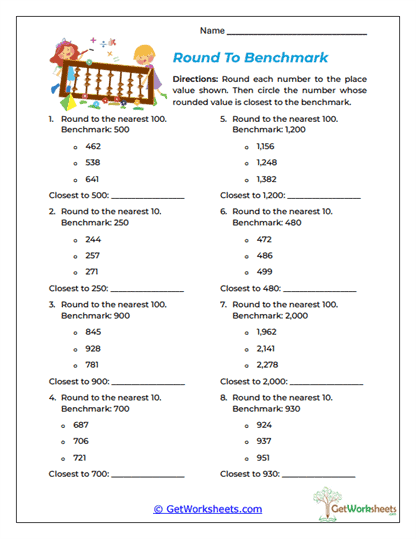
Round To Benchmark
Students round several candidate values and determine which estimate lands closest to a target benchmark. The goal is not merely to identify the largest or smallest value, but to think about numerical distance. This "closest to the target" structure broadens comparison work beyond the usual greater-than and less-than questions. It also strengthens benchmark thinking and prepares students for later work with number lines and estimation ranges.
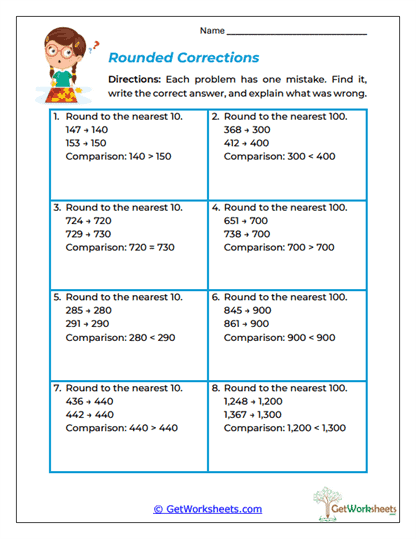
Rounded Corrections
Students act as editors of completed rounding-and-comparison problems. Each example contains a mistake somewhere in the process, requiring learners to inspect the rounded values, the comparison symbol, or both. Finding the source of the error demands an understanding of how the steps connect rather than knowledge of one isolated rule. This activity is especially effective for building careful mathematical reasoning and self-correction.
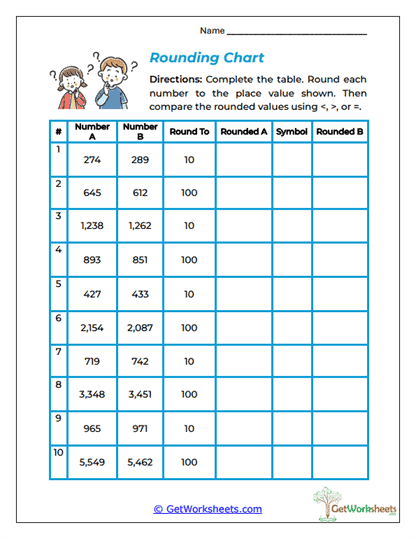
Rounding Chart
A structured table separates Number A, Number B, the required rounding place, the two rounded values, and the final comparison. That organization allows students to focus on one stage at a time while still seeing the complete mathematical process. The layout also makes mistakes easier to trace back to their source. For learners who benefit from visual structure, the chart provides a clear bridge between rounding and comparison.
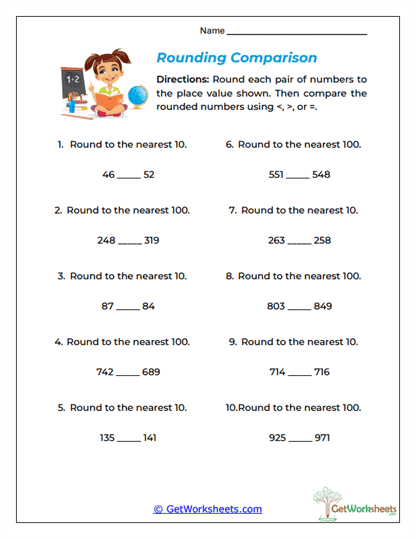
Rounding Comparison
Students round both numbers in a pair before deciding whether the resulting values are greater than, less than, or equal to one another. The activity highlights an important idea: comparison after rounding may not mirror the exact relationship between the original values. Different numbers can become equal estimates when they fall near the same benchmark. This gives students meaningful practice with approximation while reinforcing correct use of comparison symbols.
Bookmark Us Now!
New, high-quality worksheets are added every week! Do not miss out!