Rounding Multi-digit Whole Numbers Worksheets
About This Worksheet Collection
Rounding multi-digit whole numbers asks students to keep their place-value thinking organized even when numbers stretch into the ten-thousands and hundred-thousands. The underlying rule does not change, but the challenge becomes locating the correct place, identifying the digit that controls the decision, and understanding how much information is preserved at each level of precision. This makes large-number rounding an important exercise in magnitude, estimation, and structural number sense rather than simply a longer version of basic rounding.
The worksheets in this collection approach large-number rounding from several angles. Students round to mixed place values, mark target and decision digits, use number lines, organize work in tables, round one number in multiple ways, correct faulty reasoning, work backward from rounded values, match estimates, evaluate true-or-false statements, choose among possible answers, and order rounded numbers. Together, these formats give grades 4-5 students repeated opportunities to work with five- and six-digit values without allowing the practice to become mechanical.
As learners move through the collection, they gain a clearer understanding of how rounding changes with the level of precision requested. They learn to recognize benchmark ranges, distinguish a close approximation from a broad one, trace mistakes back to specific place-value decisions, and reason backward from an estimate to possible original values. These experiences help students become more confident with large numbers while building skills that support estimation, data interpretation, computation, comparison, and later quantitative reasoning.
Detailed Descriptions Of These Worksheets
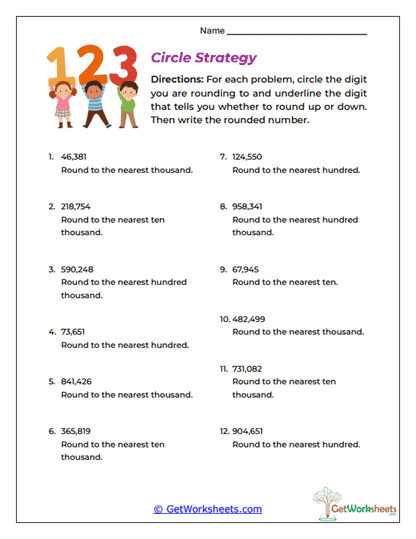
Circle Strategy
Students make their rounding decisions visible by marking the two digits that matter most. They circle the target place, underline the digit immediately to its right, and only then determine the rounded value. This visual routine helps prevent students from becoming lost inside five- and six-digit numbers. It is especially useful for building a dependable process that can be reused whenever large values feel overwhelming.
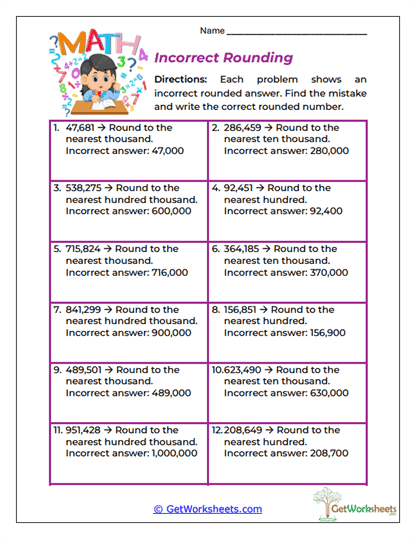
Incorrect Rounding
Students analyze completed large-number estimates that contain intentional mistakes. Each problem requires them to identify the requested place value, inspect the deciding digit, and determine what the rounded result should have been. Repairing the work demands more understanding than simply producing a fresh answer. The activity turns common errors into opportunities to strengthen place-value reasoning and self-checking.
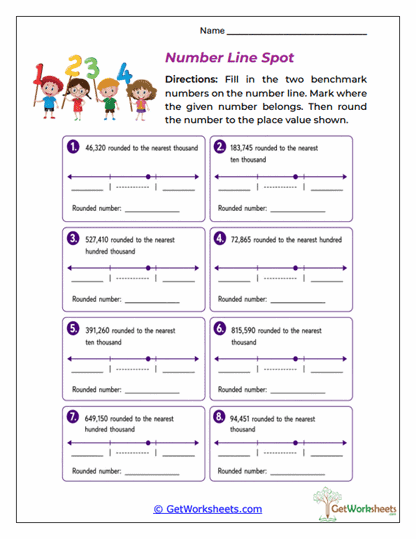
Number Line Spot
Large values are placed between appropriate benchmarks so students can reason about rounding through numerical distance. Learners identify the lower and upper endpoints, locate the original number conceptually, and decide which benchmark is nearer. Because the spacing changes with thousands, ten-thousands, and hundred-thousands, students also see how scale affects a number line. This gives a visual explanation for rounding that complements digit-based rules.
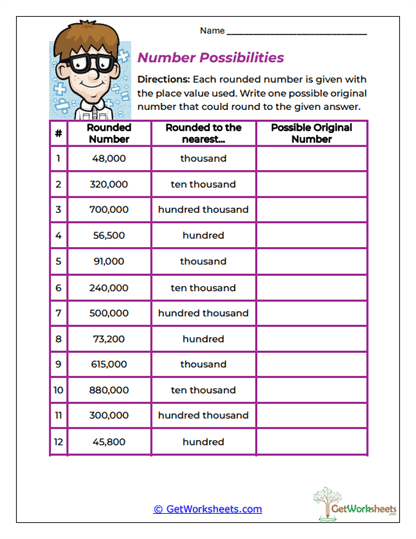
Number Possibilities
Students begin with a rounded result and work backward to create an original number that could have produced it. The open-ended structure requires them to think about lower and upper boundaries rather than search for one predetermined answer. Several different starting values may be valid, which makes rounding intervals much more visible. This activity develops flexible reasoning and introduces ideas that connect naturally with inequalities and ranges.
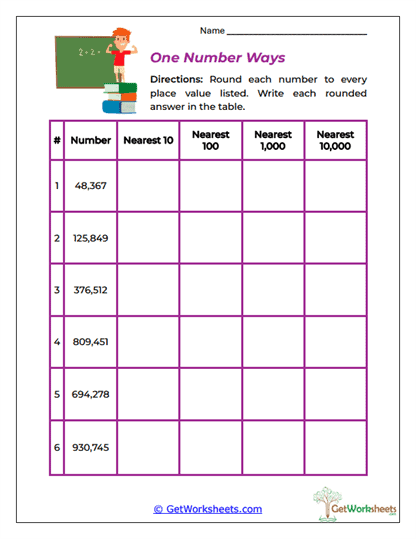
One Number Ways
The same large number is rounded to several different places so students can compare the resulting approximations side by side. A value may be rounded to the nearest ten, hundred, thousand, and ten-thousand, revealing how the amount of preserved detail changes each time. This makes precision a visible mathematical idea rather than an abstract explanation. The worksheet helps learners understand why several different rounded forms of one number can all be correct.
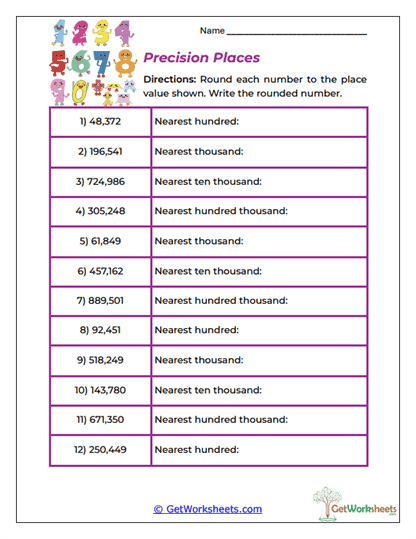
Precision Places
Students practice rounding large whole numbers to explicitly named places ranging from hundreds through hundred-thousands. The consistent format keeps attention on locating the target place and interpreting the neighboring digit correctly. As the numbers increase in size, learners discover that the same underlying reasoning still applies. This provides a strong foundation for becoming comfortable with large-number estimation.
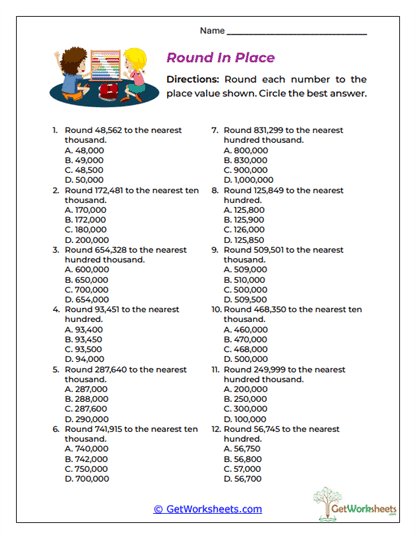
Round In Place
Multiple-choice problems ask students to round large values and select the answer that correctly reflects the requested place. The possible choices encourage comparison and often expose common errors such as rounding to the wrong position or changing too many digits. Students must therefore consider both the magnitude of the original number and the structure of a sensible estimate. The format works well for efficient mixed review without reducing the task to guessing.
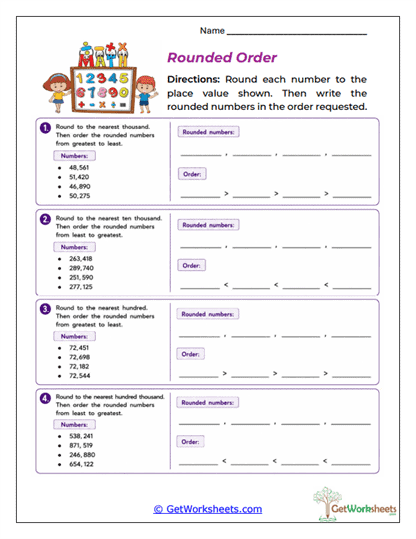
Rounded Order
Students round groups of large numbers and then organize the resulting estimates from greatest to least or least to greatest. The second step gives rounding a clear purpose and requires learners to keep track of several approximations at once. Equal rounded values may also appear, prompting students to think carefully about how ties affect an ordered list. This activity blends estimation, comparison, and organization into one multi-step number-sense task.
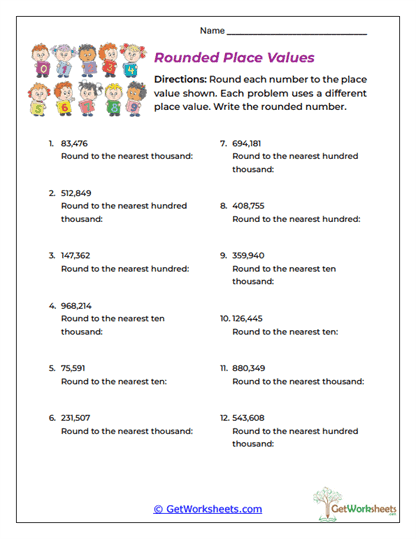
Rounded Place Values
Target places change from one problem to the next, requiring students to shift among tens, hundreds, thousands, ten-thousands, and hundred-thousands. Because the worksheet does not allow them to settle into a single repeated pattern, careful reading becomes part of the mathematical work. Large values also provide repeated practice locating digits accurately within complex numbers. The activity is particularly useful for developing flexible place-value fluency.
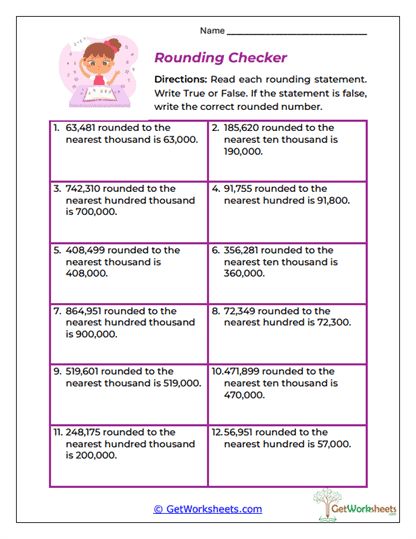
Rounding Checker
Students act as reviewers of completed large-number rounding statements. Each statement must be judged true or false, and incorrect answers are replaced with accurate rounded values. This requires learners to inspect the target place, the deciding digit, and the placement of zeros before accepting a result. The fact-checking format helps students develop the habit of testing an answer rather than assuming that completed work is reliable.
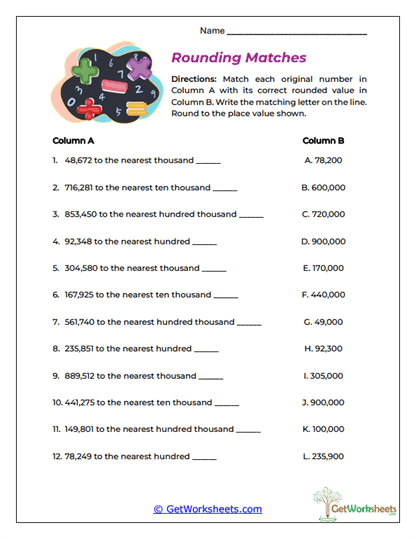
Rounding Matches
Students connect original multi-digit numbers with their correct rounded values in a separate answer bank. Since the target places vary, they must calculate each estimate before searching for the matching result. The remaining choices gradually become useful clues, giving the activity an element of elimination and self-correction. It provides mixed rounding practice while keeping attention on the overall size of six-digit values.
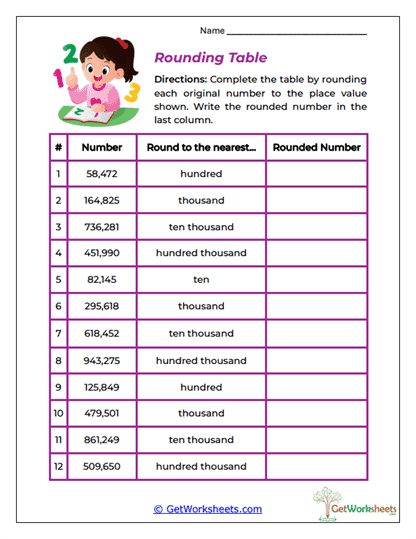
Rounding Table
A structured table separates the original value, requested place, and rounded result into clearly defined columns. This organization allows students to work methodically through large numbers without losing sight of which place controls the problem. Because the rows vary from tens through hundred-thousands, the worksheet also serves as broad mixed review. The format is particularly helpful for learners who perform more accurately when complex information is visually organized.
Bookmark Us Now!
New, high-quality worksheets are added every week! Do not miss out!