Place Value and Number Sense Word Problems Worksheets
About This Worksheet Collection
Place value and number sense word problems ask students to use rounding as a thinking tool rather than as an isolated rule. Learners must interpret what a situation is asking, decide how much precision is useful, and then use place value to create an estimate that fits the context. This kind of work strengthens not only rounding fluency, but also magnitude sense, operation choice, mathematical judgment, and confidence with larger numbers.
The worksheets in this collection approach rounding through a wide variety of real-world situations and task types. Students estimate totals and differences, choose among possible answers, decide which place value is most useful, inspect rounding mistakes, organize estimates in charts, match word problems to rounded calculations, judge whether proposed answers are reasonable, and apply estimation to travel, community data, and seasonal events. Several activities also require students to explain why a particular rounding choice makes sense, which pushes the work beyond procedure and into reasoning.
As students move through the collection, they build a more mature understanding of what rounding is actually for. They learn to simplify numbers without losing the important meaning, recognize when an estimate is far outside the expected range, choose a level of precision that matches the situation, and use approximate values to make sense of real quantities. Those habits strengthen place-value knowledge while preparing students for more advanced work with estimation, computation, data interpretation, and multi-step problem solving.
Detailed Descriptions Of These Worksheets
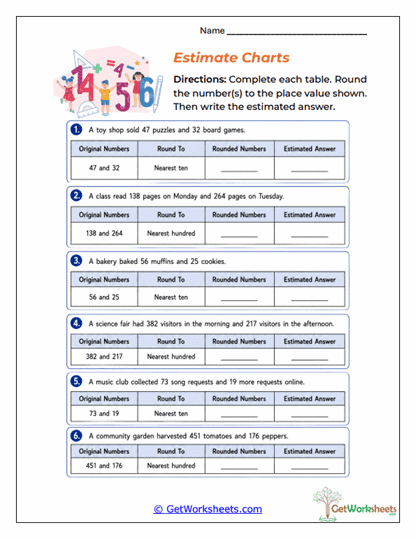
Estimate Charts
Students organize each estimation problem into a clear sequence showing the original values, required rounding place, rounded numbers, and final estimate. The table structure makes every stage of the thinking visible, which is especially helpful for learners who tend to lose track of steps. Because the problems involve everyday totals such as sales, visitors, harvests, and club requests, the numerical work stays connected to meaningful situations. The format also makes it easier to identify whether an error came from the rounding step or from the final calculation.
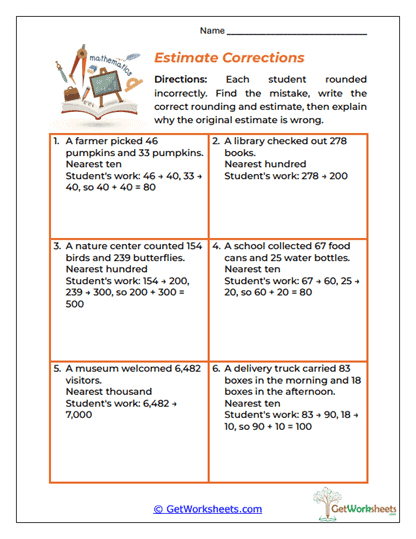
Estimate Corrections
Students examine flawed rounding work and determine exactly where the mistake occurred. Each example requires them to check the chosen place value, repair the rounded number, and then correct the estimate that follows. This turns errors into evidence rather than simply marking an answer wrong. The activity strengthens place-value understanding by asking learners to explain why a number should round one way instead of another.
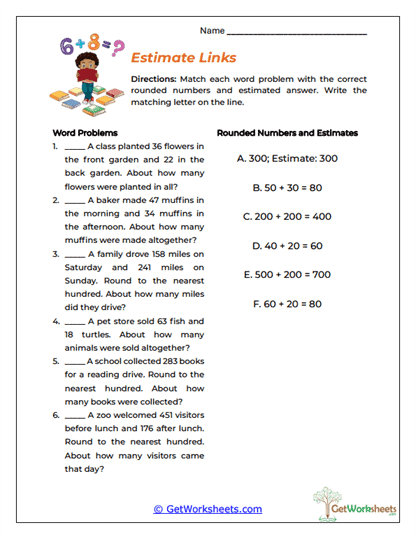
Estimate Links
Word problems are matched with the rounded number sentence and estimated answer that correctly represent them. Students must understand the situation first, decide whether addition or subtraction belongs, and then connect the story with the right approximation. The matching format creates a natural self-check because duplicated or missing matches signal that something deserves another look. This worksheet is particularly useful for showing the full path from context to rounded values to final estimate.
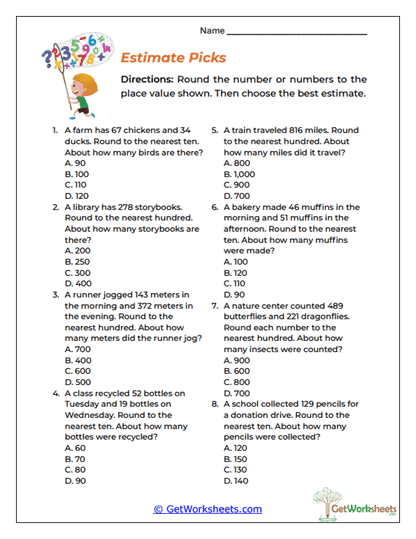
Estimate Picks
Students read short real-world situations and select the estimate that best fits each one. Several answer choices may appear plausible at first, so learners must combine rounding, operation sense, and magnitude rather than rely on guessing. The multiple-choice design helps students practice eliminating answers that are clearly too large or too small. It is an efficient way to strengthen the instinct for where a reasonable result should fall.
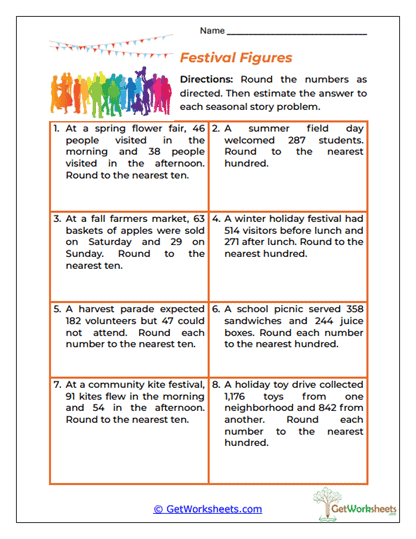
Festival Figures
Seasonal and community-event scenarios provide a changing backdrop for repeated rounding practice. Students estimate quantities involving visitors, food, volunteers, donations, and other event totals while moving between tens and hundreds. The varied settings keep the mathematics from feeling repetitive even though the core skill remains consistent. This activity also reinforces the idea that estimates are often useful when describing busy events and large groups.
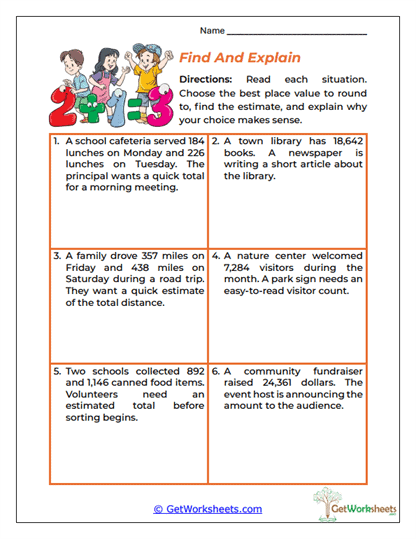
Find And Explain
Students decide which place value will produce the most useful estimate and then justify that choice. Rather than being told automatically to round to the nearest ten, hundred, or thousand, they must consider the size of the numbers and the purpose of the estimate. The written explanation makes precision itself part of the mathematical thinking. This is a strong higher-level task for students who are ready to move from performing rounding to defending a rounding strategy.
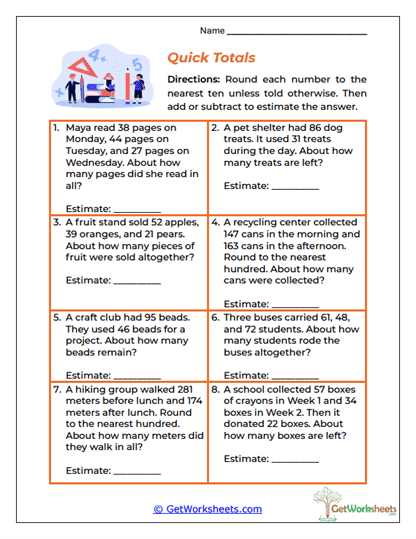
Quick Totals
Short addition and subtraction stories ask students to round first and then produce a quick approximate answer. The mix of totals, remaining amounts, and comparisons means learners must interpret the story before calculating. Working with friendly rounded values allows them to concentrate on the relationship between the quantities instead of getting buried in exact arithmetic. The activity builds speed while still requiring genuine reasoning.
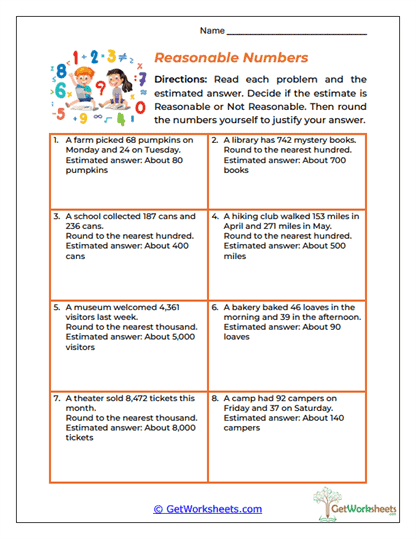
Reasonable Numbers
Students act as judges of proposed estimates and decide whether each answer is believable. They use their own rounding as evidence, then explain why the estimate fits or why it should be replaced. This pushes learners to think about magnitude and justification rather than simply following a rule. Over time, the activity helps develop the habit of asking whether a mathematical result actually makes sense.
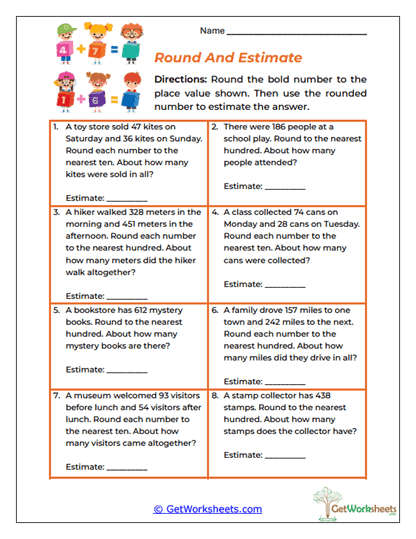
Round And Estimate
Everyday addition and subtraction situations show students how rounding can simplify a word problem before exact computation is considered. Learners identify the important values, round to the stated place, and then estimate the requested total or difference. Familiar contexts such as travel, collections, visitors, and books make the purpose of approximation easier to understand. The worksheet provides a strong bridge between isolated rounding practice and applied estimation.
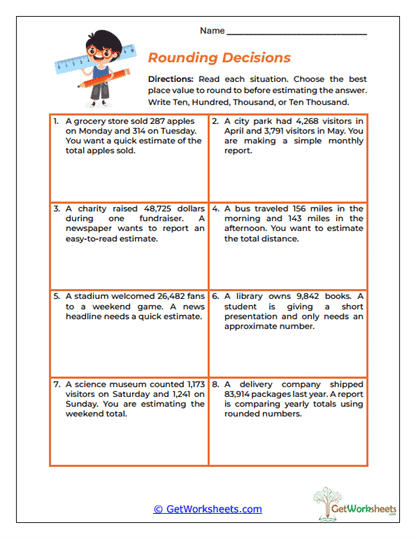
Rounding Decisions
Students examine larger real-world quantities and decide whether tens, hundreds, thousands, or ten-thousands provide the most useful level of precision. The emphasis is on purpose: a city report, stadium attendance figure, or travel estimate may not need the same degree of detail. This encourages learners to think about audience, scale, and usefulness before rounding. The worksheet develops mathematical judgment in a way that ordinary rounding drills rarely do.
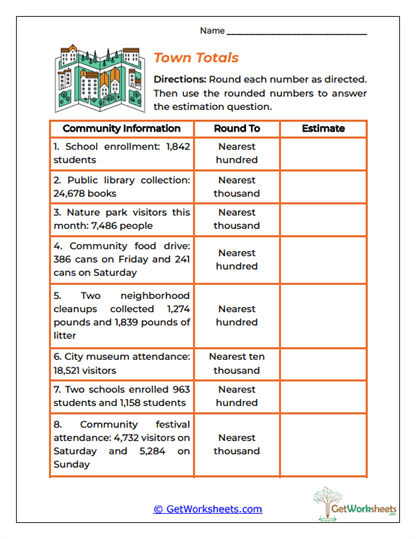
Town Totals
Community-style statistics are presented in an organized table so students can practice rounding larger values confidently. Enrollment, attendance, donations, library collections, and other quantities extend the work into the thousands and ten-thousands. Different rows require different rounding places, keeping students attentive to the directions. The activity helps make large numbers feel more understandable by converting detailed figures into cleaner approximations.
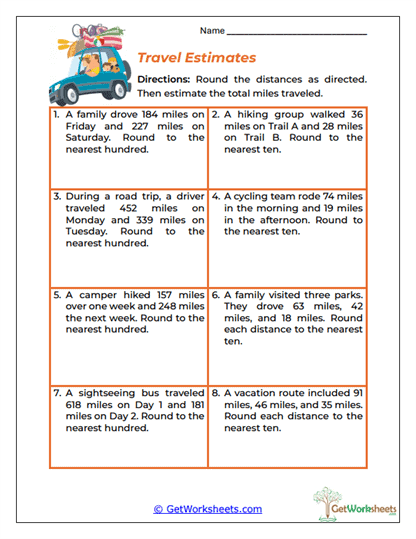
Travel Estimates
Students estimate the distance of multi-part trips by rounding each leg before combining the values. Family drives, hikes, cycling routes, park visits, and vacation travel give the numbers a clear spatial meaning. The task shows why an approximate mileage total can be useful for planning even when exact distances are available. It also reinforces mental addition and the relationship between place value and the scale of a trip.
Bookmark Us Now!
New, high-quality worksheets are added every week! Do not miss out!