Everyday Estimates
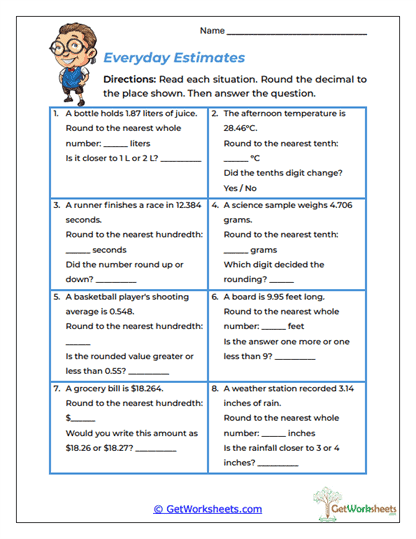
Everyday Estimates helps students practice rounding decimals in situations that feel more meaningful than isolated number drills. Students round quantities involving juice, temperature, race times, scientific measurements, shooting averages, board lengths, grocery prices, and rainfall, then answer follow-up questions about how or why the rounding worked. The worksheet strengthens decimal rounding, place value, real-world estimation, measurement, money, reasonableness, and mathematical explanation. It is especially useful for students in grades 4-6 who need to see that rounding is a practical skill used whenever an exact decimal is more precise than the situation really requires.
Learning Goals
- Round in context: Students round decimals to whole numbers, tenths, or hundredths depending on the situation.
- Explain what changed: Learners identify whether the number rounded up or down and which digit caused the decision.
- Use realistic units: Students work with liters, degrees, seconds, grams, feet, dollars, and inches.
- Interpret the result: Children decide what the rounded value means in the actual situation.
How This Helps
- Makes rounding useful: Students see why people round measurements, prices, and recorded data in everyday life.
- Supports parent guidance: Adults can ask, “How exact does this answer really need to be?”
- Builds number sense: Learners think about whether the rounded value is closer to one benchmark or another.
- Connects math to daily life: Money, weather, sports, and measurements make the skill easier to understand.
- No-prep format: The worksheet is ready for classroom practice, homework, tutoring, or homeschool instruction.
Rounding makes more sense when students can see why someone would want a simpler number. A bottle holding 1.87 liters can reasonably be described as about 2 liters, while a race time may need to stay precise to the hundredth because small differences matter. This worksheet helps children understand that the appropriate level of rounding depends on the situation. As learners complete the page, they strengthen decimal place value, estimation, measurement sense, rounding fluency, and confidence. In classroom and homeschool settings, this worksheet helps students connect a basic math procedure with the practical idea of choosing a useful level of precision.
Bookmark Us Now!
New, high-quality worksheets are added every week! Do not miss out!