Reasonable Results
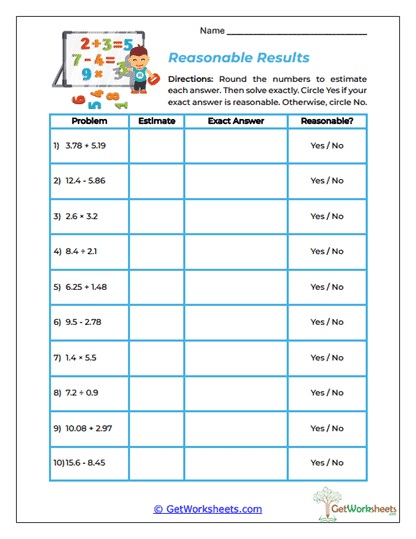
Reasonable Results helps students estimate answers before solving mixed decimal problems exactly. Students round the numbers, make an estimate, solve the original problem, and then decide whether the exact answer is reasonable. The worksheet strengthens decimal addition, subtraction, multiplication, division, rounding, estimation, number sense, and self-checking. It is especially useful for students in grades 5-6 who can calculate with decimals but need help catching answers that are far too large or too small.
Learning Goals
- Estimate first: Students round decimal values to friendly numbers before calculating exactly.
- Use the correct operation: Learners pay attention to whether the problem requires addition, subtraction, multiplication, or division.
- Compare estimate and exact answer: Students decide whether the exact result is close enough to make sense.
- Build self-checking habits: Children learn not to trust an answer automatically just because they completed the computation.
How This Helps
- Strengthens number sense: Students begin to recognize the general size an answer should have.
- Catches decimal-placement mistakes: An answer that is ten or one hundred times too large becomes easier to notice.
- Supports parent guidance: Adults can ask, “About what should this answer be before you solve it exactly?”
- Works across settings: Use it for classroom review, homework, tutoring, intervention, or homeschool instruction.
- No-prep format: The worksheet is ready to print and use immediately.
For many students, the hardest part of decimal work is knowing whether the answer they found is believable. Estimation gives them a simple checkpoint. If 3.78 + 5.19 is about 4 + 5, then an exact answer close to 9 makes sense, while an answer near 90 clearly does not. This worksheet helps children connect rounding, operation choice, exact computation, place value, and reasonableness. As learners work, they strengthen decimal fluency, mathematical judgment, estimation, self-correction, and confidence. In classroom and homeschool settings, this practice teaches a valuable habit: good mathematicians do not just calculate an answer-they also ask whether that answer makes sense.
Bookmark Us Now!
New, high-quality worksheets are added every week! Do not miss out!