Clearing Status Review
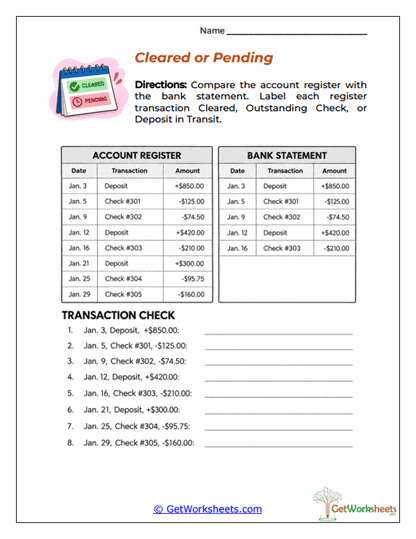
The Clearing Status Review Worksheet helps students understand why a personal account register and a bank statement may not match perfectly at the same moment. Students compare the two records, look at dates, checks, deposits, and withdrawals, and then decide whether each transaction is cleared, outstanding, or a deposit in transit. This is a strong fit for grades 6-8 because it introduces an important business-math idea: a transaction can be correctly recorded by the account holder but still not appear on the bank statement yet. For parents, the easiest way to explain it is that one record shows what the person has written down, while the other shows what the bank has finished processing.
Learning Goals
- Identify Cleared Transactions: Students recognize items that appear in both the register and the statement.
- Spot Outstanding Checks: Learners find checks that have been written but have not yet cleared the bank.
- Recognize Deposits in Transit: Students identify deposits that are recorded personally but have not shown up on the statement yet.
- Compare Financial Records Carefully: Children practice matching transaction dates, amounts, and descriptions.
Teaching Advantages
- Makes Timing Differences Understandable: Students see that two different balances can both make sense when some transactions are still processing.
- Builds Reconciliation Readiness: The activity introduces the ideas students will need before doing full bank reconciliations.
- Easy for Parents to Talk Through: Families can ask, “Has the bank processed this yet, or is it still waiting?”
- Useful for Practical Math: The worksheet fits business math, consumer math, financial literacy, or homeschool instruction.
Students strengthen transaction status, account registers, bank statements, cleared items, outstanding checks, and deposits in transit while classifying each entry. This matters because real account balances can look confusing when one record includes a transaction that the other does not show yet. In the classroom, teachers can have students match all the obvious transactions first and then examine what remains. At home, parents can compare the idea to a payment that has been made but has not yet appeared in an online account. That real-world comparison makes the concept much easier to grasp. With practice, students become more confident understanding why records differ and how those differences can be explained.
Bookmark Us Now!
New, high-quality worksheets are added every week! Do not miss out!