Startup Capital Check
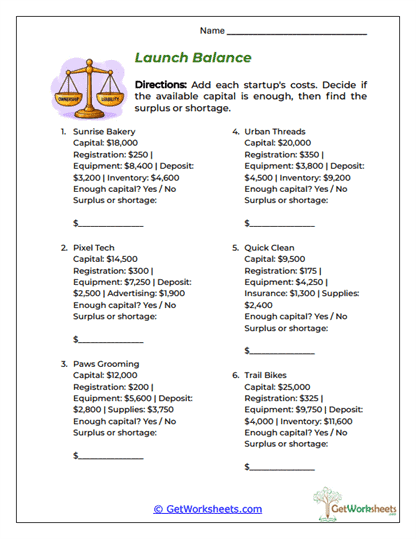
The Startup Capital Check Worksheet helps students understand that opening a business means comparing the money on hand with the total cost of getting started. Students add up registration fees, equipment, deposits, inventory, advertising, insurance, and other startup expenses, then compare that total with the capital available to decide whether the business has enough money. If it does, they find the surplus; if it does not, they calculate the shortage. This is a strong fit for grades 6-8 because it combines multi-step addition, subtraction, and comparison in a realistic business-planning situation. For parents, the idea is simple: your child is learning to ask, “Do we have enough money to open this business, and if not, how much are we short?”
Learning Goals
- Add Startup Expenses: Students combine several business costs to find the total amount needed.
- Compare Available Capital: Learners decide whether the business has enough money to cover all startup costs.
- Find Surplus or Shortage: Students calculate how much money remains or how much more is needed.
- Build Financial Planning Skills: The activity connects arithmetic with a real startup decision.
Teaching Advantages
- Makes Business Planning Concrete: Students see that a startup budget is more than one expense.
- Builds Multi-Step Money Math: Learners must add, compare, and subtract in the right order.
- Easy for Parents to Explain: Families can ask, “What does it cost to start, and how much money do they already have?”
- Useful for Entrepreneurship Lessons: The worksheet fits business math, financial literacy, career readiness, or homeschool instruction.
Students strengthen startup capital, business expenses, surplus and shortage, money addition, money subtraction, and financial planning while completing the launch checks. This matters because business owners need to know whether their funding is actually enough before they commit to opening. In the classroom, teachers can have students estimate whether each company is likely to have enough money before calculating exactly. At home, parents can compare the idea to budgeting for a big purchase and seeing whether savings cover the total cost. That makes the math easier to understand. With practice, students become more confident using numbers to make basic business-planning decisions.
Bookmark Us Now!
New, high-quality worksheets are added every week! Do not miss out!