Business Structure Snapshot
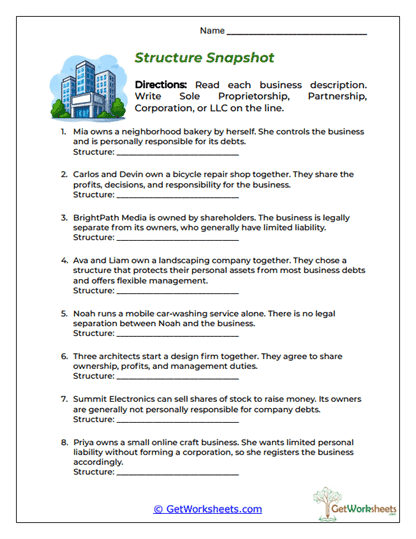
The Business Structure Snapshot Worksheet helps students learn that not every business is set up the same way. Students read short descriptions about different companies and decide whether each one is a sole proprietorship, partnership, corporation, or LLC. The scenarios give clues about things like ownership, shared profits, personal responsibility for debts, limited liability, and whether the business is legally separate from its owners. This is a strong fit for grades 7-9 because students are learning to connect business vocabulary with realistic situations instead of memorizing definitions by themselves. For parents, the easiest way to explain the value is that your child is learning how the way a company is organized affects who owns it, who makes decisions, and who is responsible if the business owes money.
Learning Goals
- Recognize Common Business Structures: Students identify sole proprietorships, partnerships, corporations, and LLCs.
- Use Clues from a Business Description: Learners look for details about ownership, liability, and management before choosing an answer.
- Compare Personal Responsibility: Students notice which structures leave owners personally responsible for debts and which provide more legal protection.
- Build Business Vocabulary: The worksheet gives repeated practice with terms that show up in entrepreneurship, accounting, and financial literacy.
Teaching Advantages
- Makes Definitions Easier to Understand: Students see what each structure looks like in a real business situation.
- Builds Decision-Making Skills: Learners must match the needs of the owners to the structure that fits best.
- Easy for Parents to Talk Through: Families can ask, “Is this one person, several owners, or a separate company?”
- Useful for Business Math Courses: The worksheet works well for entrepreneurship, financial literacy, career readiness, or homeschool instruction.
Students strengthen business structure identification, ownership concepts, liability awareness, company organization, financial responsibility, and business reasoning while working through the scenarios. This matters because starting a business is not only about selling something; owners also have to decide how the company will legally operate. In the classroom, teachers can have students underline the clue that points to each structure. At home, parents can compare the choices in plain language: one owner, shared owners, a separate corporation, or an LLC with liability protection. That makes the terminology much less intimidating. With practice, students become more confident understanding how different companies are formed and why an owner might choose one structure over another.
Bookmark Us Now!
New, high-quality worksheets are added every week! Do not miss out!