Mixed Number Landing
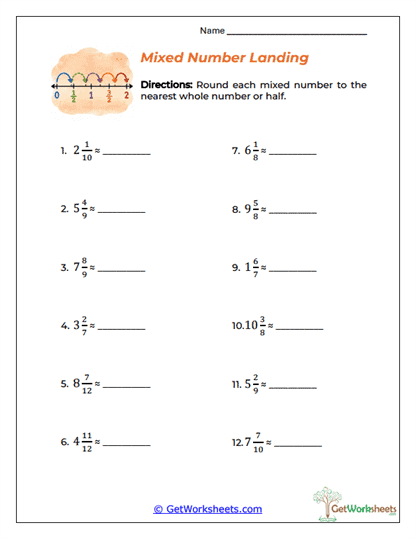
This worksheet takes fraction rounding into mixed-number territory by asking students to round values such as 2 1/10, 5 4/9, and 10 3/8 to the nearest whole number or half. Students must think about both parts of the mixed number-the whole-number portion and the fraction-before deciding whether the value should land on the whole number below, the halfway point, or the next whole number. That makes the activity a useful blend of mixed numbers, benchmark fractions, rounding, place on a number line, fraction magnitude, estimation, and number sense. It is especially appropriate for grades 4-5 students who understand basic benchmark fractions and are ready to apply those ideas to values greater than one.
Key Learning Objectives
- Round Mixed Numbers: Students decide whether each value is closest to a whole number or a half-unit benchmark.
- Use the Fractional Part: Learners recognize that the fraction tells them where the mixed number sits between two whole numbers.
- Connect Fractions and Number Lines: Values such as 7 8/9 can be understood as being very close to 8, while 4 3/7 sits nearer 4 1/2.
- Strengthen Magnitude Sense: Students practice judging the size of mixed numbers rather than treating the whole and fraction portions as unrelated pieces.
Instructional Benefits
- Parent-Friendly Visual: Adults can say, “Imagine this number sitting between two whole numbers. Is it near the start, near the halfway point, or near the next whole?”
- Builds on Familiar Benchmarks: Students use the same 0, 1/2, and 1 thinking they already know, but attach it to a whole number.
- Prepares for Fraction Estimation: Rounded mixed numbers are much easier to use later when estimating sums and differences.
- Encourages Number-Line Thinking: Students begin seeing mixed numbers as positions rather than just written symbols.
- Flexible Practice: The worksheet works well for independent work, centers, review, intervention, or homeschool instruction.
This worksheet helps students bridge the gap between basic fraction benchmarks and larger mixed numbers. Mixed numbers, halves, whole numbers, fraction magnitude, rounding, number lines, estimation, and number sense all come together as students decide where each value should “land.” For parents, a useful way to explain the idea is that 8 7/12 is already past 8 1/2, while 2 1/10 has barely moved past 2. That visual way of thinking often makes mixed numbers much easier to understand than trying to memorize another rule. In classroom and homeschool settings, this activity builds confidence with fraction magnitude and prepares students for estimating operations with mixed numbers.
Bookmark Us Now!
New, high-quality worksheets are added every week! Do not miss out!