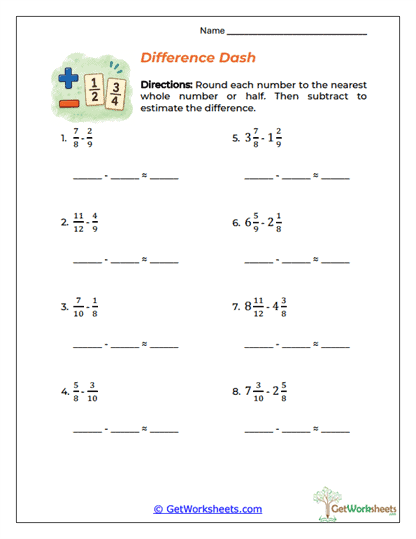
Difference Dash
This worksheet gives students a fast, approachable way to estimate subtraction problems involving fractions and mixed numbers. Students round each number to the nearest whole number or half, then subtract the friendlier values to find an approximate difference. The activity strengthens fraction estimation, subtraction, benchmark fractions, mixed numbers, mental math, number magnitude, and number sense while helping students understand how far apart two fractional values are without calculating an exact answer first. It is especially useful for grades 4-5 students who are learning fraction subtraction and need a simpler way to predict whether a final answer will be small, moderate, or close to a whole-number difference.
Key Learning Objectives
- Round Fractions Before Subtracting: Students use nearby benchmark values to simplify each subtraction expression.
- Estimate Mixed Number Differences: Learners work with values greater than one while keeping the mental math manageable.
- Think About Relative Size: Students must recognize which number is larger and approximately how far apart the two values are.
- Use Estimation as a Check: The rounded difference gives students a reference point for later exact subtraction.
Instructional Benefits
- Easy for Parents to Talk Through: Ask, “About what is the first number? About what is the second? Now how far apart are they?”
- Makes Fraction Subtraction Less Intimidating: Whole numbers and halves are easier to subtract mentally than unfamiliar fraction pairs.
- Strengthens Benchmark Fluency: Repeatedly judging fractions against halves and wholes helps students recognize size more quickly.
- Supports Exact Computation Later: A reasonable estimate helps students catch mistakes when subtracting fractions exactly.
- Useful Across Settings: The worksheet fits well into centers, homework, guided practice, intervention, review, or homeschool lessons.
This worksheet helps students understand that subtraction with fractions is really about distance between quantities. Fractions, mixed numbers, subtraction, benchmark values, halves, estimation, magnitude, and number sense all work together as students create manageable versions of each problem. For parents, the strategy is much easier to explain than jumping immediately into common denominators: first decide roughly where each number lives, then subtract those simpler values. That quick estimate gives children something sensible to expect from the exact answer later. In classroom and homeschool settings, this activity builds stronger fraction intuition and helps students approach subtraction with greater confidence instead of seeing every fractional expression as a brand-new challenge.
Bookmark Us Now!
New, high-quality worksheets are added every week! Do not miss out!