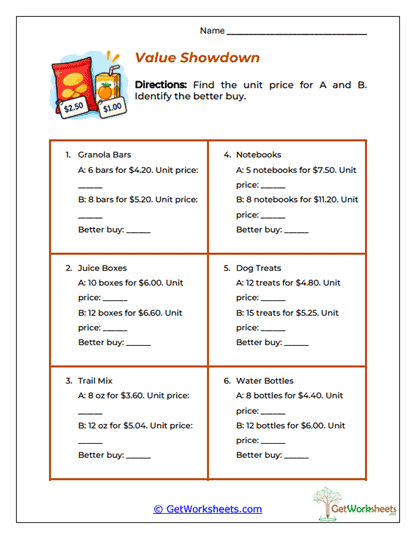
Value Showdown
This worksheet teaches students how to compare two purchase options by finding the unit price for each one. Problems include granola bars, juice boxes, trail mix, notebooks, dog treats, and water bottles. Students divide the total cost by the number of items or ounces to find the price for one, then decide which option is the better buy. This is an especially useful ratio-and-proportion skill because it connects directly to real shopping decisions.
For a parent, the basic idea is simple: two packages may have different sizes and different total prices, so looking only at the price tag can be misleading. The fair way to compare them is to ask, “How much does one item or one ounce cost?” Whichever option has the lower unit price is usually the better value.
Learning Goals
- Find Unit Prices: Students divide total cost by quantity.
- Compare Two Rates: Learners decide which option costs less per unit.
- Use Money in Ratio Problems: Students connect unit rate thinking to shopping.
- Interpret Decimals: Learners work with prices expressed in dollars and cents.
- Make Consumer Decisions: Students use math to identify the better buy.
Parent-Friendly Explanation
For example:
Option A: 6 bars for $4.20
$4.20 ÷ 6 = $0.70 per bar
Option B: 8 bars for $5.20
$5.20 ÷ 8 = $0.65 per bar
Since $0.65 is less than $0.70, Option B is the better buy.
Why This Worksheet Helps
- Teaches a Real Shopping Skill: Students learn how to compare packages fairly.
- Strengthens Division with Decimals: Unit prices require careful money calculations.
- Builds Rate Understanding: Cost per one item is a unit rate.
- Encourages Practical Decision-Making: Students use math to choose the better value.
- Connects Proportions to Personal Finance: Unit pricing is useful far beyond the classroom.
Classroom & Home Use
- Great for Financial Literacy: The worksheet naturally connects to budgeting and shopping.
- Helpful for Parents: Adults can reinforce the skill during grocery trips.
- Useful for Real-World Practice: Students can compare actual shelf prices or store ads.
- Good for Intervention: The repeated divide-then-compare structure is easy to follow.
- Strong for Homeschooling: Families can create extra examples from household purchases.
The main value of this worksheet is that it teaches students that “cheaper” does not always mean the lower total price. What matters is the cost per unit. Division, decimals, money, rates, and comparison all work together. For parents, the best coaching question is: “How much does one cost?” Once that is known for both choices, the better buy becomes much easier to see.
Bookmark Us Now!
New, high-quality worksheets are added every week! Do not miss out!